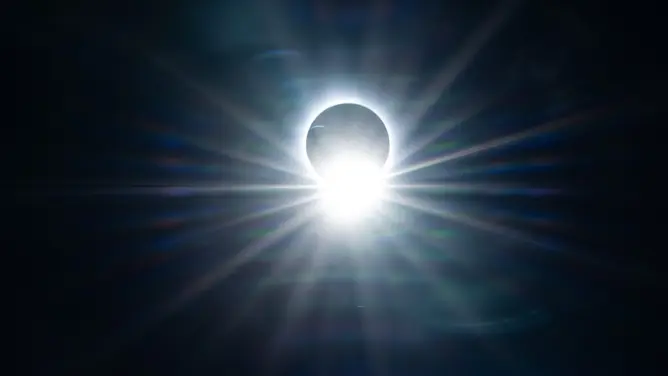
It’s not often that we get a chance to observe our planet’s shadow, but we can get a fleeting glimpse during a lunar eclipse.
THE TAKEAWAY
- Partial lunar eclipse to occur on Aug. 27 to 28.
- A lunar eclipse is safer and easier to watch than a solar eclipse.
- A partial lunar eclipse will be visible from most of North and South America.
As millions of skywatchers worldwide brace for another eclipse at the end of the month, it is worth exploring the different experiences when viewing these events between the sun and the moon.
On the night of Aug. 27, a partial lunar eclipse will be visible from most of North and South America, as well as parts of Europe and Africa.
The main priority when viewing these celestial events is eye safety, as not using proper eyewear during an eclipse can cause severe eye injury.
SCIENTISTS DISCOVER THE SAME SUGAR FOUND IN RASPBERRIES DEEP IN SPACE FOR THE FIRST TIME
To start, a big difference between a lunar and solar eclipse is that one is easier to view than the other.
TUPPER LAKE, NEW YORK, UNITED STATES – 2024/04/08: View of total solar eclipse hosted by Adirondack Sky Center and Observatory at LP Quinn Elementary School. Total solar eclipse was visible across the United States with Western and Northern parts of New York State mostly in the path of the eclipse. Hundreds of people gathered on the grounds of LP Quinn Elementary School as Adirondack Sky Center is one of twelve locations nationwide providing NASA (National Aeronautics and Space Administration) with a live video feed of the eclipse.
(Lev Radin/Pacific Press/LightRocket / Getty Images)
A solar eclipse happens when the moon gets in the way of the sun’s light and casts a shadow on Earth.
“Except during the brief total phase of a total solar eclipse, when the moon completely blocks the sun’s bright face, it is not safe to look directly at the sun without specialized eye protection for solar viewing,” NASA said.
NASA TELESCOPE UNCOVERS HIDDEN PLANET USING REVOLUTIONARY METHOD AFTER YEARS OF COSMIC HIDE-AND-SEEK
When viewing a partial or annular solar eclipse, you must use solar viewing glasses or a handheld solar viewer to do so safely.
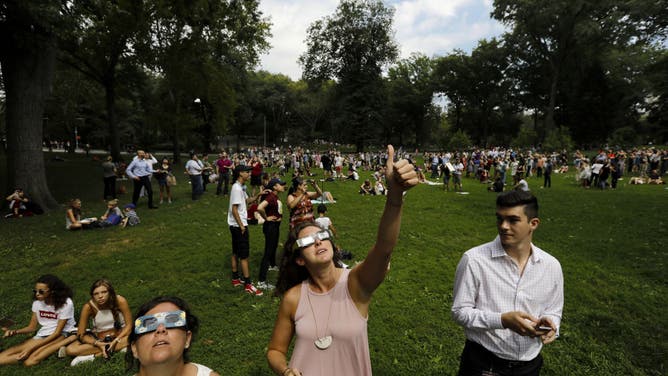
A woman wearing solar viewing glasses, center, holds up her thumb while looking at the sun during a solar eclipse at Central Park in New York, U.S., on Monday, Aug. 21, 2017. Millions of Americans across a 70-mile-wide (113-kilometer) corridor from Oregon to South Carolina will see the sky darken as the sun disappears from view total during the eclipse. Photographer: Peter Foley/Bloomberg via Getty Images
(Peter Foley/Bloomberg / Getty Images)
This kind of tool isn’t usually readily available, making this event harder to watch than a lunar eclipse.
During a lunar eclipse, Earth is positioned between the moon and the sun, and the planet’s shadow falls on the moon’s surface, dimming it and sometimes turning it red.
THE NUCLEAR OPTION: SCIENTISTS REVEAL HOW ATOMIC BLASTS COULD SAVE EARTH FROM ASTEROIDS
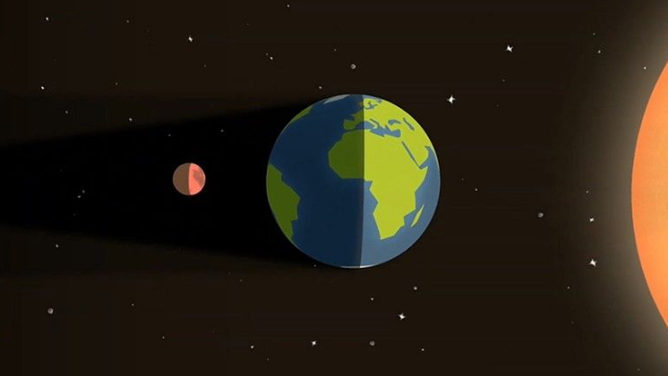
This image depicts the alignment of the Moon, Earth, and Sun during a lunar eclipse (not to scale)
(NASA’s Scientific Visualization Studio / NASA)
These are much easier to view because, from down here, we are looking at reflected sunlight bouncing off the moon. This gives you a chance to view the celestial event without safety glasses.
PHOTOS: MYSTERIOUS METALLIC SPHERES WASHING UP ON AUSTRALIAN BEACH IDENTIFIED
Moonlight is reflected sunlight, which makes it appear bright, almost white, when in reality the moon is dark shades of gray, like rocks found near volcanoes on our planet.
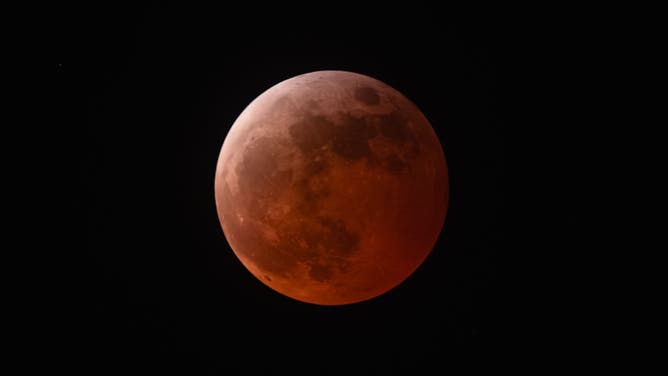
LOS ANGELES, CALIFORNIA – MARCH 13: The moon is seen during a total lunar eclipse on March 13, 2025 in Los Angeles, California. A total lunar eclipse is visible across the U.S. on the night of March 13, with the moon appearing a deep reddish color as it passes through the Earth’s shadow. (Photo by Qian Weizhong/VCG via Getty Images)
The upcoming event will be a partial lunar eclipse, where the moon will pass through only part of Earth’s umbra, as the shadow grows and then recedes without entirely covering the moon, according to NASA.
PARTS OF A SPACEX ROCKET CRASHED INTO THE MOON. HERE’S WHAT TO KNOW
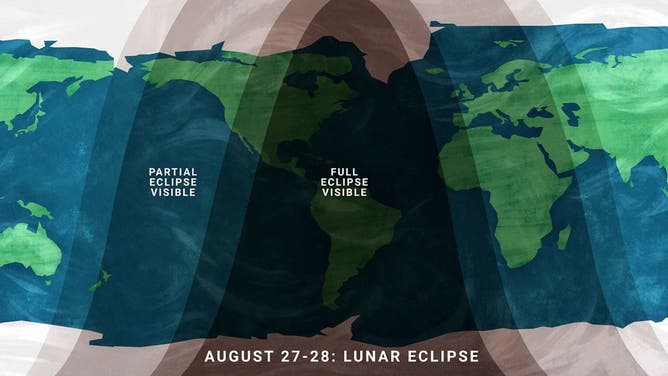
Overview of the upcoming partial lunar eclipse.
(NASA/JPL-Caltech)
About 93% of the moon’s diameter will be inside Earth’s dark shadow, which is the umbra.
Although the moon will not be completely covered, it will look dramatically darkened, with a rusty, coppery tint along the edges.
COULD HUMANS REACH MARS FASTER? NASA GETS BOOST FROM NEW THRUSTER TECHNOLOGY
Since it is safe to view without safety glasses, use a telescope, binoculars or other viewing tools to get a closer view of Earth’s curved shadow moving across the lunar surface.