At a secret location in southern Germany, the manager of a drone factory owned by Helsing SE — Europe’s most valuable artificial-intelligence defense start-up — hands me a lethal killing machine to cradle in my arms. Weighing just 26 pounds, the black, hard-foam attack drone is so light and looks so simple that it is easy to forget its role in a surging multibillion-dollar industry, the Russia-Ukraine War — and maybe even in Europe’s future security.
For decades, Western governments have ordered supplies like tanks, fighter jets and submarines from contractors such as Lockheed Martin or Northrop Grumman. Those items take years to deliver and are dizzyingly expensive; an F-35 jet can run to over $100 million.
That sort of multiyear government contract still accounts for a lot of military spending. But the current trend is clear: defense technology is becoming cheaper and nimbler, with breakthroughs developed by privately funded companies rather than governments.
“There’s a transformation in defense economics,” said Alexander Blanchard, senior researcher in A.I. governance at the Stockholm International Peace Research Institute.
Of the Pentagon’s $1.5 trillion budget request for next year, about $55 billion is earmarked for the creation of a new unmanned, A.I.-powered arsenal. On a more modest scale, the E.U. is piloting a €115 million program to fund A.I. defense companies. These budgets are expected to grow, and defense technology has become a booming area for venture capital.
Helsing, like other far smaller defense start-ups, has already flipped the script on sluggish governments, by harnessing the type of disruptive innovation more common in Silicon Valley, tapping billions in venture capital and hiring top tech talent. The company, some of whose top ranks migrated from Palantir, Tesla, Apple and Meta, set out to mass-produce war machines costing as little as €17,500. Powered by A.I., they require minimal military personnel and barely a week’s training. And the drones have been battle-tested under fire in Ukraine.
Few companies illustrate the profound shift in the way militaries spend as clearly as does Helsing, the five-year-old Munich-based start-up. This month the firm allowed DealBook to be the first U.S. journalists inside its drone factory.
Situated in a serene, suburban industrial complex, the factory operates under watertight security. DealBook agreed not to disclose its location, and other tenants in the complex are kept unaware of its existence. Helsing’s name appears nowhere: The company fears the factory could be a prime target for sabotage or attack, given that thousands of the drones assembled here have been deployed against Russian forces in Ukraine.
The factory is able to be dismantled and relocated within a day, in case of a threat. The 100 or so factory workers, many of whom were recently laid off by flagging German carmakers, undergo extensive security vetting and sign nondisclosure agreements. Painted on one wall is a motivational slogan reading, “protecting our democracies.”
When Helsing’s three founders started the company in 2021, with seed funding from the Spotify founder Daniel Ek’s venture capital firm, they had one mission: Stave off Russian threats, and fast.
“The urgency was clear, or at least clear to us,” said the company’s co-founder and co-chief executive Gundbert Scherf, who was previously an adviser to Germany’s defense ministry and a partner at McKinsey. “There was a need to do more in defense and give Europe a stronger footing.” Yet with Russia’s invasion of Ukraine still a year away, investors were unconvinced. “At the time, it was virtually impossible to raise money for defense in Europe,” Scherf said.
The onrush of investments
There has been a seismic change since then — and not solely because of the war in Ukraine. President Trump’s demands for Europe to increase its military spending and his repeated threats to take control of Greenland have helped push defense budgets much higher. A flurry of investments in defense tech start-ups has followed. DealBook hears investors have rushed to participate in Helsing’s latest funding round, which was initially estimated to be about $1.2 billion, valuing the company at about $18 billion, according to The Financial Times.
“The market opportunities are enormous, and there is no one company that is going to capture it,” said Raviraj Jain, a partner at Lightspeed, which he says has so far invested more than $100 million in Helsing.
For investors, Helsing’s key advantage comes from its role in the grueling combat in Ukraine, where Helsing has deployed thousands of drones since late 2024. Those missions provide Helsing a trove of data, allowing it to update its software regularly; Ukrainian soldiers record many attacks on video, for mission-success analysis. “There is so much more at stake here,” Scherf said. “These technologies move very fast.”
Cat-and-mouse video games
The videos from Ukraine show a cat-and-mouse game. A so-called loitering munition or kamikaze drone, the HX-2 (the X is for its crossed wings) hovers over the battlefield, picking out minuscule Russian targets like battery systems and armored vehicles, camouflaged in forests. When Ukrainian soldiers, who operate the drone from many miles away, give the go-ahead, it swoops down and eviscerates the threat, often under fire.
Scherf said mission success rates in Ukraine were around 70 percent, “something we are very proud of.” The A.I. software allows the drones to continue functioning even if their communications systems and GPS are disabled by Russia’s well-honed electronic jammers. “I don’t know any other Western company that has got the autonomy Helsing has,” said Khaled Helloui, a partner at the London-based venture capital firm Plural, which he says has invested about $800 million in defense companies, including Helsing.
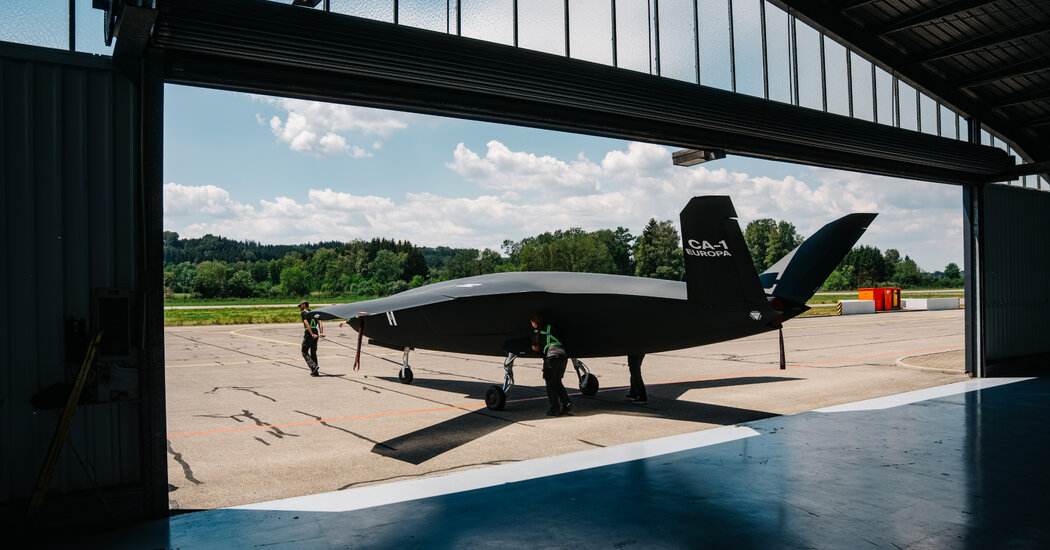
Helsing’s next innovation sits on a sunbaked airfield 90 minutes by car west of Munich, where aircraft engineers are building the company’s first unmanned fighter jet, named CA-1 Europa. Made with lightweight carbon fiber, the jet should be capable of striking deep inside an adversary like Russia by the time it is deployed in 2029.
The aim is simple: For a small fraction of the cost of one regular fighter jet, Helsing can, in theory, produce hundreds of Europas. It can send one ahead to jam the enemy’s electronic network, followed by several attack jets — all loaded with precision-guided weapons similar to those found on an F-35. “If you don’t have a pilot, you can conduct completely different, more dangerous missions,” said Stephanie Lingemann, Helsing’s vice president for its air programs. “You are no longer thinking about the human life you have to protect.”
That calculus is clear in the U.S. too. A Pentagon spokesman, Sean Parnell, told the U.S. Naval Institute this month that “drones and autonomous systems represent the most consequential battlefield innovation of this generation.”
For all Helsing’s whiz-bang A.I., it is possible that the proliferation of defense tech start-ups could confound investors, or even turn them off. “Defense tech, because of all the interest, has become a very noisy place,” Scherf said. “There are a lot of new players, and that makes it hard to read for investors, the public, and governments.”
But few believe the demand for unmanned warfare will subside any time soon. And in Helsing’s drone factory, the outline of the next potential conflict in Europe is already taking shape. In a large storage room, dozens of boxes are stacked several feet high, many containing drones awaiting shipment, not to Ukraine, but to a battle-ready German brigade stationed in Lithuania, near the Belarus border. Germany’s parliament this week approved a €220 million military contract for Helsing to develop a broad range of A.I. systems.
Ballooning military spending might be good for investors, but it could signal tough times for the world. “A lot of it hangs on the thinking that we are on course for a larger conflict in Europe,” Blanchard said. “You don’t grow your arms industry because you are expecting a generation of peace.”
A word from Andrew
Good morning. Andrew here. The business of war is a booming industry and a number of tech-focused defense companies are rewriting the rules. This morning, DealBook contributor Vivienne Walt takes us inside Europe’s most valuable artificial intelligence defense start-up. Also: I take a look at the transformation of Wall Street’s culture over the last two decades with Jonathan Knee. And make sure to take this week’s quiz about the tobacco’s industry’s new high flyer.
IN CASE YOU MISSED IT
Turmoil in the Middle East elevated oil prices and inflation fears. President Trump said he thought a three-week-old cease-fire between the U.S. and Iran was “over,” though peace talks were not, and the two countries traded fire throughout the week on targets around the Persian Gulf. A recovery in shipping in the Strait of Hormuz also looked shaky.
SK Hynix posted a strong U.S. debut. The South Korean memory-chip maker raised $26.5 billion in the largest ever U.S. listing by a foreign company, and its American depositary receipts surged 13 percent on their first day of trading. The successful listing is a sign that investor appetite for memory chip stocks remains high, despite fears over the glut of A.I. spending and the sustainability of tech companies’ huge valuations.
Goldman limits employee betting on prediction markets. Amid growing fears of wagers based on illicit information, the bank barred workers from wagering on almost everything except sports and entertainment. JPMorgan Chase and Morgan Stanley have also made moves to limit employee betting on such platforms.
‘The Accidental Investment Banker’ turns 20
Twenty years ago, Jonathan Knee skewered Wall Street in his hit tell-all, “The Accidental Investment Banker.” The book became a revered guide to the psychology of Wall Street. It also named names, painting personal and often unflattering portraits of the Wall Street elite, while bemoaning the industry’s transition from “discreet trusted advisers to increasingly mercenary deal hounds.”
Knee released the book while continuing to work in the industry, and he still does.
Now an adviser at the boutique investment firm Evercore Partners, where he was a managing partner when he wrote the book, Knee spoke with Andrew about how his sharp critique has aged. The interview has been condensed and edited.
Andrew: You bemoaned the shift from “trusted adviser” to “mercenary.” In an era of instant leaks and social media, is the concept of the “discreet banker” officially extinct?
Knee: That trend described in 2006 has sadly maybe even accelerated. But the concept will never be extinct, because the need for the core service has never been greater.
A smart, trustworthy banker can deliver perspective based on a cleareyed view of the company, sector, competitors and investors. And given the importance of corporate leaders making well-informed decisions, good bankers serve an important social function. Yes, I am a hopeless romantic, but it is why I have never been able to fully give it up, even as teaching has become my full-time job.
And have bankers just turned into execution services, akin to lawyers?
I have a message for any professional service engaged in mere execution: A.I. is coming for you. The good news is that the judgment required to effectively advise on critical corporate decisions will never be replaced by A.I.
You teach at Columbia. Do today’s M.B.A. students still view the opulent investment banker “Master of the Universe” lifestyle as the ultimate goal, or has the “accidental” path you took become the norm?
“Master of the Universe” has not been a thing for a very long time. If it existed today, it would refer to tech bros, venture capital or private equity, not banking. The social standing of investment banking collapsed in the face of the industry’s complicity in the 2008 financial crisis. These perceptions matter. Columbia Business School still sends a higher percentage of its M.B.A.s to banking than any of its top peers, but that is half as many as it sends to consulting. At Stanford, where I went to business school, they actually eliminated investment banking as a reported employment category for a time because so few now pursue it.
You highlighted the “sleepless nights” for analysts. With the recent industrywide push for “protected Saturdays” and mental health awareness, has the culture actually changed, or is it just better P.R.?
The good news for investment banking is that the one area where the quality of people has never been higher is at the analyst level. The bad news is that almost none of them stay in the profession. This is mainly because they were always planning to use the excellent training investment banks still provide to pivot into the sexier and more lucrative private equity domain. But it is also at least in part because the shift noted, from a relationship to a transactional ethos, applies not just to how clients are treated but also to how employees are treated. There are big disparities between and within institutions, but generally things have gotten better.
If you were to add a chapter covering the 2010s and 2020s, who would be the new “International Man of Mystery” skewered in its pages?
The closest analogues are the successful tech bros and venture capitalists who seek to cast themselves as philosopher kings. They spew obviously self-interested public policy pronouncements that toggle between radical libertarianism and demands for special government protection. The only unifying theme is the desire to do whatever they want without consequence.
You wrote about Joe Perella’s “silverware inspections” and occasional “flatulence.” Did you ever actually eat lunch in this town with him again?
Joe is one of the few heroes in the “The Accidental Investment Banker.” As I wrote, “no one was smarter or had better judgment or was more generous with his time or cared more about coming to the right answer.” Professional services firms routinely promote the biggest producers to management roles for which they are ill-suited. I used Joe in the book to demonstrate that it is possible to be an effective producer-manager — and he was an extraordinary one. I also sought to humanize Joe’s persona by describing his sometimes idiosyncratic style, probably unwisely. Yes, he was pissed, and yes, I apologized. But Joe is a big boy and he got over it, although I don’t recall any subsequent lunches. Maybe I will call him now.
Is there any relationship you permanently torched with the book that you actually miss?
No.
Big Tobacco’s new buzz
This question comes from a recent Times article. Click an answer to see if you’re right. (The link will be free.)
Cigarette sales have plummeted, but demand for new nicotine-laden products is on the rise. Now Big Tobacco is betting heavily on nicotine pouches — tobacco-free “lip pillows” that are placed between the cheek and gum. Sold in a variety of flavors under brand names like Zyn, the pouches are surging in popularity, including among teenagers. To meet demand, the industry has invested more than $1 billion in new production capacity, despite growing public health concerns.
Worldwide nicotine patch sales reached $6.9 billion in 2025. What are they projected to be in 2033?
Thanks for reading! We’ll see you Monday.
We’d like your feedback. Please email thoughts and suggestions to [email protected].
Follow DealBook on Instagram: @nytdealbook