
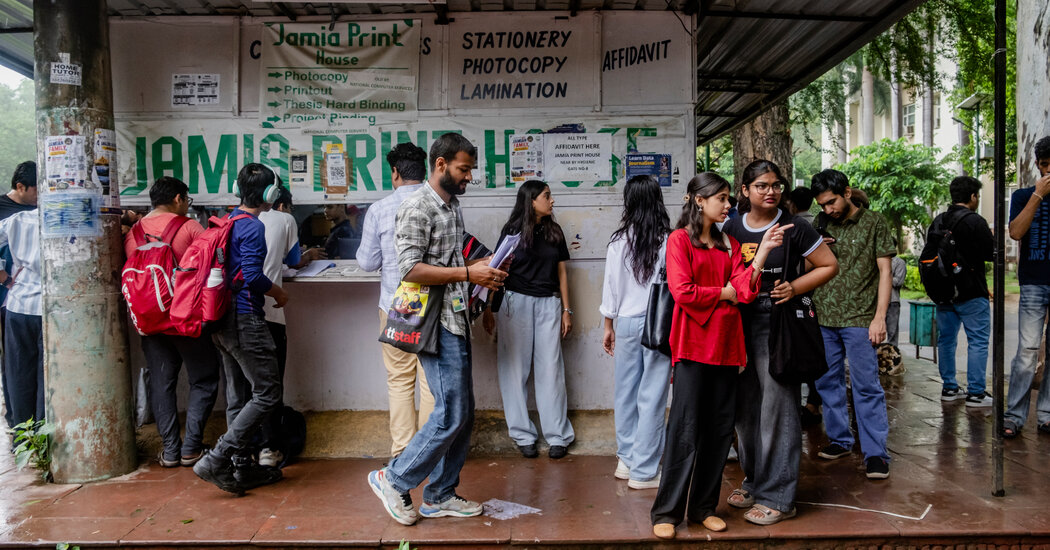
Knowledge Park 3, part of an education hub in northern India, was built on a promise that a college degree could lift young Indians into the middle class.
But for many of the roughly 100,000 students drawn to this cluster of private colleges and universities, two hours from central New Delhi, it delivers something else: debt and disappointment.
Families are draining their savings to attend schools that have proliferated across the area’s five Knowledge Parks over the past decade. The flood of graduates the schools are producing vastly outnumbers the availability of well-paying jobs.
Harshit Rai, 18, from the north Indian city of Varanasi, spends his days studying artificial intelligence, machine learning and anything else he thinks might help him land a job. He expects his degree from the Noida Institute of Engineering and Technology to cost $15,000, financed in part with $7,000 in bank loans. He said his goal was to earn 80,000 rupees a month, or about $10,000 a year.
He would settle for half that, he conceded, though at that salary it would take five or six years to earn back the cost of his education. A year after graduation, his loan will begin accruing interest at 10 percent annually.
“I feel some stress,” he said. “How can I repay on time?”
That anxiety is increasingly familiar among India’s young people. Last month, widespread student-led protests forced a rare capitulation from the government of Prime Minister Narendra Modi. The public displays of outrage have subsided, but the frustration that fueled them has not.
What began as a protest about rigged exams widened into anger over the obstacles young Indians see blocking their path to a better life. The satirically named Cockroach Janta Party — an allusion to a disparaging remark made in May by India’s top judge, who compared India’s unemployed youths to “cockroaches” — became one expression of that discontent. Private universities sit squarely within the students’ dissatisfaction.
India’s working-age population, already the world’s largest at nearly one billion, grows by about 12 million people a year. For families with money to spare, education is one of the few apparent routes out of low-paid farming and wage labor. The best option is a place at one of the country’s highly competitive public universities. For those who cannot get in, private colleges offer another route.
That industry has exploded. The number of private colleges tripled in the decade after Mr. Modi became prime minister in 2014. By 2024, India had 45 million students in higher education, up 41 percent from a decade earlier, according to a government survey. More than two-thirds of all students attend private institutions.
But the expansion of higher education has far outpaced the creation of good jobs.
Nearly 40 percent of all college graduates under the age of 25 are unemployed, according to a study published by Azim Premji University. India creates only about 250,000 new jobs a year paying more than $500 a month, a benchmark for a comfortable living among the country’s top earners. Graduates of elite public universities have an enormous advantage in competing for them.
“There’s a lie that’s been sold to the young people, which is that a degree equals a job,” said Akshay Saxena, an entrepreneur and a founder of an education fellowship program.
India has roughly 550 public universities, but only about a tenth are considered elite. Fewer than 5 percent of applicants are accepted at the top institutions, where tuition averages less than $250 a year and a degree can propel graduates toward the country’s most desirable jobs.
Everyone else faces a much riskier calculation.
Mr. Saxena estimates that 400,000 students a year spend more than $20,000 on private engineering colleges, hoping for a big payoff. Median salaries for graduates are around $3,000 a year.
“The employability of the average graduate is just about 20 percent,” he said.
The mismatch has fueled what Mr. Saxena called “a terrible national psychosis”: ferocious competition for engineering degrees that once seemed to offer reliable entry into India’s technology industry. Companies such as Infosys and Tata Consultancy Services built enormous businesses providing information technology services to multinational companies. Now artificial intelligence is making even those jobs appear less secure.
“Borrowing heavily to pursue degrees in India is unwise,” Sridhar Vembu, a co-founder of Zoho, an Indian cloud software company, wrote on social media. “I strongly believe we should not trap young people in debt in the name of education.”
In Noida, on the outskirts of New Delhi, a handful of tired and anxious undergraduates took shelter from a monsoon downpour at a cafe near the flagship campus of Amity University.
For many students, Amity is a backup when cheaper options fall through. Atul Anand had been admitted to a top public school in his native state, Bihar. But a car accident derailed his admission two years ago, he said, and he borrowed money to attend Amity instead.
He expects his degree and living expenses to cost roughly $15,000. His state government lent him $4,000 toward the bill, while his family has stretched its savings to the limit.
His father teaches math and Hindi at a village school. At night, Mr. Anand takes freelance graphic-design jobs to help cover his daily expenses.
With luck, he said, he might graduate into a technology job paying $10,000 a year.
“My dreams are not big,” he said. “I want to reduce the burden of the loan and the costs to my family.”
Against that backdrop, Mr. Anand joined the final day of last month’s protests — not as a protester, he said, but in solidarity with students who saw the gathering as a place to air grievances of every kind.
“I did not go for any political reason,” he said.
His friend Viswesh M.J. was skeptical of the protesters’ stated demands, which focused on overhauling India’s testing processes. In his view, the unrest reflected something deeper.
“The anger is a mask for your fear,” he said of the protesters. “You’re all very afraid of the future.”
Mr. Saxena knows what the other side of India’s education divide looks like. He attended the Indian Institute of Technology Bombay, one of the country’s elite public universities, before joining Boston Consulting Group and helping build start-ups in Silicon Valley. Now, through Avanti Fellows, he helps deserving lower-income students prepare for the exams that can win them places at elite institutions.
The program offers free test preparation and intensive coaching. But there are far more aspiring students than places at those schools and far fewer good jobs than graduates chasing them. That leaves a vast private education industry selling families a chance at upward mobility even as the odds deteriorate.
“No one’s really going to get a job,” Mr. Saxena said. “People are going to monetize their desperation.”


