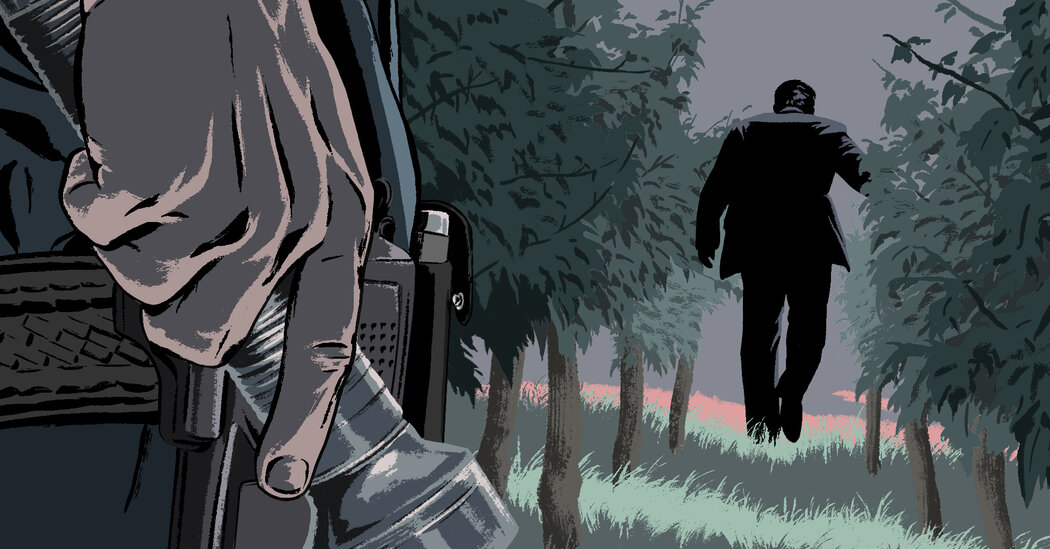
A British con man was sentenced to 10 years in prison on Monday for swindling nearly $100 million from more than 140 victims. The financial asset he used to build his scheme? It wasn’t crypto or real estate. It was wine.
The con man, James Wellesley, told his investors they were making loans to wine collectors, and that he was holding those collectors’ valuable wines as collateral, according to federal prosecutors. Unfortunately for those who trusted him with their money, neither the wine nor the collectors existed.
The high-profile case is one of many recent incidents of scammers turning grapes into financial crimes. Patrick Briones, the former top wine buyer at the grocery chain Albertsons, pleaded guilty in October to bribery and conspiracy, after prosecutors alleged that he’d accepted kickbacks like fancy vacations and expensive watches from wine sellers. And the winemaker Jeffry Hill was sentenced in January for orchestrating a $2.5 million grape scam in which he fraudulently mislabeled his bottles.
This new wave of wine fraud has occurred as the industry experiences a severe downturn, with climate change disrupting grape-growing conditions and consumers drinking less. According to Silicon Valley Bank, the number of wineries with “very weak” financial health has nearly tripled since 2022.
Experts are hesitant to link the surge in crime to the broader business environment. Rather, they say financial crime is a long-running problem that’s practically embedded in the industry.
Frances Dinkelspiel, the author of “Tangled Vines,” a book about an arson attack at a California wine house, says it’s the nature of the product. “I think this industry attracts people who want to cheat, because there’s a certain mystique around wine,” she said. “Wine and fraud go hand in hand.”
Maureen Downey, an expert on wine fraud and the founder of Chai Consulting, blames the proliferation of wine crime on the industry’s murky supply chain, saying that it’s “more opaque than guns or illicit drugs.”
“It’s getting bigger and getting worse because nobody wants to talk about it,” Downey said of the crimes. “The producers don’t want to admit that it’s happening, victims don’t want to come forward and governments don’t want to invest time going after it.”
A well-cellared trend
One of the first modern criminal scandals to rock the wine world came in the early 1990s amid the meteoric rise in popularity of white zinfandel, a blush wine invented by the budget winery Sutter Home. Its sweet taste and low price made it extremely popular.
In 1993, the famed vintner Fred Franzia, whose spout-laden white zinfandel boxes filled many a baby boomer’s fridge at the time, pleaded guilty to misrepresenting lower-quality grapes as zinfandel. His firm paid $2.5 million in fines, and Franzia completed community service. This type of fraud, dubbed “blessing of the loads,” extended to other wineries and, according to The Los Angeles Times, cost consumers $55 million at the time.
It was the first glimpse into how far Napa Valley wineries would go to increase profits, but the headlines soon faded into the background as wine became more popular, with sales of red wine jumping 39 percent in 1992 alone. Franzia overcame his white zin scandal and, in 2002, launched “Two Buck Chuck” through Trader Joe’s, which sold over 800 million bottles over the next decade.
An ensuing lack of scandal in Napa Valley during the 2000s was likely not a function of less crime being committed, but of a lack of enforcement. “There had been a lull,” Benjamin Kingsley, the former assistant U.S. attorney for the Northern District of California, told DealBook, adding that the geographical and cultural isolation of Napa Valley made it especially hard to investigate.
“The ability to make a case is entirely contingent on a really dogged agent and a dogged A.U.S.A.,” he said, referring to his prior position.
These prosecutorial stars aligned after the 2008 financial crisis. Money flowed back into Napa Valley, crime followed and big cases started getting made.
The rise of big wine crime
Rudy Kurniawan is one of the most prolific scammers in the world of modern wine. Between 2002 and 2012, he sold an estimated $150 million in fraudulent wine. The subject of the 2016 documentary film “Sour Grapes,” Kurniawan preyed on the gullibility of unsophisticated wine drinkers who tried to buy prestige through acquiring rare vintages. In 2009, the billionaire Bill Koch sued Kurniawan, and in 2013 the con man was sentenced to 10 years in prison.
Kurniawan seemed to be a bellwether for a certain type of criminal that had embedded itself into the wine ecosystem. His crimes involved more money and were more sophisticated than most previous wine scams (with notable exceptions: In 2005, the winemaker Mark Anderson, for example, burned down a warehouse that housed 4.5 million bottles of wine — with a value of roughly $250 million — to erase evidence of his fraudulent business practices).
After Kurniawan was arrested, investigators exposed a flurry of additional frauds, forgeries and fakes. In 2015, a bookkeeper for Whitehall Lane Winery was arrested and charged for embezzling over $600,000 and, that same year, the longtime wine dealer John E. Fox was busted for running a decades-long Ponzi scheme in which he sold “wine futures” to investors. Fox admitted to selling, or trying to sell, $20 million worth of “phantom wine” between 2010 and 2015.
Also around that time, burglars stole $550,000 worth of wine from the famed Bay Area restaurant The French Laundry, and the well-known Napa vintner Robert Dahl killed his business investor Emad Tawfilis after Tawfilis discovered that Dahl had been misappropriating funds. After chasing Tawfilis through his vineyard with a gun and shooting him, Dahl turned the weapon on himself.
Ripening conditions
The wine industry has experienced pronounced economic headwinds over the past few years, which have been some of Napa Valley’s most challenging. “I started talking about a market correction in 2017,” said Rob McMillan, an executive vice president at Silicon Valley Bank who authors the bank’s annual report on the wine industry. “But it’s worse than I expected.”
According to the International Organization of Vine and Wine, wine consumption is at its lowest level since the 1960s, and Gallup found that overall alcohol consumption was at its lowest level in 90 years, falling to 54 percent among U.S. adults in 2025 from 60 percent in 2023.
This has hit wineries, especially in Napa Valley, particularly hard. “Thirty percent of the industry is really struggling,” McMillan said. The middle is stable, he added, and the top 20 percent of winemakers are doing well — another instance of a K-shaped trajectory.
With Napa Valley’s future in jeopardy, crime may seem even more tempting to desperate vintners. And the market’s very nature makes it easy to commit fraud, forgery, bribery and theft.
A lot of wineries are small businesses, which attracts infusions of unstructured capital that are easier to manipulate than institutional investments. The regulatory framework and criminal enforcement surrounding wine have proven spotty, and unlike most products, determining a wine’s legitimacy requires an element of technical sophistication that is extremely hard to master. Many wine drinkers, faced with a blind taste test, would be hard-pressed to distinguish a $2,000 bottle of wine from a $20 bottle. Because of this, many believe that fraud will find its way into wine, regardless of economic conditions.
“Through all economies over the last 30 years, we’ve had crime,” McMillan said. “There are so many ways to create fraud through wine. That’s the problem, not the state of the economy.”
IN CASE YOU MISSED IT
The Justice Department dropped its criminal probe of Jerome H. Powell. The end of the inquiry, which focused on whether Powell, the Fed chair, lied to Congress about costly renovations of the central bank’s headquarters, could clear the path to confirmation for Kevin M. Warsh, President Trump’s pick for to be Powell’s successor. But it may not end concerns about political interference at the Fed.
Spirit Airlines is in advanced talks to secure a government loan. The distressed airline, which has filed for bankruptcy twice in the last two years, would get an infusion of up to $500 million from the Trump administration, a loan that would give the government a more senior claim on assets than other creditors. While the deal could potentially save thousands of jobs, it also raised questions about the role of government in the private sector.
The Trump administration debuted a system to refund tariffs. This week, businesses began to submit documentation to recover what they paid in tariffs that were later struck down by the Supreme Court. More than $166 billion was collected from the tariffs.
SpaceX struck another A.I. deal. Elon Musk’s rocket and satellite company said on Tuesday that it had reached an agreement with the artificial intelligence start-up Cursor, which makes code-writing software, that includes the option to acquire the company for $60 billion later this year. Musk, who for years said that SpaceX was on a mission to colonize Mars, has put more emphasis on A.I. as SpaceX prepares to go public.
More big deals: Amazon is investing up to $25 billion more in Anthropic, and Google has committed to invest as much as $40 billion in the company. Tesla expects to spend $25 billion this year on its own A.I. pursuits, among other things. Lululemon hired a new C.E.O. And the fight between Elon Musk and Sam Altman is heading to court next week.
Apple’s next C.E.O.
Apple announced on Monday that John Ternus, its 50-year-old head of hardware engineering, would succeed Tim Cook as C.E.O. Cook, who will become the company’s executive chairman, is a difficult act to follow: During his tenure, Apple’s value ballooned more than tenfold to $4 trillion.
DealBook talked with Kalley Huang, who covers Apple for The New York Times, about Apple’s big transition.
Was this at all a surprising choice?
To Apple’s closest watchers, no. Since joining the company in 2001, Ternus has risen through its ranks. And in 2021, he became a part of its executive leadership team as head of hardware engineering. If you’ve regularly tuned into Apple’s keynote events, especially in recent years, you’d be familiar with Ternus. Beyond that, Apple had taken steps to introduce Ternus to the general public. Last month, for example, he appeared on Good Morning America to discuss the company’s new laptop. But I would guess that the average consumer started paying attention to Ternus only after Apple’s announcement on Monday.
You published a story yesterday that outlined the challenges facing Apple as Ternus takes over. It’s a big list: navigating ties to China, wooing Trump, building a new management team and figuring out A.I. Which challenge is seen as the biggest stretch for Ternus?
Politics are never easy. That’s particularly the case here. Cook is a bit of a Trump whisperer, which means big shoes to fill for Ternus. He has been an engineer in Silicon Valley for all of his adult life, and he doesn’t have much experience with geopolitical tap dancing. Luckily for Ternus, he will have time to learn the ropes. Cook is staying at Apple as executive chair. The company has said his role will include “engaging with policymakers around the world.”
There’s a perception that Cook was good at making money but not at creating innovative products. How is Ternus’s reputation similar and how is it different?
Cook and Ternus are both known as mild-mannered, even-handed and detail-oriented. They’re also both considered skilled managers who are good at navigating internal politics without rocking the boat. And their reputations are similar in that, internally, Ternus is known more for maintaining products than for developing new ones.
Recently, though, he has been involved with newer and funner products, like Apple’s experimentation with foldable phones and the iPhone Air.
There are high hopes that, under Ternus, Apple leans further into that sort of product. After all, he is the company’s first chief executive in three decades to have spent his career working on hardware.
Quiz: Prediction market manipulation
This question comes from a recent Times article. Click an answer to see if you’re right. (The link will be free.)
As prediction sites like Polymarket and Kalshi have grown, so have concerns about insider trading and market manipulation on such platforms.
Unusual activity on Polymarket recently led French authorities to investigate whether someone who was attempting to profit from a prediction market had tampered with what?
Thanks for reading! We’ll see you Monday.
We’d like your feedback. Please email thoughts and suggestions to [email protected].