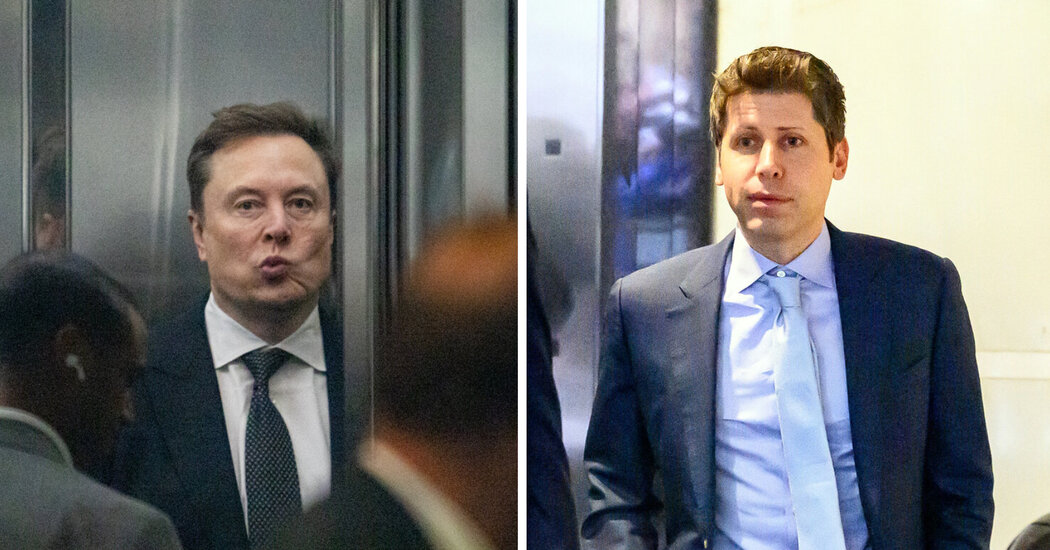
When it comes to Musk vs. Altman, the verdict is in.
In the Oakland, Calif., trial in which Elon Musk accused Sam Altman and OpenAI of “stealing” the nonprofit in order to enrich themselves, and they accused him of sour grapes, the jury decided that Musk had waited too long to file his suit. The statute of limitations meant it was null and void.
Still, both sides come out of the three-week exercise in name-calling tarnished.
The real question raised by the trial — can these people really be trusted with a technology set to disrupt everyone’s world, possibly forever — wasn’t answered. But as tech watchers and investors pick apart the implications, one surprise winner has emerged: the suit itself.
Not the lawsuit, the suit suit.
After decades of being dismissed as a relic of the old world by the inventors of the new, a shackle meant to be shrugged off by the visionaries of the future who needed to free themselves from the jacket and tie to think their big thoughts, the importance of the suit was the one thing on which almost everyone seemingly agreed.
At least, judging from what they wore to court.
Musk, who testified first at the trial, set the tone in a black suit and matching tie rather than his usual T-shirt, jeans and aviator jacket. Greg Brockman, the president of OpenAI, wore a navy suit and blue tie instead of his typical sweater and pants. Satya Nadella, the chief executive of Microsoft, also showed up in a dark suit and glossy tie, not his usual blazer and open-collar shirt.
Then there was Altman himself, watching with his legal team and on the stand. He was not in the “gray sweater and jeans” that he recently told The New Yorker he wore every day to lessen his “decision fatigue” (and maybe to associate himself with Steve Jobs, the famous uniform-wearer), but in his own series of navy and gray suits and blue ties.
There were nuances between the choices, to be sure. Musk’s dark lord mien, and memes, sneaked in via his “Reservoir Dogs” chic. Altman leaned more blue-sky choirboy, Nadella and Brockman, more banker serious. But overall, the suits were a statement unto themselves — no matter who was actually talking.
It was as dramatic an image change as if every member of Congress suddenly decided to show up for the State of the Union in hiking shorts and a fleece. Sure, the protagonists were dressing to show respect to the court. But they were also dressing to manage a bigger message, which has to do with the broader shift in the relationship of the tech world to the watching world.
Despite their supposed rejection of old dress codes in order to let their brains run free in the fields of the binary, the technorati have always understood the symbolic role clothes play in conveying their agenda. They know how effective their refusal to adopt both pre-existing outfits and pre-existing professional assumptions was in building their myth. That’s how hoodies and Tevas became synonymous with the digital frontier. The about-face in the courtroom isn’t chance. It’s strategy.
“Tech going from Patagonia to Brioni is a symbol of its rising importance,” said Venky Ganesan, a partner at the investment firm Menlo Ventures. “It’s the transition from ‘move fast and break things’ to ‘stability and responsibility so that you can trust us with the future of mankind.’”
It’s the transition from upstart and angel investing to giant public company that has to woo Wall Street. (SpaceX has filed for an I.P.O. planned for June; OpenAI may soon follow.)
A suit, after all, is the garment of the manager, and the executive. It is the uniform of authority and tradition, of Washington, Wall Street and the institution. It plays by all the old sartorial rules and taps into long-held cultural associations with adulthood, aspiration and success. It is, not coincidentally, the preferred outfit of the president, who many of these companies are currently wooing.
It comes complete with a familiar value system practically woven into the seams — especially suits from Brioni and Kiton, the Italian brands Ganesan said had become the most popular in Silicon Valley, and which were once the uniforms of the great industrialists of the past.
As the underbelly of the technological revolution is exposed in trials like this one, and as tech executives are called to testify before Congress to defend and explain their choices, covering oneself in the costumes of duty and accountability can serve as a quiet counterpoint. The tie draws a line somewhere deep in the subconscious between the current reality and satires like “The Audacity,” the new AMC show in which the morally unhinged characters have equally unbuttoned-up wardrobes.
This is especially important at a time when fear of A.I. is rising, with twice as many Americans feeling pessimistic as optimistic about the technology, according to a recent Economist/YouGov poll, and as graduates boo commencement speakers who talk up the machine-learning future.
And even though the trial is now over, the costuming is likely to continue. And not just because Musk has vowed to appeal. Or because of the social media addiction cases moving through the court systems in other states.
“Tech spent years positioning itself culturally outside systems — Washington, courtrooms, congressional hearings — that are still deeply encoded with the semiotics of traditional executive authority,” said Joseph Rosenfeld, an executive image consultant who works with clients on the West and East Coasts. “Now, many of these tech leaders operate directly inside those systems. Clothing naturally shifts with that change in relationship to power.”
In other words, while crew necks and three-quarter zips are probably not entirely going away, the era of the Silicon Valley suit may also be upon us.