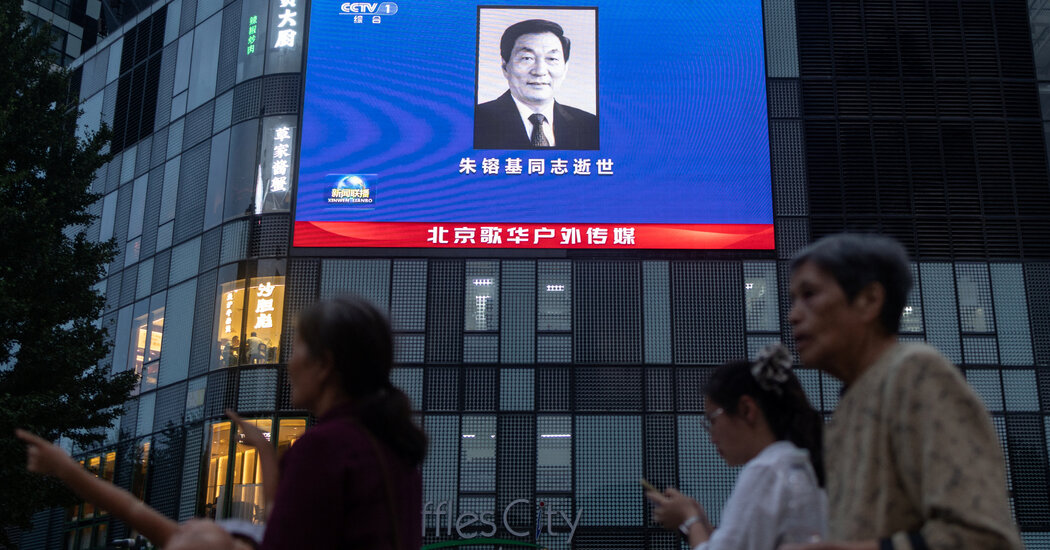
In 1998, Zhu Rongji, then China’s premier, told the staff of an investigative news program that he was a devoted viewer. He went so far as to say that the broadcast had given him ideas for reforms.
He then challenged the Communist Party’s doctrine that the media should emphasize what it called positive reporting. “Did ‘mainly positive reporting’ mean that 99 percent of reports had to be positive?” he asked rhetorically. “Wouldn’t 51 percent be enough?”
“Without such programs, how can the people’s voices be heard?” he asked.
Mr. Zhu was not calling for an independent press, which the party did not permit. The investigative show, after all, was aired by the state broadcaster. But he made clear that he regarded critical reporting not as a threat to the government, but as essential to effective government.
After Mr. Zhu’s death on Wednesday at 97, Chinese people circulated that story alongside many others portraying him as a straight talker, an independent thinker and, in the words of one commentator, “the finest premier in China’s march toward modernity.”
Mr. Zhu, who served as premier from 1998 to 2003 under former President Jiang Zemin, was the forceful technocrat behind some of China’s most consequential economic changes. He pushed the country deeper into the market economy and the global trading system, laying the foundations for two decades of extraordinary growth. Those changes also caused mass layoffs, strengthened the central government and left enduring social and economic problems.
The grief was about more than Mr. Zhu himself. It was also about what he had come to represent: an era when China was opening to the world, officials could publicly acknowledge the country’s problems and the future seemed more prosperous and hopeful. In remembering that era, many people were also passing judgment on present-day China, which has become more closed to the world, less tolerant of criticism and far less confident about what lies ahead.
On WeChat Moments, the semiprivate equivalent of a Facebook timeline, my feed filled with tributes from former journalists, entrepreneurs and professionals.
An investment banker posted a black-and-white photo of Mr. Zhu and remembered “an era when the country was on the rise,” a shared memory, he wrote, that seemed “extraordinarily precious today.” “We were lucky just to have lived through it,” a real estate developer replied.
Others posted photos of Mr. Zhu and his boss, Mr. Jiang, leaning toward each other, whispering and laughing heartily. Some comments said that Chinese leaders in that era still showed a human touch. The images evoked a political atmosphere that appeared more relaxed, collegial and human than the rigid one under Xi Jinping, the current president.
Many of the WeChat posts came from people I know or have interviewed. I’m withholding some of their names for fear of causing them trouble. One lawyer asked me to stop contacting him on WeChat and to use encrypted messaging apps such as Signal instead.
On China’s more public social-media platforms, searches for Mr. Zhu’s name on Weibo and Xiaohongshu, or RedNote, produced sparse results dominated by state media. On Wednesday afternoon, a search I conducted on RedNote returned only 25 results. Some ordinary users omitted his name, posting only a photograph or referring elliptically to “that era” or “him.”
Nearly three decades after Mr. Zhu called the media “the people’s voice” and “a mirror for the government,” the public discussion of his own death appeared to be carefully managed.
The authorities have seen how mourning for former leaders could turn into criticism of the current one. After Mr. Jiang died in 2022, people remembered the relative openness and optimism of his era, drawing thinly veiled comparisons with Mr. Xi. Weibo restricted comments and deleted a popular post thanking Mr. Jiang for allowing Chinese people to watch “Titanic.”
When former Premier Li Keqiang died unexpectedly the next year, videos of him promising that China would remain open to the world were deleted. Comments calling him “a good premier for the people” were censored.
By the time Mr. Zhu died, the censors appeared determined not to let nostalgia for another leader from the reform era become a public referendum on Mr. Xi’s China.
Lu Yiheng, a Chinese political commentator based in Toronto, saw a bitter irony in that nostalgia. Chinese people once dwelled on the failings of the reform era and imagined that a new generation of leaders would build something better. “But who could have imagined,” he wrote on X, “that today we would be grateful simply not to be heading toward another Cultural Revolution?”
That reversal in expectations animated many of the tributes. Amid pervasive job insecurity, slumping consumption and the party’s tightening grip on private enterprise, what some people seemed to miss most was not prosperity itself but the belief that hardship would eventually produce something better.
In a WeChat post, an executive recalled graduating from college in 1998, when jobs were scarce and the government was shedding workers. As he looked back, he wrote, that year may have marked the bottom for China’s economy. “Hardship is not frightening,” he wrote, “as long as there is hope.”
The nostalgia fogs over the brutality of Mr. Zhu’s reforms. Yasheng Huang, an economist at M.I.T., told me that more than 30 million state-sector workers had lost their jobs, many before China had established a meaningful social safety net. He argues that Mr. Zhu later used wrenching reforms to address problems aggravated by some of his earlier policies.
“His economic legacy was very complicated,” he said. “He used his right hand to solve problems created by his left.”
A Shenzhen resident surnamed Jin wrote on WeChat about how family members lost their jobs or were hounded by creditors during the Zhu years.
Yet popular culture of the period urged workers to accept their suffering as a necessary sacrifice. A hit song told them to “start over,” while a nationally televised comedy sketch declared, “If I don’t get laid off, who should?”
Mr. Zhu once said he hoped to be remembered as “a clean official” who had accomplished a few practical things. Mr. Jin saw another side to such ambition. “Throughout history,” he wrote, “some of those who make ordinary people suffer most are clean officials determined to get things done.”