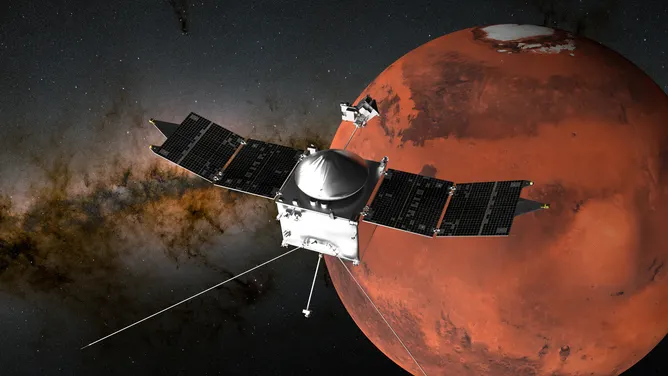
The Nancy Grace Roman Space Telescope is a NASA observatory designed to settle essential questions in the areas of dark energy, exoplanets, and infrared astrophysics.
An iconic spacecraft orbiting Mars has entered its final days after more than a decade of service. But the mission was only supposed to last a year.
The Mars Atmosphere and Volatile Evolution (MAVEN) Mission was the first mission devoted to understanding the Martian upper atmosphere.
Following 11 years of service providing tons of data to experts, NASA officials said farewell to the spacecraft after it experienced an unexpected loss of signal when passing behind Mars on Dec. 6, according to NASA.
NASA’S NEW NANCY GRACE ROMAN SPACE TELESCOPE SET TO LAUNCH MONTHS AHEAD OF SCHEDULE
The spacecraft launched on Nov. 18, 2013, setting off to discover Mars’ dusty secrets.
The Solar System is the gravitationally bound system of the Sun and the objects that orbit it. It formed 4. 6 billion years ago from the gravitational collapse of a giant interstellar molecular cloud. The vast majority 99. 86 of the system`s mass is in the Sun, with most of the remaining mass contained in the planet Jupiter. The four inner system planets “Mercury, Venus, Earth and Mars”are terrestrial planets, being composed primarily of rock and metal.
(Nemes Laszlo / Getty Images)
After officials evaluated the spacecraft’s status, it was determined to be unrecoverable, and scientists began standard procedures to archive the full mission data set.
Leading up to the anomaly that disrupted the spacecraft, all systems were working normally, according to NASA.
NASA ASTRONAUTS RETURN TO INTERNATIONAL SPACE STATION AFTER RUSSIA PAUSES REPAIRS TO NEW LEAKS
After the spacecraft cruised behind the Red Planet, NASA’s Deep Space Network (DSN) did not observe a signal.
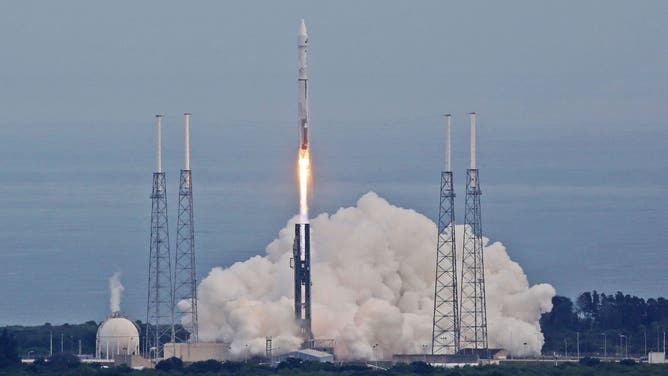
An AtlasV rocket, carrying the Maven spacecraft, blasts off at Cape Canaveral Air Force Station, Fla., on Monday, Nov. 18, 20131. Maven is on a 10-month journey will directly assess the atmosphere of the planet Mars.
(Red Huber/Orlando Sentinel/Tribune News Service / Getty Images)
At the same time, a brief fragment of data from the DSN indicated it was in safe mode and rotating at an unusually high rate.
“These preliminary findings do not address a potential root cause for the anomaly, which is still being investigated,” NASA officials said.
THE BEST CELESTIAL EVENTS IN 2026 YOU WON’T WANT TO MISS
After further review, officials concluded that, due to the high rate of rotation, the spacecraft’s batteries had drained, causing the communications system to lose power and ultimately become unusable.
“The science MAVEN has given us is key to informing what kind of radiation protection and safety measures we must take before sending humans to Mars,” Louise Prockter, director of the Planetary Science Division at NASA Headquarters in Washington, said.
“The data collected from MAVEN will continue to provide valuable insight into Mars for decades to come,” Prockter continued.
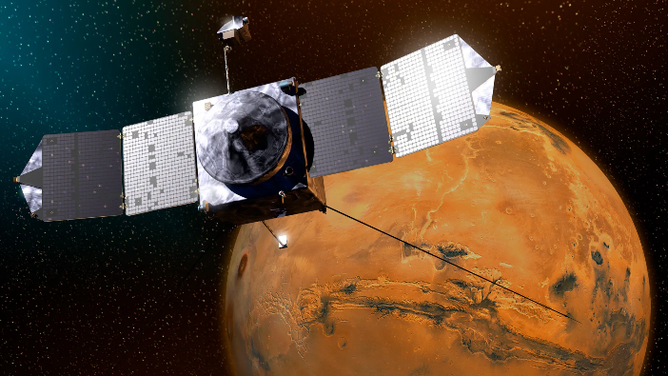
NASA says farewell to the MAVEN Mars Mission after the spacecraft served over a decade.
(NASA/Goddard/University of Colorado/Laboratory for Atmospheric and Space Physics)
NASA teams studied Mars’ atmosphere, observing how solar storms continually strip away the planet’s atmosphere.
This will help scientists learn how this harmful process to Mars’ atmosphere played a key role in transforming the Martian climate from a potentially habitable world to the cold and dry landscape we know today.
NASA STARTS PREPARATIONS FOR ARTEMIS III MISSION WITH SPACE LAUNCH SYSTEM ROLLOUT
Over time, we will discover more vital information about the planet that will aid in the human conquest and establishment of a colony on Mars in the future.