Monday, May 18, 2026
No Result
View All Result
LJ News Opinions
  • Home
  • U.S.
  • Politics
  • World News
  • Business
  • Entertainment
  • Sports
  • Technology
  • Health
  • Opinions
  • Home
  • U.S.
  • Politics
  • World News
  • Business
  • Entertainment
  • Sports
  • Technology
  • Health
  • Opinions
No Result
View All Result
LJ News Opinions
No Result
View All Result
Home Technology

Huge asteroid with the potential to obliterate an entire city will skim past Earth TONIGHT – here’s how you can watch the narrow miss live

by LJ News Opinions
May 18, 2026
in Technology
0
Share on FacebookShare on Twitter


An enormous asteroid with the potential to destroy an entire city will skim past Earth this evening.

Astronomers say the space rock, called 2026 JH2, is up to four times the size of a London bus and will get ‘as close as you can without hitting’.

It is expected to zoom by our planet at an estimated distance of around 56,000 miles (90,000km) at 10:23pm BST.

This is exceptionally close – the equivalent of just a quarter of the distance between us and the moon.

Estimates place the size of the space rock between 52 and 115ft (16 and 35 metres) in diameter, and it is racing towards Earth at around 20,000mph (32,000 kmph).

Despite having enough mass to wipe out a city, simulations suggest there is no chance of impact for at least the next 100 years.

While it will be too faint to see with the naked eye, it may be visible through amateur telescopes under dark sky conditions. But for those without access to stargazing equipment, you can still watch the unusually close encounter.

Astronomers in Italy will be sharing a livestream of the flyby, recorded through a telescope, on The Virtual Telescope Project’s YouTube channel. The broadcast will start at 8:45pm BST.

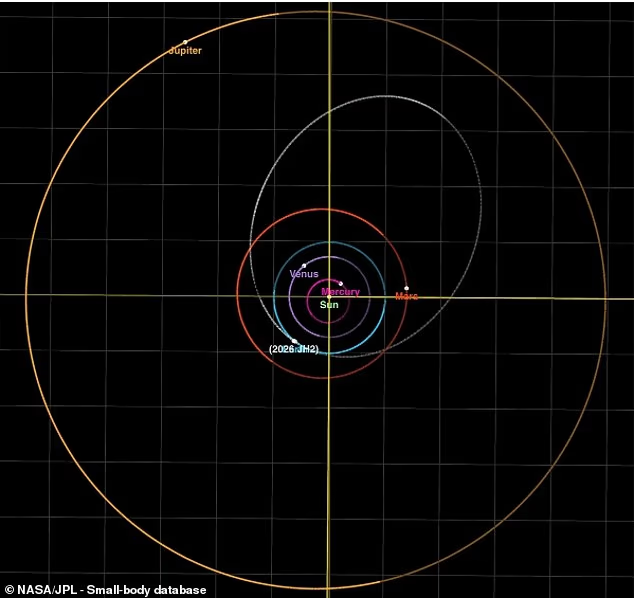
This illustration shows the orbit of asteroid 2026 JH2 (grey) relative to Earth’s orbit (light blue). Its oval–shaped orbit takes it nearly as far out as Jupiter

Thankfully, simulations suggest there is no chance of an impact for at least the next 100 years (stock image)

Thankfully, simulations suggest there is no chance of an impact for at least the next 100 years (stock image) 

People in the UK will have the best chance of spotting asteroid 2026 JH2 from dark–sky locations with a clear northern horizon.

Around closest approach, it should be moving through the region of Ursa Major, fairly high in the sky.

Binoculars probably won’t be good enough unless they are very large. However, it should be visible with small telescopes.

It will look like a faint moving dot, rather than a dramatic streak.

The asteroid was first discovered on May 10 by astronomers at the Mount Lemmon Observatory near Tucson in Arizona.

Data suggests it likely circles the sun every 3.7 years on an oval–shaped orbit that takes it nearly as far out as Jupiter.

The size of the asteroid is an estimate based on the amount of light reflecting off its surface, which means that measurements cannot be entirely certain.

If the asteroid is made of a particularly dark or unreflective material, then it could be nearer to the higher end of the estimate range or potentially even larger.

2026 JH2 is expected to zoom by our planet at an estimated distance of around 56,000 miles (90,000km) tonight

2026 JH2 is expected to zoom by our planet at an estimated distance of around 56,000 miles (90,000km) tonight

Estimated to be between 16 and 35 metres (52 to 115ft) across, 2026 JH2 is a similar size to the 20-metre Chelyabinsk meteor (pictured), which exploded with 30 times the energy of the atomic bomb dropped on Hiroshima

Estimated to be between 16 and 35 metres (52 to 115ft) across, 2026 JH2 is a similar size to the 20–metre Chelyabinsk meteor (pictured), which exploded with 30 times the energy of the atomic bomb dropped on Hiroshima 

Asteroid 2026 JH2

Estimated size: 16 to 35 metres (52 to 115ft) in diameter

Closest pass to Earth: 56,000 miles (90,000km)

Time of closest pass: May 18th 10:23pm (BST)

Risk of hitting Earth: None

How to watch live: Astronomers will be sharing a livestream of the flyby, recorded through a telescope, on The Virtual Telescope Project’s YouTube channel. The broadcast will start at 8:45pm BST.

However, even at the lower end of its estimated range, the asteroid still carries a huge destructive potential.

‘It’s the kind of thing that would ruin a city quite efficiently, if it hit,’ Mark Norris, from the University of Lancashire, told New Scientist.

Experts say if 2026 JH2 did strike Earth, it would cause an event comparable to the Chelyabinsk meteor.

In 2013, an 18–metre (59ft) meteor exploded over the city of Chelyabinsk in Russia, near the border with Kazakhstan.

The resulting explosion was 30 times more powerful than the atomic bomb dropped on Hiroshima, producing a shockwave that travelled twice around the world.

Directly beneath the explosion, 28 miles (45km) above the ground, the heat was so intense that people were left with burns and retinal damage.

Around 1,500 people were injured and over 3,600 homes were damaged, even though only 0.05 per cent of the original rock made it to the ground.

With a potential size up to 35 metres (115ft) in diameter, 2026 JH2 has the potential to be even more destructive – possibly even ranking it as a ‘city killer’ size asteroid.

However, although the asteroid will pass extremely close to the planet, it poses no threat whatsoever to Earth.

Thanks to careful study by the network of planetary defence telescopes, astronomers are able to make very precise calculations of asteroids’ orbits

The next sizable space rock that will get this close to Earth will likely be the ‘God of Chaos’ asteroid, 99942 Apophis, which will fly within 20,000 miles (32,000 km) of Earth on April 13, 2029.

After Apophis, the next major flyby will be from 2024 YR4, also known as the ‘city killer’ asteroid, which will zoom past the moon at a minimum distance of around 13,200 miles (21,200 km) in 2032.

POTENTIAL METHODS FOR ELIMINATING THE THREAT OF AN ASTEROID  

DART is one of many concepts of how to negate the threat of an asteroid that have been suggested over the years. 

Multiple bumps 

Scientists in California have been firing projectiles at meteorites to simulate the best methods of altering the course of an asteroid so that it wouldn’t hit Earth. 

According to the results so far, an asteroid like Bennu that is rich in carbon could need several small bumps to charge its course.

‘These results indicate multiple successive impacts may be required to deflect rather than disrupt asteroids, particularly carbonaceous asteroids,’ researchers said.  

Nuke 

Another idea, known simply as ‘nuke’, involves blowing up a nuclear explosive close to the asteroid.

However, this could create smaller but still potentially dangerous fragments of rock that could spin off in all directions, potentially towards Earth. 

Ion Beam Deflection

With Ion Beam Deflection, plumes from a space probe’s thrusters would be directed towards the asteroid to gently push on its surface over a wide area. 

A thruster firing in the opposite direction would be needed to keep the spacecraft at a constant distance from the asteroid. 

Gravity tractor 

And yet another concept, gravity tractor, would deflect the asteroid without physically contacting it, but instead by using only its gravitational field to transmit a required impulse. 

Professor Colin Snodgrass, an astronomer at the University of Edinburgh said: ‘There have been a few concepts suggested, such as a ‘gravity tractor’ to slowly tow an asteroid away instead of pushing it with a kinetic impactor.

‘But the kinetic impactor is definitely the simplest technology to use on the sort of timescale that is most likely to be of concern for this size of asteroid, i.e. years to decades warning time.’

Source link

Tags: arizonadailymailearthitalyLondonsciencetechyoutube
LJ News Opinions

LJ News Opinions

Next Post

BBC Director General Matt Brittin Day One On Savings & Technology

Recommended

Renaming of The John F. Kennedy Memorial Center for the Performing Arts, in Washington

PHOTOS: Kennedy Center adds Trump’s name to memorial Congress created for JFK

5 months ago

James Cameron Letter On Warner Bros Sale Gets Netflix Response

3 months ago

Popular News

    Connect with us

    LJ News Opinions

    Welcome to LJ News Opinions, where breaking news stories have captivated us for over 20 years.
    Join us in this journey of sharing points of view about the news – read, react, engage, and unleash your opinion!

    Category

    • Business
    • Entertainment
    • Health
    • Opinions
    • Politics
    • Sports
    • Technology
    • U.S.
    • World News

    Site links

    • Home
    • About us
    • Contact

    Legal Pages

    • Privacy Policy
    • Cookie Privacy Policy
    • Terms of Use
    • Disclaimer
    • California Consumer Privacy Act (CCPA)
    • DMCA
    • About us
    • Advertise
    • Contact

    © 2024, All rights reserved.

    No Result
    View All Result
    • Home
    • U.S.
    • Politics
    • World News
    • Business
    • Entertainment
    • Sports
    • Technology
    • Health
    • Opinions

    © 2024, All rights reserved.