They’re often referred to as ‘man’s best friend’ – but can you really tell how your dog is feeling?
Vets from Utrecht University have revealed the 17 key signs that indicate your dog is in pain.
Many of the signs are fairly obvious, such as changes in personality, hesitant paw lifting, and reduced play.
However, others are less easy to interpret – including nose licking, yawning, and air sniffing.
In fact, the researchers found that barely half of dog owners are able to identify symptoms such as nighttime restlessness and clinginess.
‘These subtle signs in a dog’s behaviour might provide early warning signs for dog aggression,’ the researchers explained in their study, published in PLOS One.
‘When in pain, dogs may behave unpredictably and react to stimuli that they usually would not react to with aggression.
‘Thus, the recognition of subtle behavioural signs might be of value to human health and wellbeing.’
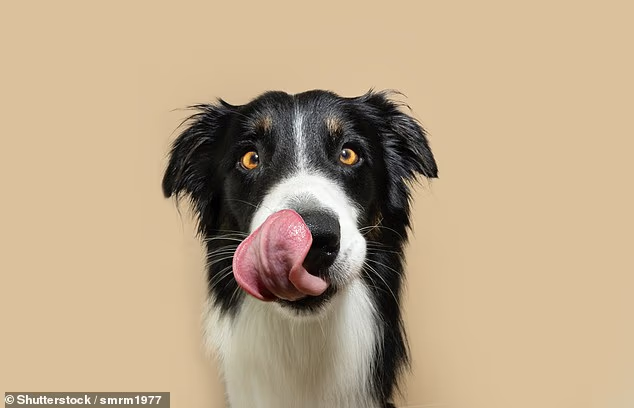
Vets from Utrecht University have revealed the 17 key signs that indicate your dog is in pain – including licking their lips or nose (stock image)
Previous research has shown that humans are adept at interpreting dogs’ facial expressions.
For example, a study in 2022 found that slight changes, from wide eyes to a lolling tongue, can help to detect six different emotions in dogs.
However, until now, our skills at deciphering subtle behaviours has been unclear.
To get to the bottom of it, the team enlisted 530 dog owners and 117 non–dog owners, who were given an online questionnaire.
In one part of the questionnaire, they were shown a list of 17 signs of pain, and asked to rank them.
Next, they were given three separate case studies of dogs, described in vignette format.
The first case study described a dog with subtle pain signs, the second described a dog with overt pain, and the third described a dog with no pain.
For each, they were asked for five possible reasons why the dog was behaving how it was.

The results revealed that people are best at recognising signs of pain that are related to movement, such as limping (stock image)
The results revealed that people are best at recognising signs of pain that are related to movement, such as limping.
Speaking to the Daily Mail, Dr Ineke R. van Herwijnen, lead author of the study, said: ‘Possible signs of pain that we are less alert to so far are sudden changes in behaviour like nighttime restlessness and increased owner–attachment behaviours.
‘Also, signs that we deem funny, may indicate discomfort or pain in a dog, like a dog licking the air.’
Surprisingly, the researchers found that dog owners and non–dog owners did not differ in their recognition of pain signs – with the exception of three behaviours.
Non–dog owners gave higher likeliness scores for turning the head or body away, and freezing.
‘This may indicate that dog owners recognise subtle dog pain signs with less ease,’ the team explained.
‘Possibly, dog owners recognise signs such as “turning head or body away” and “freezing” (more so) as a stress/fear sign, than as a possible pain sign.’
The researchers hope the findings will encourage dog owners to be more wary of unexpected behaviours in their pets.
Dr van Herwijnen said: ‘A key thing dog owners can do for their dogs is considering pain as a possible motivation for dog behaviour.
‘Often we regard a dog’s behaviour as caused by boredom, disobedience or stubbornness, when in fact pain may be the real motivation.
‘If we consider pain as an option, we can help an animal earlier on when it suffers, look at their behaviour in a different light and perhaps mitigate behaviours we see as undesired or troublesome.’