Venice is renowned for its unique canal system and popular gondolas – but the ‘Floating City’ might have to be relocated to protect it from rising sea levels, experts warn.
The tourist hotspot is already at risk of succumbing to its sinking foundations and rising waters, with 18 extreme flooding events occurring over the last 23 years.
Experts predict that over the next 300 years, global sea levels could rise by up to seven metres – while a 16–metre rise ‘cannot be ruled out’.
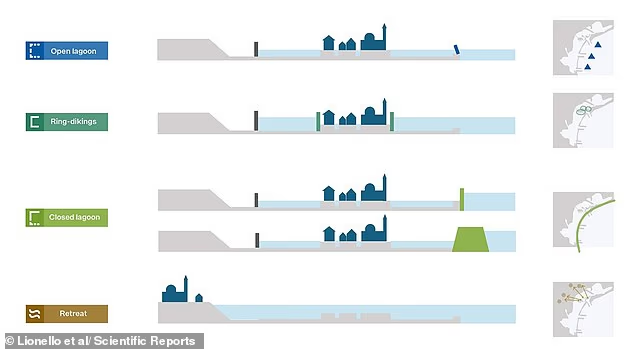
To help protect the historic place, researchers explored the cost and effectiveness of four different measures for protecting the city from the effects of climate change.
Even with the implementation of additional pumps to remove water during storms, Venice’s current defences may only be adequate up to roughly 1.25 metres (4.1ft) of sea level rise.
And they said relocating the most historically significant parts of the city may be more feasible than constructing additional flood defences.
However, this would come at a hefty cost, with a relocation estimated to cost a whopping $100 billion (£87 billion)
‘Under extreme sea level rise, relocation of monuments to suitable inland areas and abandonment would be the only remaining strategy, which might become unavoidable in the 22nd century under current climate policies and an Antarctic ice–sheet collapse,’ the team wrote.
For their study, a team from the University of Salento in Italy assessed four potential strategies to save the city from sea level rises

One of Venice’s worst flooding events occurred in 2019, when the iconic Saint Mark’s Square was covered in several feet of water
The historic city of Venice is built atop 120 small islands crisscrossed by 177 canals and nearly 400 bridges.
Its current flood defences include a trio of movable barriers at the lagoon’s edge which can seal the area from high tides.
For their study, a team from the University of Salento in Italy assessed four potential strategies to save the city from sea level rises.
This includes introducing more movable barriers, installing a continuous line of flood defences called ring dikes, closing the Venetian Lagoon with a ‘super levee’ and relocating the city, its residents and historic landmarks further inland.
The authors estimate that dikes or closing the lagoon may be necessary in the case of a 0.5m sea rise, which may occur before 2100.
But they warned relocating the city might be necessary beyond 4.5 metres of sea level rise, which is projected to occur after 2300.
‘Planned relocation and abandonment by residents are two components of the retreat strategy,’ they wrote in the journal Scientific Reports.
‘Planned relocation consists of dismantling buildings and reassembling them in new higher locations.

Venice (located at number one on this map) is especially susceptible to rising sea levels, the experts warns
‘This unprecedented and complex operation would not prevent the loss of the cultural, historical and monumental assets of the original settlement.’
They added: ‘The relocated monuments could be visited by tourists and new residential areas built around them. The flooded remains would progressively deteriorate and could be visited for a limited period by boat.’
In their study they referenced the smaller–scale relocation of the Abu Simbel temples in Egypt.
Between 1964 and 1968, the temples were cut into over 1,000 massive blocks weighing 20–30 tonnes each, and moved 65 metres higher and 200 metres inland to escape flooding from the construction of the Aswan High Dam and Lake Nasser.
This drastic measure, if implemented in Venice, would be the most expensive option, the researchers said – costing up to $100 billion (£87 billion).
One of Venice’s worst flooding events occurred in 2019, when the iconic Saint Mark’s Square was covered in feet of water.
The tide reached a peak height of 187cm (6.1ft) above sea level, resulting in more than 80 per cent of the city being under water.
The worst ever flooding event, which took place in 1966, saw water levels rise to 194cm (6.4ft) above sea level, and is thought to have seriously damaged at least three–quarters of the city’s shops, businesses and studios.

The researchers referenced the smaller-scale relocation of the Abu Simbel temples in Egypt. Between 1964 and 1968, the temples were cut into over 1,000 massive blocks weighing 20-30 tonnes each and moved 65 metres higher and 200 metres inland to escape flooding
The scientists warned that, as the construction of large–scale interventions such as permanent barriers can take between 30 and 50 years, early planning is essential.
Co–author Professor Robert Nicholls, from the University of East Anglia, said: ‘This analysis shows that there is no optimal adaptation strategy for Venice.
‘Any approach taken must balance multiple factors including the wellbeing and safety of Venice’s residents, economic prosperity, the future of the lagoon’s ecosystems, heritage preservation, and the region’s traditions and culture.
‘This study shows that all low–lying populated coastal areas should recognise the challenge of long–term sea–level rise and start considering adaptation implications now.’