Amna Nawaz:
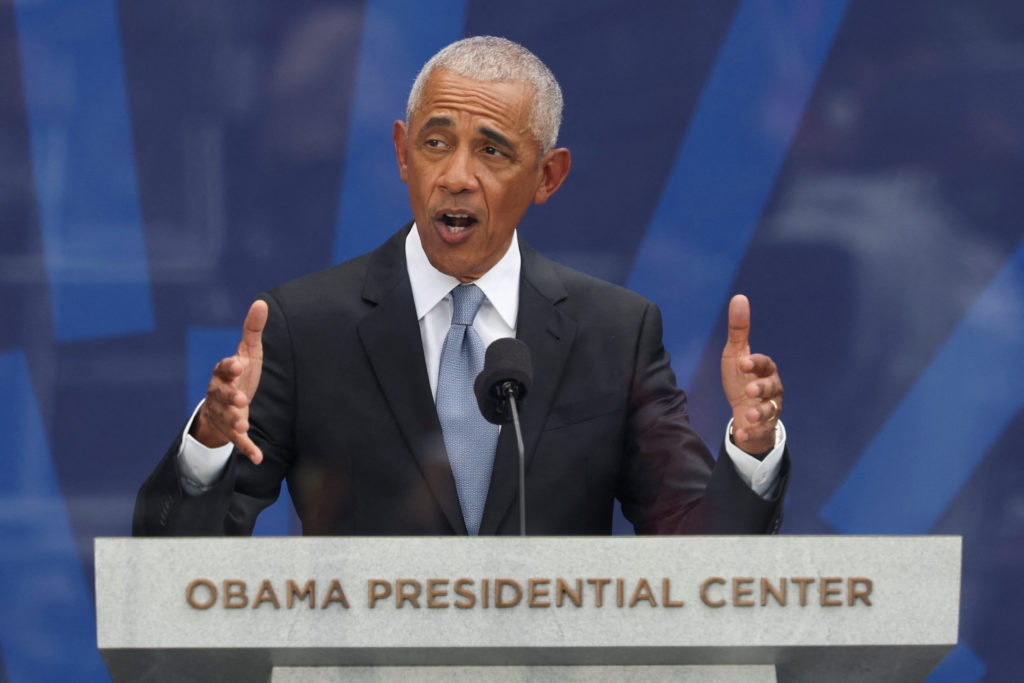
Today, the Obama Presidential Center opens to the public. It follows a celebration yesterday that featured VIPs, members of the Obama administration, and longtime residents of South Side, Chicago, where the center is located.
Ali Rogin takes a look at what this new center tells us about the sort of legacy former President Barack Obama wants to leave.
Ali Rogin:
Former President Obama said he did not want the center to feel like a shrine or a museum, but, rather, like a representation of an American story still being written, in which his is one chapter.
Barack Obama, Former President of the United States: If you come for a day, and you don’t have time to see everything, I would urge you to skip the clips of my speeches — you have heard them all before — in favor of the stories of those ordinary citizens who helped make that change happen.
Ali Rogin:
Mr. Obama did not mention President Donald Trump, who was not invited, but he did talk about the political divisiveness that’s been a hallmark of Trump’s two terms. And Obama urged people not to give in to cynicism and despair.
For more on what the former president is seeking to communicate through this new institution, I’m joined by Yale University historian Beverly Gage.
Beverly, thank you so much for joining us.
Welcome back to the “News Hour.”
Beverly Gage, Yale University:
Thanks for having me.
Ali Rogin:
And I want to take a step back first by asking you, what service do presidential libraries historically play? What purpose do they serve?
Beverly Gage:
Presidential libraries have been a really important part of our presidential history.
Franklin Roosevelt was the first one to kind of come up with the idea. And they typically have the museum piece which you see at the Obama Center, but they’re also these enormously important research repositories run by the National Archives. That’s where historians go to write about all of these presidential administrations.
Ali Rogin:
And President Obama specifically said that he wanted his center — he doesn’t call it a library — to be something different.
In what ways is this different. You mentioned how institutions like these typically are repository of research information. But this one is different, right?
Beverly Gage:
That’s right. He said from the very beginning that he wanted this to be different.
First, he wants all of the records of his administration to be digitized. And so it’s possible that there will never be a research room that historians go to write about the Obama administration. And so I think some historians are a little nervous about that piece.
But the other thing that he really wanted to do differently was not to just make it a kind of stand-alone museum or shrine that’s just about history, but to make it this living, breathing community place. And that seems to be what they have really tried to do.
Ali Rogin:
And, as we noted, President Obama did not mention President Trump’s name during the speech, but during his and first lady Michelle Obama’s addresses, there did seem to be some subtle, but deliberate counterprogramming to President Trump’s vision for America.
What sort of message do you think they wanted to convey?
Beverly Gage:
Well, the fact that Trump was not only not mentioned, but was not there, is pretty significant, because these presidential library openings, they tend to be these moments of bipartisan unity.
And we saw that with, of course, the Bushes there, but not Trump. And to some degree, it’s no surprise. Trump has been heaping abuse on not only Barack Obama, but Michelle Obama and all that they stood for, for years. And I think it’s also true that, when Trump shows up just about anywhere, he sort of sucks all the oxygen out of the room.
And so that may be also a part of what they were thinking.
Ali Rogin:
It also seemed very intentional that the former president mentioned his former rivals for the White House.
He mentioned John McCain and Mitt Romney. Why do you think he went out of his way to mention them?
Beverly Gage:
Well, I think that was always part of what Barack Obama stood for. And, in this moment, it can seem like a long time ago that such things were possible, but he tried his very best to stand for a kind of reaching across the aisle, a faith in the American political process, a dignity of the office.
And a lot of that, Trump has dismissed or run against. But I think Obama is trying to be part of that much longer tradition.
Ali Rogin:
The Obamas have largely stayed out of the political fray since they left the White House. But yesterday’s events seem to give us a hint of how this president is thinking about his legacy.
How, so far, is he similar and different from those other members of this very small club of former presidents?
Beverly Gage:
It is a small club.
And lots of different presidents have done this differently. A lot of it has to do with age. So, Barack Obama was a young ex-president. And so he had these decades stretching out in front of him to think about what to do with, in contrast to someone like, say, Ronald Reagan or now Joe Biden.
It’s true that he has been pretty recessive up to this point, has taken that step back that it’s often expected that ex-presidents will take. But I think there are a couple of signals here. First of all, you can see him coming into his own a little bit as the community activist of his youth. A lot of this center has that vibe. It’s trying to draw upon that history.
And then I think he’s also trying to recover something of a sense of progress, a sense of optimism, a sense of hope that was always so central to his message that has been just so battered over the past decade. And you can sort of see him coming forth to play that role and try to revive that message once again.
Ali Rogin:
Beverly Gage with Yale University, thank you so much for joining us.
Beverly Gage:
Thanks.