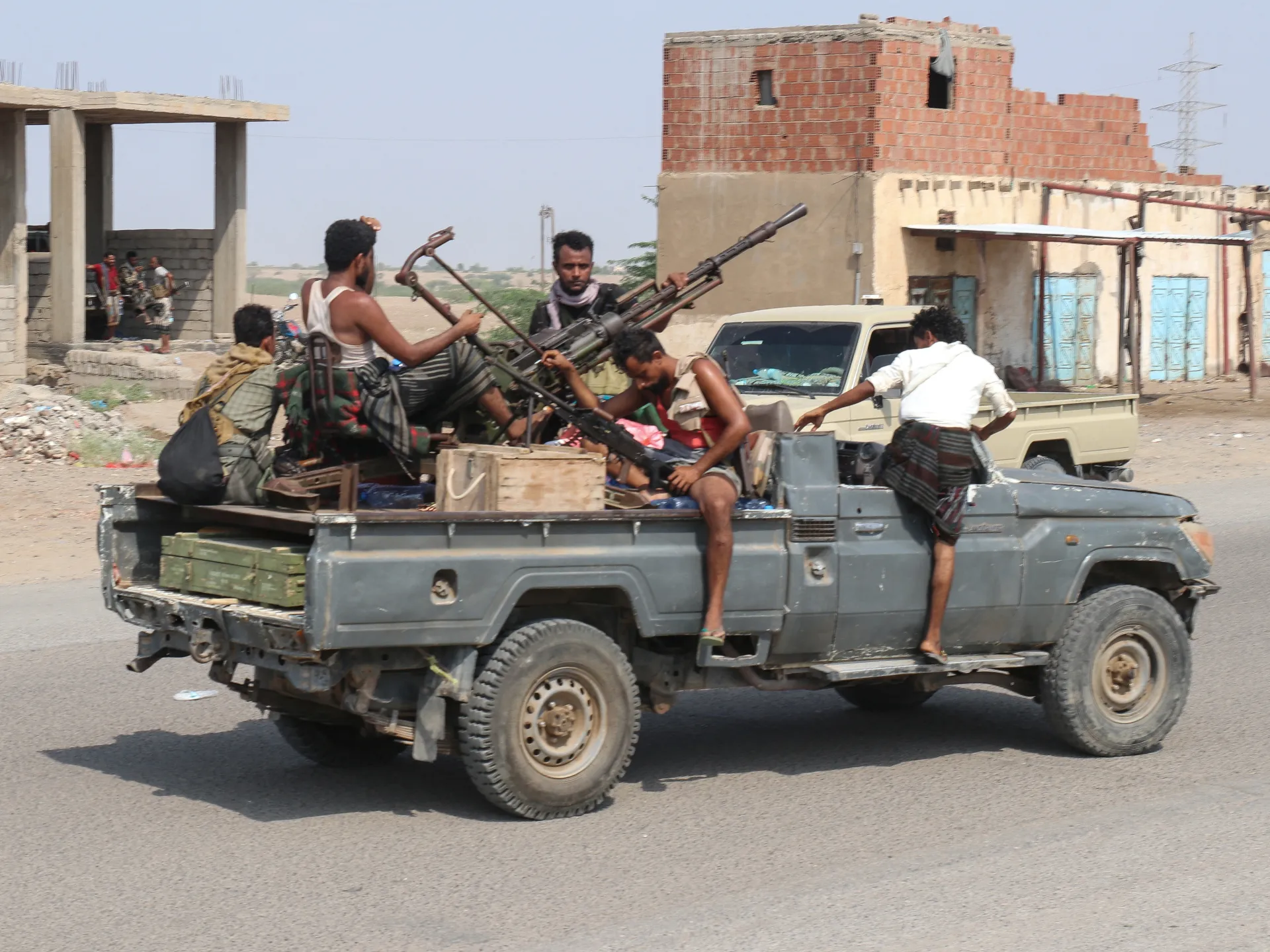
Yemen’s internationally recognised government says its forces have made significant gains against the Houthis as fighting has escalated in recent weeks, raising fears of a return to full-scale war.
The government forces on Saturday said they had recaptured strategically located territory in Hodeidah province under Houthi control and advanced in western Taiz.
Recommended Stories
list of 3 itemsend of list
However, the latest gains do not yet amount to a decisive shift in Yemen’s long-running war.
The Iran-aligned Houthis still control the capital, Sanaa, and several other cities, and have themselves recently advanced around Taiz as they seek to threaten the government-held port of al-Makha (Mocha) and move towards areas bordering the strategically vital Bab al-Mandeb strait, the chokepoint that connects the Red Sea to the Arabian Sea.
The fighting comes amid a wider regional conflict involving Saudi Arabia, which is a key backer of the Yemeni government.
Riyadh has carried out air strikes against positions recently captured by the Houthis, as the battle increasingly focuses on territory leading towards one of the world’s most important shipping routes.
Here is what you need to know:
What is the latest fighting on the ground?
The government forces have been fighting the Houthis across several fronts, with some of the heaviest clashes in Taiz and Hodeidah provinces, and along the western Red Sea coast.
The SABA news agency, controlled by Yemen’s internationally recognised government, reported on Saturday that the Yemeni military had taken control of Hais district in Hodeidah, citing an unidentified military source.
Hais is strategically located at the junction of Hodeidah, Taiz and Ibb provinces. The Houthis have yet to comment on this latest development.
The source also said government forces have regained areas around the al-Barh junction in western Taiz and advanced towards Houthi positions. Taiz is divided between the Houthis and the Saudi-backed Yemeni government.
Fayad al-Numan, a Yemeni Information Ministry official, said government forces had also captured dozens of Houthi fighters during clashes in al-Jarahi district in southern Hodeidah.
Clashes in Taiz killed more than 60 people, including civilians, on Saturday, the AFP news agency reported.
On Thursday, fighting erupted as Houthi forces launched a major offensive along front lines in western Taiz and southern Hodeidah, using ballistic missiles, drones and artillery as ground forces attempted to advance towards government-held territory along the Red Sea coast.
The United Nations Office for the Coordination of Humanitarian Affairs (OCHA) said that about 1,800 families have been displaced over the past two days as fighting escalated in Taiz.
Fighting renewed in early August after months of calm when Yemeni government forces launched attacks on Houthi positions across multiple front lines.
The Yemeni government re-established control over major southern and eastern territories following a Saudi-backed counteroffensive and the subsequent dissolution of the UAE-backed Southern Transitional Council (STC) in January.
They now aim to unite Yemen after bringing the areas under Houthi control under one administration.
But the Houthis have pushed towards government-held areas near al-Makha and territory bordering the Bab al-Mandeb strait amid reinforcements and counteroffensives from the government forces.
The latest escalation follows a period of relative calm in Yemen that had largely held since a UN-brokered truce in April 2022. The ceasefire brought an end to major fighting since the Houthis’ capture of much of the country, including Sanaa, in 2014.
But Thursday’s attacks hint at a return to large-scale conflict.
Are Yemen’s forces regaining control?
The capture of Hais could be significant because of its position linking Hodeidah, Taiz and Ibb, while advances around al-Barh could help government forces push back against Houthi forces in western Taiz.
Presidential Leadership Council chairman Rashad al-Alimi said Yemen’s armed forces were capable of restoring control over the entire country and warned that Houthi “miscalculations” would lead to their “complete collapse”.
However, it is too early to describe the developments as a significant shift in control.
The Houthis had themselves seized positions near Taiz shortly before the government counteroffensive, according to an AFP news agency citing a military officer.
Houthi forces have also been attempting to cut off the government-held port of al-Makha, and advance towards areas bordering the Bab al-Mandeb strait.
The scale of government losses also shows how contested the battlefield remains. Twenty-six government soldiers were killed in several hours of fighting on Saturday alone, according to AFP’s military sources.
What is Saudi’s role in the conflict?
The escalation is also increasingly intertwined with the wider regional conflict linked to the US-Israel war on Iran.
The Iran-backed Houthis announced a maritime blockade of Saudi Arabia in July and began targeting Saudi ships and territory, while Saudi Arabia has carried out air strikes against Houthi positions in Taiz.
Bab al-Mandeb has become particularly important after Iran closed the Strait of Hormuz to commercial shipping. The Hormuz blockade has triggered a global energy crisis and is pushing the global economy into turbulence.
The waterway is a key transit route for Saudi oil, one of only two exit-entry points to the Red Sea, the other being the Suez Canal, raising the stakes as Houthi forces attempt to advance towards areas bordering the strait.
In July, Saudi Arabia announced a mission to form an international alliance to guard the Red Sea from attacks on shipping by Iran-backed Houthis in Yemen.