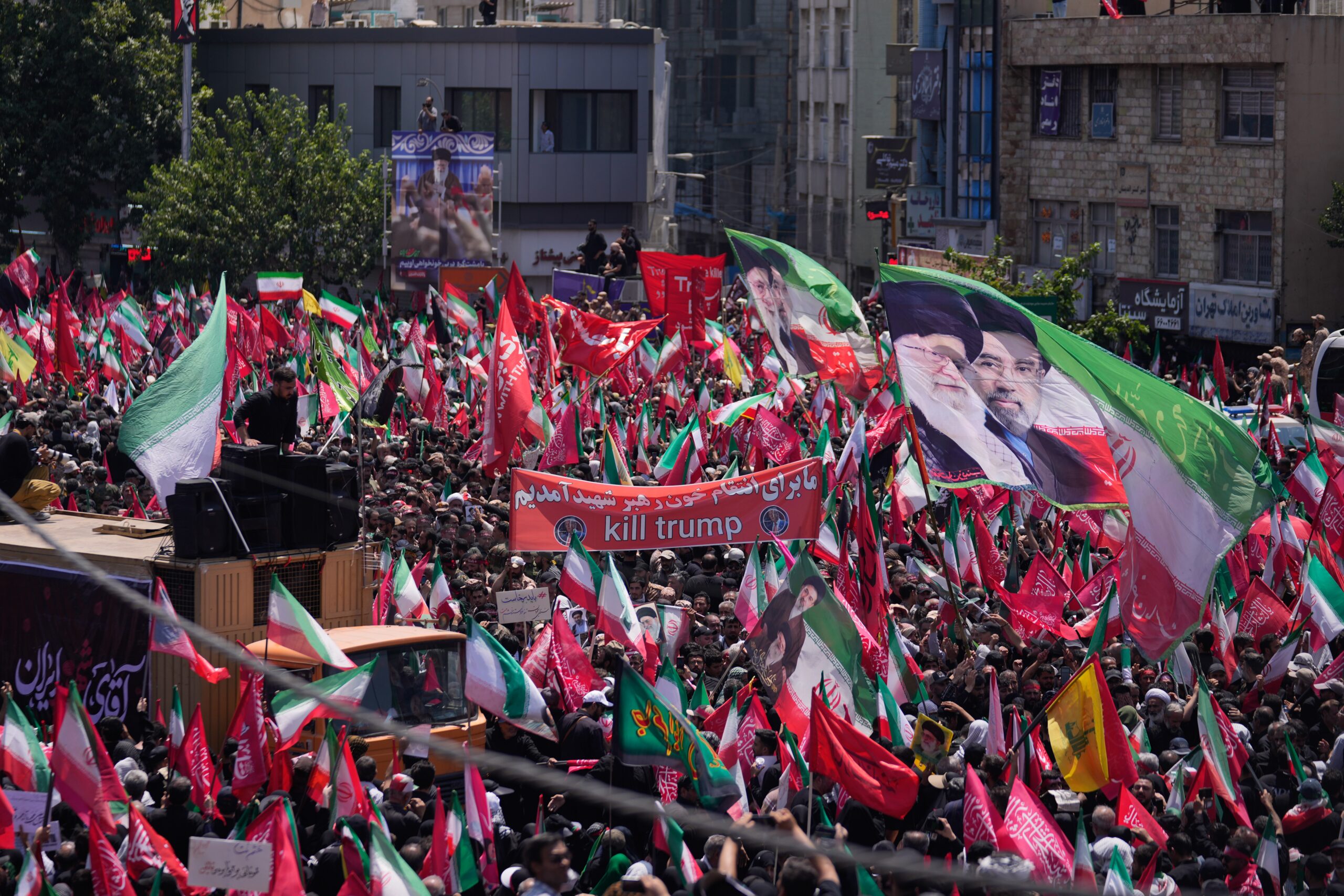
Iran’s Supreme Leader Mojtaba Khamenei vowed in a social media post to avenge the death of his father, Ayatollah Ali Khamenei. The former Supreme Leader was killed in the United States-Israel airstrikes that marked the start of the war with Iran on Feb. 28. His funeral was marked by chants calling for the deaths of both U.S. President Donald Trump and Israeli Prime Minister Benjamin Netanyahu, and it unfolded amid renewed escalations between the United States and Iran.
In what is only his second public statement, the new Supreme Leader—who has not appeared in public since he was reportedly wounded in the airstrikes that killed his father—said he would avenge “the blood of all those martyred … by bringing the criminal and dishonorable killers to justice.”
“This revenge is the demand of our nation, and it will most certainly be carried out. These criminals — whose names are known from top to bottom — will take to their graves the unfulfilled wish of dying peacefully in their beds,” he wrote on July 11.
While Khamenei did not mention Trump by name, Israeli intelligence informed Washington earlier that week that Iran was exploring assassination plots, according to the Wall Street Journal.
Trump responded on Truth Social, saying that the U.S. would “decimate and destroy all areas of Iran” in response to any attempts on his life.
Read More: How the Iran War Worsens the Climate Crisis
“1000 Missiles are Locked and Loaded and aimed at the Islamic Republic of Iran, with thousands of more to immediately follow, should the Iranian Government act on its threat, pronounced in many corners of the Globe, to assassinate, or attempt to assassinate, the sitting President of the United States of America, in this case, ME,” Trump said in his post.
Trump has long said that he considers himself a target of the Iranian regime. At the NATO summit in Ankara, Turkey, last week, Trump told reporters that he was “No. 1 on the kill list for Iran.”
“I’ve been on their list for a long time. That’s what we’re dealing with,” he said in an interview with the New York Post on July 10. “I’ve left instructions: If anything happens, to just literally bomb them at levels that they’ve never seen before.”
The remarks echoed his comments from early 2025, after the discovery of two Iran-linked plots against the President.
The first came to light in July 2024, when Pakistani national Asif Merchant was arrested—and later convicted—for a plot to kill United States politicians, potentially including Trump. The government said that Merchant had worked with Iran’s Islamic Revolutionary Guard Corps to hire hitmen on American soil. Then, soon after Trump was elected for his second term in November 2024, the Justice Department announced charges against Afghan national Farhad Shakeri, alleging that he was directed by Iran’s government to draw up a plan to assassinate Trump.
Trump told reporters in the Oval Office in February 2025 that assassinating him “would be a terrible thing for them to do.”
“If they did that, they would be obliterated. That would be the end,” he continued. “I’ve left instructions: If they do it, they get obliterated. There won’t be anything left.”
Why Tehran Keeps Calling for Revenge
Despite Trump’s warnings about the repercussions of an attempt on his life, Iranian leadership continues to call for vengeance against the United States—a mission that Iranian President Masoud Pezeshkian has described as his “legitimate right and duty.”
Experts say that the rhetoric is expected after a major attack on a country’s leadership. The former Supreme Leader is the latest example, but the U.S. was also responsible for the death of Iranian Quds Force Leader Qasem Soleimani during Trump’s first term in 2020.
“As bad as the enmity between the two countries has been for the last 47 years, it was taken up to a new [level] after the assassination of Soleimani—and then even more importantly, the assassination of Khamenei,” Trita Parsi, Executive Vice President of the Quincy Institute for Responsible Statecraft, tells TIME. “I think that is what has opened the door for these kinds of threats and counter-threats.”
Parsi says that Khamenei’s renewed threats “throw a bone” to appease Iranian officials who argue internally that “it is the right of the nation to have its revenge.”
“It’s important to understand how much of this is all wrapped up in Iranian internal politics and factional fighting,” he says, explaining that arguments are “primarily coming from a minority of ultra-hardliners who have opposed the diplomacy, who opposed the MOU, who do not want to see any relinquishing of control of the Strait of Hormuz, even if it is an arrangement that others in the Iranian system would find acceptable.”
David Satterfield, Director of Rice University’s Baker Institute for Public Policy, agrees that the Islamic Republic is “rallying for national support” in its calls for vengeance.
Notably, the Iranian government does not want to “deal with” another popular protest like it did in January, Satterfield tells TIME. The subsequent crackdown reportedly killed tens of thousands of Iranians.
At the same time, he says that these calls for vengeance sustain Iranians’ faith in their nation’s “ability to project influence and power in the region” after its closure of the Strait of Hormuz led to a worldwide energy crisis.
“The calls for vengeance are both normative—a public Iranian internal direct call to generate support for the regime—[and] a further part of their strategic desire to be seen as a dominant force,” he says.
Read More: U.S. and Iran Trade Strikes For Second Night In a Row After Trump Says Cease-Fire Is ‘Over’
How Prior Threats Have Impacted Trump’s Security
Regardless of whether Iran’s threats are primarily meant to rally domestic support, recent attempts on Trump’s life have prompted heightened security measures around the President.
Last week, prosecutors indicted eight men on murder and terrorism conspiracy charges for their roles in a foiled sniper attack plan at the UFC Freedom 250 fight at the White House in June.
In the affidavit, prosecutors allege that the suspects aimed to assassinate not only Trump, but also Vice President JD Vance, Israeli Prime Minister Benjamin Netanyahu, trillionaire businessman Elon Musk, and “other high value targets” at the event.
“Thanks to the rapid action of this FBI, our partners, and the Department of Justice in a multi-state operation, multiple individuals are now in custody, and allegedly planned attacks were stopped cold,” FBI Director Kash Patel said in a social media statement.
This was the most recent in several highly publicized attempts to kill the President, tracing back to the campaign trail, where a bullet struck Trump during a rally in Butler, Pennsylvania, in July 2024. In September 2024, a man was found hiding in the bushes with a rifle outside of Trump International Golf Club in West Palm Beach, Florida. A gunman was apprehended after opening fire at the White House Correspondents Association dinner in April 2026.
In response, Trump’s team implemented more rigorous security measures, including walls of bulletproof glass to stand between him and attendees at public speaking events and expanded security detail.
On Friday, the Washington Post reported that the Trump Administration is considering permanent fencing to surround Lafayette Square Park and along Pennsylvania Avenue, which would allow officials to quickly close the park in the event of a live threat.
The heightened security has unfolded alongside Trump’s unusually public discussion of rising threats—something former Secret Service officials say does not alter how agents evaluate risk.
“Having been with several presidents and vice presidents, everybody’s personality is different,” Bobby McDonald, a retired supervisory Secret Service agent and an assistant professor of practice at the University of New Haven, tells TIME. “We’ve really never seen a president like Trump before.”
But he says that the job of the Secret Service doesn’t change, even with an unprecedented level of running commentary coming out of the White House.
“He’s out there with the rhetoric or whatever you want to call it—poking the bear in this war—and the rest of us who are the professionals in this area have to go out and manage that threat assessment and that threat detection and mitigation plan,” McDonald says.
He and other experts caution that public discourse, intelligence assessments, and actual operational intent should not be treated as interchangeable.
Separating Rhetoric From Reality
Assessing the risk from Iran requires weighing two separate questions, experts say: how much confidence to place in recently shared Israeli intelligence, and whether Khamenei’s calls for vengeance could encourage others to act.
Parsi says it’s reasonable to question the merits of any intel being shared with Trump’s Administration by Israel, given that Netanyahu’s refusal to withdraw troops from Lebanon has created friction for U.S.-Iran peace talks.
“The Israelis are not particularly credible in this context because they have been pushing against the MOU and pushing for a return to war,” he says. “To the best of my knowledge, there’s nothing in the public domain that suggests that it is [credible].”
Satterfield also believes it is unlikely Iran’s government would directly try to assassinate Trump.
“That’s not Iran’s modus operandi,” he says. But, he adds: “It is a threat to take seriously—maybe more seriously because it does not suggest that the government of Iran would do this themselves.”
Rather, Khamenei’s calls for revenge have the potential to inspire a “lone wolf” or “proxy” to carry out an attack in the regime’s name, Satterfield explains.
He points to Ayatollah Ruhollah Khomeini’s 1989 fatwa calling for the death of author Salman Rushdie. Although Iran announced in 1998 that it would not enforce the decree, Rushdie survived an assassination attempt that left him blind in one eye in 2022. Satterfield points to the attack as an example of how the government’s rhetoric could inspire violence in the U.S.
Regardless, Trump’s security detail will be prepared, McDonald says, explaining that “all types of threats have to be taken with the utmost care and seriousness” by the Secret Service.
Investigations occur through intelligence-gathering, interviews with people “on the ground” in multiple countries, and through embassies, he says.
“The Secret Service takes any type of threat as credible initially, and then through investigation, interviews, and doing their homework of a particular case, then they may make a decision that a particular threat is not credible,” he says. “But that has to be investigated.”