Thursday, April 23, 2026
No Result
View All Result
LJ News Opinions
  • Home
  • U.S.
  • Politics
  • World News
  • Business
  • Entertainment
  • Sports
  • Technology
  • Health
  • Opinions
  • Home
  • U.S.
  • Politics
  • World News
  • Business
  • Entertainment
  • Sports
  • Technology
  • Health
  • Opinions
No Result
View All Result
LJ News Opinions
No Result
View All Result
Home Technology

How do dogs know how to get home? The science behind their ‘homing instinct’ – as seven stolen pups escape Chinese meat factory and form a ‘band of brothers’ to walk 10 miles together

by LJ News Opinions
March 25, 2026
in Technology
0
Share on FacebookShare on Twitter


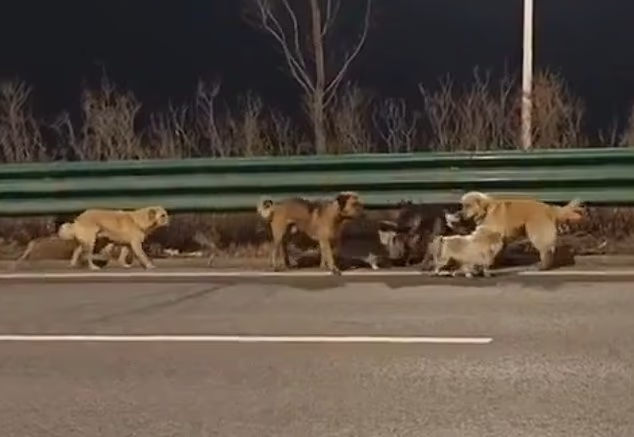
Heartwarming footage shows the moment seven dogs managed to escape a meat factory in China, before embarking on a 10–mile journey home together.

In what sounds like the plot of Homeward Bound, the dogs formed a ‘band of brothers’ and trotted down a busy highway in Changchun, Jilin province.

In the clip, the dogs surround an injured German shepherd, while a Corgi leading the pack repeatedly looks back to ensure none are left behind.

The group also included Golden Retrievers, Labradors and a Pekingese.

So, how did the muttley crew find their way home?

Studies have shown that dogs have a unique blend of homing instincts and keen sensory abilities.

Known for their sense of smell, dogs can sniff out objects or people up to 12 miles away.

Meanwhile, an internal compass helps them find their way over hundreds of miles by using magnetic fields.

Heartwarming footage shows the moment seven dogs managed to escape a meat factory in China , before embarking on a 10–mile journey home together

1. Sense of smell

While most humans rely on sight, scent is how dogs largely experience the world. 

In fact, studies have shown that dogs can sniff out objects or people as far as 12 miles away – suggesting their noses may have partially guided them home from the meat factory. 

‘Dogs are primed to detect smells,’ explained Jacqueline Boyd, a senior lecturer in animal science at Nottingham Trent University in an article for The Conversation. 

‘The average dog’s nose has more than 10 million scent receptors in their nose, compared to humans, who only have about 6 million.

‘This makes the canine nose more than 10, 000 times better at detecting scents than we are. 

‘They can detect minute quantities of scent. For example, forensic detection dogs can detect 0.01 microlitres of gasolene. A microlitre is one millionth of a litre.’

2. Magnetic homing powers

In what sounds like the plot of Homeward Bound, the dogs formed a 'band of brothers' and trotted down a busy highway in Changchun, Jilin province

In what sounds like the plot of Homeward Bound, the dogs formed a ‘band of brothers’ and trotted down a busy highway in Changchun, Jilin province

Aside from their powerful sense of smell, dogs also have a sensitivity to the Earth’s geomagnetic field that can guide them home. 

In 2020, researchers from the Czech University of Life Sciences tracked 27 dogs from 10 breeds over the course of three years.

They attached a GPS collar and camera mount to each dog, before periodically releasing them from their leashes during walks in a forest.

After being released, each dog ran deeper into the woods, and after a certain distance they were called back to their owners. 

At this point, they all did something unusual – they conducted what the researchers describe as a ‘compass run.’

The dogs completed a short dash of around 65 feet, closely tracking with the Earth’s north–south geomagnetic axis. 

According to the researchers this suggests that the dogs were using Earth’s geomagnetic field to orient themselves for the return trip.

‘It is unlikely that the direct involvement of visual, olfactory or celestial cues can explain the highly stereotyped and consistent ~north south alignment of the compass run,’ the researchers explained in a summary of their findings in the online journal eLife.

After completing the brief compass run, dogs used two main modes of navigation to return to their owners, a scent-driven method called 'tracking,' and a landmark and visual marker based method called 'scouting'

After completing the brief compass run, dogs used two main modes of navigation to return to their owners, a scent–driven method called ‘tracking,’ and a landmark and visual marker based method called ‘scouting’

‘For example, the forested habitat and dense vegetation of the study sites make visual piloting unreliable and, in many cases, not possible.’

After this initial compass run, the dogs worked their way back relying on two particular forms of navigation.

Around 59 per cent of the dogs switched to scent–based navigation (called ‘tracking’) while 32 per cent relied on physical landmarks and other visual information, described as ‘scouting’. 

Eight per cent of the dogs used a mix of tracking and scouting behaviors to make their way back to their owners.

HOW ANIMALS USE EARTH’S MAGNETIC FIELD TO NAVIGATE

Some animal species migrate around the world and travel vast distances. 

With some animals doing it every year, some several times a year and some only once in their lifetime to the same place they were first born or hatched.

A Bar-Tailed Godwit, for example, is a small bird which is only 15 to 16 inches long (37 to 41 cm) and every year migrates from Alaska to New Zealand. 

What is even more remarkable about this journey, is the fact that this bird does so without stopping. 

The journey is more than 7,000 miles (11,500 km) and the bird does snot stop once for food or water, relying only on its fat reserves.  

These birds are also incapable of soaring, meaning they have to flap their wings the entire time.  

Some birds, such as stalks, can soar for long periods of time, relying on warm air currents to stay aloft. 

These birds have also been shown to take fleeting naps of mere seconds whilst soaring on their journeys.

As to how they traverse such vast expanses, remains somewhat of a mystery. 

For years, experts have believed that birds use visual signs or the sun to navigate. 

Others speculated that a special organ in their beak allowed them to detect magnetic signals from the Earth. 

Marine animals such as some whales and sea-turtles also cover huge distances before returning to a specific point.

Theories ranged from sonar to magnetic field detection yet again but conclusive proof has remained elusive.  

The latest research has found, conclusively, that loggerhead sea-turtles do use the magnetic field of the Earth to navigate back to the same beach where they were hatched to reproduce. 

Source link

Tags: chinadailymailearthsciencetech
LJ News Opinions

LJ News Opinions

Next Post

Wild reporter Jessi Pierce deadly fire not intentional, officials say

Recommended

Nigeria vs Benin: World Cup qualifier – start time, team news and lineups | Football News

6 months ago

Northeast snowstorm causes travel delays and power outages for millions

4 months ago

Popular News

    Connect with us

    LJ News Opinions

    Welcome to LJ News Opinions, where breaking news stories have captivated us for over 20 years.
    Join us in this journey of sharing points of view about the news – read, react, engage, and unleash your opinion!

    Category

    • Business
    • Entertainment
    • Health
    • Opinions
    • Politics
    • Sports
    • Technology
    • U.S.
    • World News

    Site links

    • Home
    • About us
    • Contact

    Legal Pages

    • Privacy Policy
    • Cookie Privacy Policy
    • Terms of Use
    • Disclaimer
    • California Consumer Privacy Act (CCPA)
    • DMCA
    • About us
    • Advertise
    • Contact

    © 2024, All rights reserved.

    No Result
    View All Result
    • Home
    • U.S.
    • Politics
    • World News
    • Business
    • Entertainment
    • Sports
    • Technology
    • Health
    • Opinions

    © 2024, All rights reserved.