Most Americans know the U.S. became a country on July 4, 1776. But what many don’t realize, is that the American Revolution nearly ended just two months later, before a dense fog helped save the Continental Army. FOX Weather Senior Correspondent Robert Ray is in Brooklyn, New York, with more.
As the 250th birthday of the United States has officially passed, its history remains forever ingrained in our nation’s roots, as we look back at the events that took place and the help from allies that shaped it.
World War I was known as “the war to end all wars,” claiming the lives of 15 to 22 million people.
Weather played a role in the war in various ways, as battles were won and lost under different conditions.
Both England and the U.S. established meteorology programs within the military after discovering the major role it played in daily combat.
In 1915, a year into the war, the Meteorological Field Service, known as Meteor, conducted operations from British Headquarters in Montreuil, France, where two meteorologists, Ernest Gold and AEM Geddes, were granted temporary appointments to the general list as captain and lieutenant, respectively.
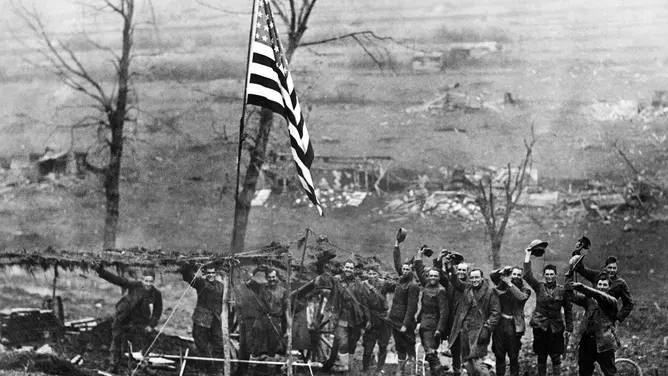
Gun from Battery D, 105th Field Artillery, showing American flag, hoisted after last shot was fired when the armistice took effect, Etraye, France, U.S. Army Signal Corps, November 11, 1918.
(Circa Images/GHI/Universal History Archive/Universal Images Group / Getty Images)
This operation became a 24/7 service for the first time, supported by the Meteorological Office in London.
Along with the demands of the war, the U.S. military was established within the Signal Corps, as commanders needed information to support anti-aircraft defenses, long-range artillery, aviation and general operational planning.
SUNKEN WWI SHIP ‘TAMPA’ FOUND OFF ENGLISH COAST, SOLVING CENTURY-OLD MYSTERY
The Army Signal Corps is responsible for communications and information systems that support all the armed forces.
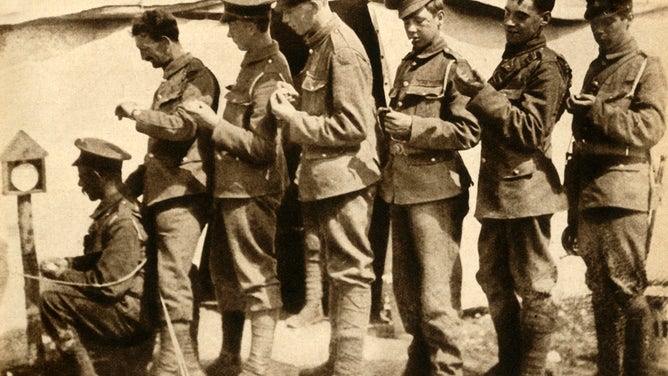
British soldiers synchronising their watches on the front line during World War I.
(The Print Collector / Getty Images)
They recruited experts outside the army to meet these needs and one individual, William R. Blair, received a commission as a major in the Signal Corps Officer Reserve and became the Chief of the Meteorological Service for the American Expeditionary Forces, according to the U.S. Army.
Throughout the four-year war, soldiers endured harsh conditions of torrential rain and sub-zero temperatures on the Western Front, conditions that significantly influenced the outcome of some battles.
THE WEATHER BEHIND D-DAY: HOW METEOROLOGISTS INFLUENCED OPERATION OVERLORD
A notable siege in which weather played a role was the Battle of Passchendaele, which took place from July 31 to Nov. 10, 1917, and was one of the bloodiest confrontations of World War I.
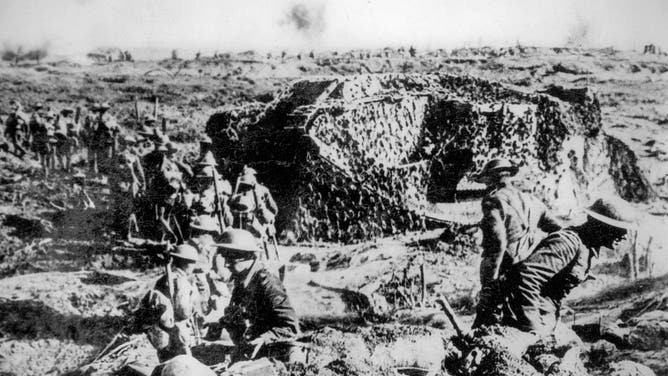
WWI British infantry soldiers and camouflaged tanks during the World War One Battle of Polygon Wood near Ypres. Ieper, West Flanders, Belgium in 1917.
(Arterra/Collection Philippe Clément/Universal Images Group / Getty Images)
This marked one of the wettest periods in 75 years along the western front, according to the United Kingdom Meteorological Office.
WOOL UNIFORMS AND EXTREME HEAT: A FIRSTHAND ACCOUNT OF WEATHER DURING THE BATTLE OF GETTYSBURG
Due to the heavy rain, artillery and tanks often got stuck in the liquid mud. Not to mention that the wet mud would cling to soldiers’ uniforms and get into their rifles, jamming them and making them useless.
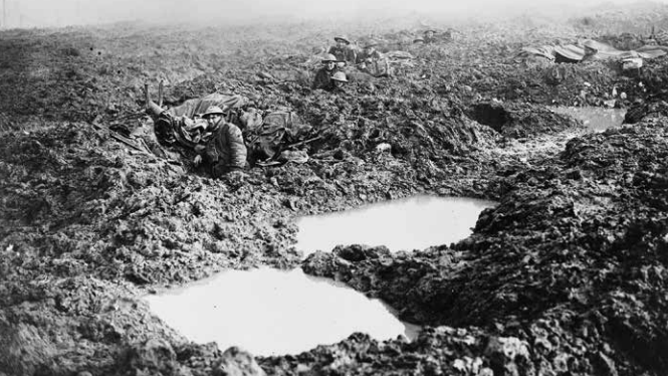
Soldiers set up around rain filled holes caused by artillery shells.
(© IWM / The Commonwealth War Graves Commission’s Tyne Cot Cemetery )
When soldiers would shoot artillery, the shell holes would fill with water due to days of persistent rainfall, and the mud would become so deep that some men and horses would get stuck and drown.
As a result of the relentless rainfall, forecasts became critical for planning military operations.
WHAT WAS THE WEATHER LIKE ON THE FIRST EVER INDEPENDENCE DAY IN 1776?
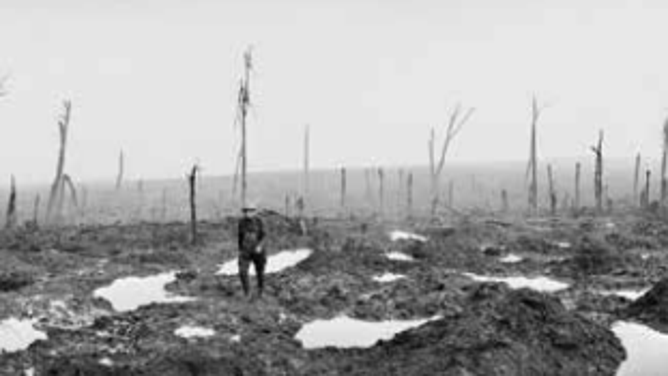
Water filled holes caused by heavy artillery during World War I.
(© IWM / The Commonwealth War Graves Commission’s Tyne Cot Cemetery )
When the weather finally improved in late September, aided by meteorologists’ precise forecasts of good and poor conditions, the Allies were able to gain an essential ridge of land in Northwest Belgium.
In total, the battle resulted in the casualties of around 275,000 British soldiers, including thousands of soldiers from Australia, Canada, and New Zealand, along with 70,000 dead, according to History.com.
CELEBRATING WEATHER HISTORY: HOW FOG HELPED GEORGE WASHINGTON SAVE AMERICAN INDEPENDENCE
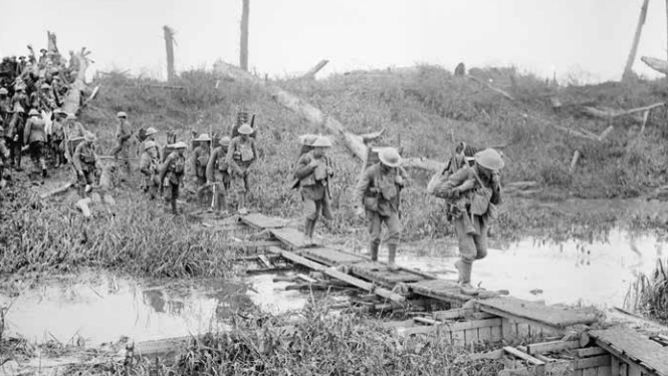
A wire carrying party cross a bridge during the battle of Pilckem Ridge, July 31, 1917.
(© IWM / The Commonwealth War Graves Commission’s Tyne Cot Cemetery )
The Germans, on the other hand, lost 260,000 men in one of the most costly and controversial Allied offensives of World War I.
THE MOST PATRIOTIC FRONT LAWN IN AMERICA CELEBRATES THE NATION’S 250TH WITH A BALD EAGLE MURAL
This is a prime example of how much weather played a role in one of the bloodiest battles in human history, and why meteorology has been essential to military operations ever since.