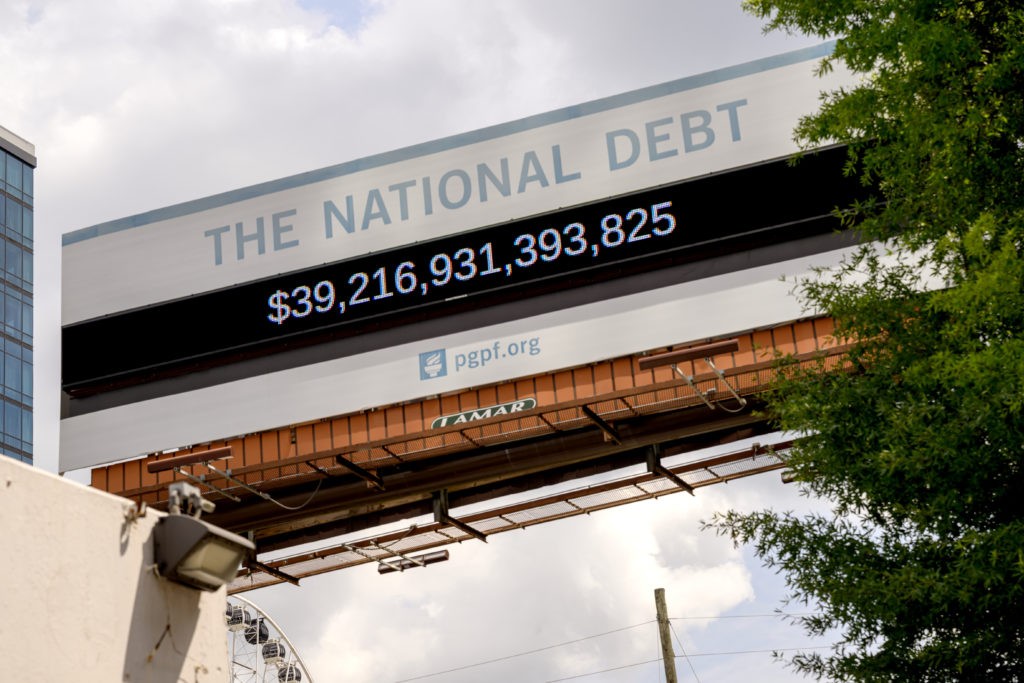
Total public debt hit $40 trillion Wednesday, faster than expected.
There is a lot to unpack about the national debt, which is easily misunderstood. Here’s a starter guide to what’s happening with the national debt right now.
What exactly does $40 trillion represent?
There are many ways to measure the national debt. This $40 trillion figure represents the total debt of the United States government. Also known as the “gross debt” (bonus as a double entendre).
This includes all the debt owed to others as well as what the government owes itself. Thus, it includes IOUs to the Social Security Trust Fund, from which the U.S. has borrowed for years.
How big is $40 trillion? More than the median value of every single-family home in America. It is, as you might expect, a massive figure.
How did we hit $40 trillion?
Watch the segment in the player above.
There are two primary reasons: unexpected economic shocks and political convenience.
This century, two major shocks have rocketed up the deficit: the 2009 recession and, starting in 2020, the COVID-19 pandemic. You can see these moments clearly in this chart from the U.S. Treasury, depicting the deficit increases around both events. (Deficits are the annual amount the U.S. government spends over what it brings in.)
Graphic by Treasury Department
But also look at the deficit levels after the pandemic, to 2023 and beyond. Deficits remained at higher levels than prior years. That is a question of political priorities and decisions in Washington. Both parties have repeatedly solved problems by spending money. And Republicans have cut taxes, which they argue helps the economy overall, but which at least in the short term can affect the revenue coming into the Treasury.
How does our debt compare with other countries?
U.S. debt is a cornerstone financial instrument around the world.
If we are to compare, we want to look at the debt in terms of the economy of each country, measured by gross domestic product (GDP). There are a few ways to calculate this, be aware. But here is the International Monetary Fund’s most recent estimates of gross national debt to GDP.
For the United States, our total government gross debt-to-GDP ratio is 125.8%, according to IMF’s tracker. In other words, our total debt is some 125% of what the nation produces in a year. We owe more than we can make in a year.
Just eight nations in the world have a higher debt-to-GDP figure than the U.S.
- Japan leads with 204 percent
- Singapore (172 percent)
- Sudan (169 percent)
- Bahrain (152 percent)
- Italy (138 percent)
- Greece (137 percent)
- Senegal (132 percent)
- Maldives (129 percent)
What is going on with Japan?
A few things. The Federal Reserve wrote about this last year. Japan’s economy has multiple challenges, including an aging population and years of a relatively stagnant economy.
If Japan can survive with higher government debt, shouldn’t that make us feel better?
Not really. Japan’s debt structure is notably different. Its debt is overwhelmingly held by its own domestic banks. Thus, there is less risk of outside investors panicking and selling the debt in a fiscal crisis. Here is a short story from Fortune that covers this as well as Japan’s higher household savings rate, which also helps it manage its debt.
What happens next?
After hitting the $40 trillion milestone, U.S. debt is now on track to reach $50 trillion in a few short years. It is already causing major issues in the bond market. The interest payments on the nation’s debt are already larger than what we spend on national defense or Medicare.
There are several groups urging Congress to start making tough decisions now – including the Committee for a Responsible Federal Budget (which offers an interactive “debt fixer” tool we love), the Cato Institute, the Peter G. Peterson Foundation and the Concord Coalition. If lawmakers do not start adjusting spending and revenues soon, those decisions will become harder.
The choice ahead for lawmakers is not an easy one: They must decide to make these tough decisions now or they can make deeply painful ones, with fewer options, later.