
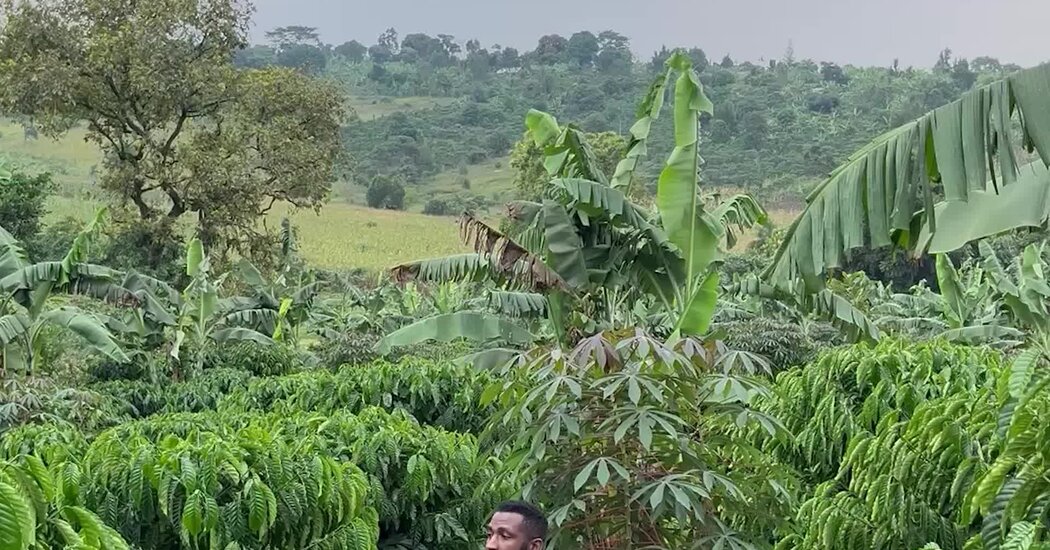
When Ernest Mwebaze, a tech developer in Uganda, was building an artificial intelligence system last year tailored for his country’s many languages, he tested American and Chinese tools to see which one could help.
China’s won.
The A.I. model from the Chinese internet giant Alibaba handled Uganda’s dozens of languages better than anything from Meta or Google, Mr. Mwebaze said. It was also inexpensive, and he could customize the model with his own data.
“We want to build things as cheap as possible, yet have them work really well,” said Mr. Mwebaze, a former research scientist at Google. His system, called Sunflower, is now used across Uganda, including by farmers to receive weather information and crop advice in local dialects.
Mr. Mwebaze, 47, is one of thousands of developers across Africa who have turned to Chinese A.I. models in the past year. In Kenya, entrepreneurs are using the models to streamline legal and business services. In Nigeria, they have made educational tools that teach high school students. In Ghana, developers are building local chatbots.
China’s A.I. is surging, especially in developing countries, as people look for the best possible system at the lowest possible cost. Unlike models made by the leading American A.I. companies OpenAI and Anthropic — which are closed and charge fees — the Chinese systems are publicly available to download and modify without payment or approval.
Chinese “open-source” models account for roughly half of total A.I. use on OpenRouter, a service with 400 A.I. models for users to choose from, up from less than 25 percent a year ago, according to a New York Times analysis of data from eight million customers. Chinese models are also 19 of the 25 most downloaded open-source systems on Hugging Face, another A.I. database.
In more than two dozen interviews across Kenya, Uganda and other countries, developers, policymakers and executives described a rapidly changing A.I. market where cost, computing resources, data control and customization mattered more than where a model was made. Often they were not looking for bleeding edge A.I. They just wanted something that worked well enough on limited resources.
Using Chinese models was like owning a house while using U.S. models was like renting one, they added. Rather than spending millions to train a model from scratch, developers can download a Chinese system and build an entirely new product on top of it, paying mainly for servers. In contrast, U.S. models are a one-size fits all technology, needing subscriptions and other fees depending on the job.
“Why use an expensive Ferrari to do the school run when a Toyota hatchback can do the same?” said Moses Kemibaro, a Nairobi entrepreneur who runs a digital marketing agency, Dotsavvy, adding that Chinese models can be up to 90 percent less expensive when including costs like computing infrastructure.
Chinese officials hope their gains in Africa are a preview of things to come. Last month, powerful new Chinese A.I. systems rattled Wall Street and Silicon Valley, stoking fears in Washington that U.S. tech dominance could be undercut.
Xi Jinping, China’s leader, is using A.I. as a form of soft power. At a July conference in Shanghai, he cast Chinese models as more reliable and cheaper and warned that A.I.’s benefits must be shared or they would create “new historical injustices.” Kenya, Ethiopia, South Africa and seven other African countries signed an A.I. pact with China at the event to promote international cooperation.
Chinese firms are also courting African developers with free computing and hands-on engineering help, developers said. Many Chinese-made smartphones in Africa come with Chinese A.I. tools preinstalled.
At the same time, China’s A.I. industry faces challenges. Companies have struggled to make money from their users and face security questions about data and links to Beijing. Many African developers still pay for American A.I. models, especially for technical tasks like coding.
Yet Africa’s experience shows the global A.I. competition is now a two-horse race.
Kamal Budhabhatti, the chief executive of Craft Silicon, a Nairobi banking software company, feels the pull of both sides. He recently rebuilt his firm’s tech systems with Claude Code, Anthropic’s programming tool. A 10-person team finished in half the time a project that once took 100 engineers. The bill was high, he said, but the speed was worth it.
Huawei, the Chinese tech giant, also came calling with “some very unbelievable incentives” to switch to Chinese systems, he said, including a year of free computing and a trip to the company’s headquarters.
“It’s very hard to say no,” Mr. Budhabhatti said.
The China Model
About 50 miles southeast of Nairobi, one of Kenya’s biggest collaborations with Chinese technology sits half-finished on the savanna.
Konza Technopolis, a planned city, was announced 18 years ago as Kenya’s answer to Silicon Valley. Hopefully branded the Silicon Savannah, it is now a grid of empty boulevards and skeletal buildings, watched over by a powerful Chinese surveillance system.
It would look like a failed experiment but for one slate-gray building behind an electric fence. Financed by Chinese loans and built by Huawei, the site is a data center that runs computing for Kenya’s government.
For two decades, Chinese firms have wired Africa’s telecommunications networks and paved its roads. M-Pesa, Kenya’s celebrated mobile-money system, runs on Huawei technology.
These tech ties gave China a foothold in the continent, which it is using to sell A.I. One project advertised at Konza will use technology from the Chinese A.I. firm DeepSeek to combat telecom fraud.
Locked out of advanced chips because of U.S. export controls, Chinese companies could not outspend Silicon Valley. So they gave their A.I. models away as open source, hoping to pull people from U.S. rivals.
At first, it seemed a losing bet. The United States dominated open-source A.I. Meta offered a model called Llama that developers used worldwide. But after some stumbles, Mark Zuckerberg, Meta’s chief executive, turned more to closed models.
“It left a huge hole,” said Lucas Atkins, co-founder of Arcee A.I., an American start-up that builds open models. “It allowed the Chinese to explode into the vacuum.”
Breakthroughs came quickly. In December 2024, a DeepSeek A.I. model matched the best models at a fraction of the cost. Last month, the Chinese A.I. lab Moonshot AI released a model with coding abilities approaching the leading American systems.
In Kenya, developers embraced Chinese models.
Michael Michie builds A.I. systems for Kenyan banks and government agencies at EverseTech. His customers are price sensitive, so he makes almost everything on Chinese open-source models. Businesses want the cheapest way to use the technology, not the most advanced, he said.
“I don’t think people should worry so much about who built it,” he said. “The focus should be, does it deliver the capability you need?”
Sentai Simons, a start-up founder in Nairobi, downloaded Chinese models to build a product that turned paper legal records into searchable databases. He customized the system with about one million legal files.
His product, JibuDocs, ended up about 140 gigabytes in size — smaller than many iPhones — and cost about $25,000 to create and maintain. Using a service like Anthropic’s Claude, he said, would have cost more than $1 million.
“It’s absolutely the difference between having a business and not having a business,” he said.
Many developers said Chinese companies treated them like a priority, while U.S. firms were hardly present.
Ahmet Acar, a former principal adviser at Amazon Web Services who lives in Nairobi, said joining a developer program from Anthropic required a lengthy screening. Alibaba’s took minutes.
“With the Chinese, it was like: ‘Hey, are you able to do this? Are you located here? All right, man, go have fun,’” he said.
(The New York Times has sued OpenAI and Microsoft, claiming copyright infringement of news content related to A.I. systems. The two companies have denied those claims.)
Wake Up Call
In a Nairobi high-rise in June, a top Kenyan civil servant for technology said he was surprised when Anthropic pulled access to Fable, its powerful model, at the Trump administration’s behest.
It was a “wake up call” to the world, said John Tanui, the principal secretary in Kenya’s Ministry of Information, Communications and the Digital Economy. The abrupt move was a warning that relying on U.S. models could pose risks, he said.
A former Huawei employee who once led the Konza Technopolis project, Mr. Tanui said China and the United States had pressed Kenya to pick a side. He intends to take from both.
“We don’t lean on West or East,” he said.
Being in the middle is tricky. Developers are building systems controlled elsewhere, which means the technology can be yanked, altered or re-priced without warning. Some worry about dependence on the United States. Others do not trust China.
Mr. Budhabhatti of Craft Silicon said he was considering Huawei’s offer of generous subsidies, but was also cautious. Many of his customers are international banks that could demand their software not use Chinese hardware.
Chinese models, too, have not always been reliable. Shikoh Gitau, the founder of the Nairobi start-up Qhala, recalled when DeepSeek went dark in China before the country’s college entrance exams in 2024. It was to deter cheating, but it also disrupted African businesses like hers. Now American models could vanish because of a White House decision.
“At least with China’s models, I can download it on my computer and run it,” she said.
Others have been burned by A.I. politics. Mr. Mwebaze’s Ugandan chatbot service, Sunflower, ran into trouble when a researcher at China Media Project, an independent media research group, asked it about China. Sunflower described China as a democracy and sidestepped questions about the country’s economic and environmental impacts in Uganda.
Chinese state media praised Sunflower, and Huawei contacted Mr. Mwebaze about using its cloud services.
Mr. Mwebaze, whose nonprofit organization, Sunbird AI, is dedicated to A.I. for social good, was unnerved by the experience. He is now using Google’s open-source model, Gemma, to create a product aimed at smartphone users.
“We need to make sure we’re not on the wrong side of geopolitics,” he said.
America Strikes Back
For all of China’s momentum, much of the A.I. money in Kenya still flows to U.S. companies.
Everyday users are on U.S. systems like ChatGPT and Claude. One 2025 survey found that 42 percent of Kenya’s 23 million internet users had used ChatGPT in the previous month, among the highest rate in the world.
Even Chinese models earn Americans money. Kenyan companies often run Chinese open-source models on cloud services from Amazon and Microsoft, so the U.S. giants make money from their data centers that deliver the technology to customers.
The U.S. advantage was clear in a concrete building in Nairobi’s industrial district, where binders of paper purchase orders lined dark offices for Chandaria Industries, one of Kenya’s largest makers of toilet paper, soap and home goods.
For decades, orders arrived from supermarkets by email or on paper, and clerks keyed them in line by line. An order could take hours to process.
Chandaria recently hired Sanifu, a Kenyan start-up that uses A.I. to streamline business processes, for help. Sanifu uses OpenAI’s models for precision and reliability.
Sanifu’s digital system based on those U.S. models has transformed Chandaria. “Where an order took about two hours to process, that now takes less than 10 minutes,” said Neer Chandaria, who helps run the family firm. Four clerks who once typed in orders now audit the A.I.’s work.
But Sanifu is being courted too. On LinkedIn this year, a Singaporean employee of the Chinese internet firm ByteDance offered Sanifu’s founders access to its A.I. model.
ByteDance’s model was not accurate enough, but the courtship made an impression, said Bernard Momanyi Nyagaka, a co-founder of Sanifu. Nothing like it comes from the American labs.
And Chinese models keep improving, Mr. Nyagaka said.
“If you look at how fast they’re catching up with the American models, it’s really, really fast,” he said.
Edwin Okoth contributed reporting from Nairobi, Kenya.


