
Nick Schifrin:
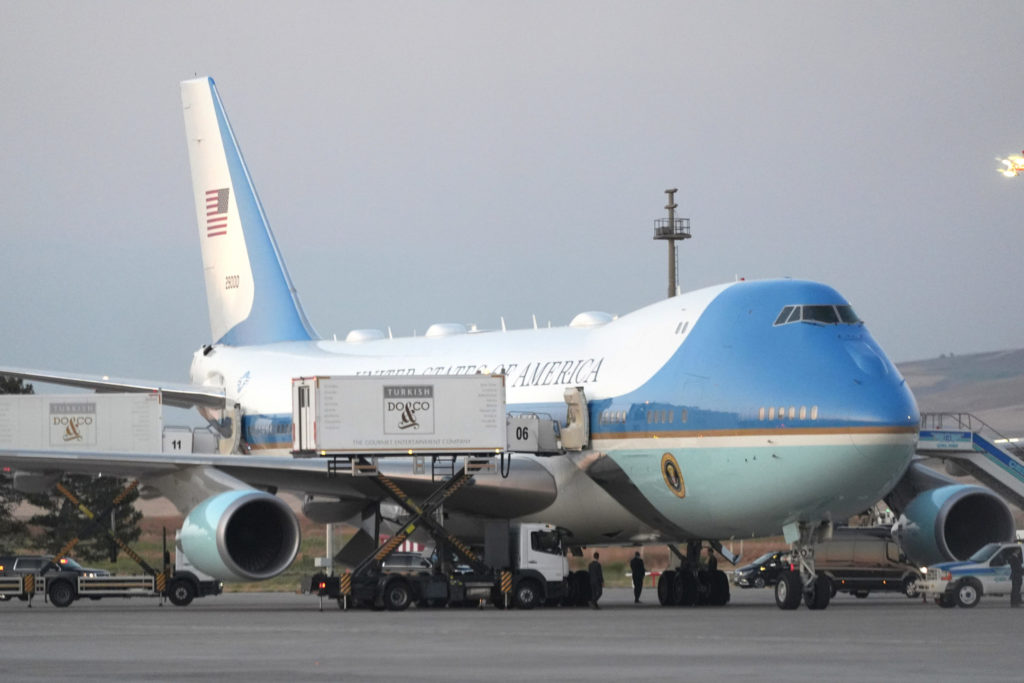
As he finished his trip to the Ankara NATO summit last month, President Trump swept aside a question about why he wasn’t flying home on the plane on which he’d arrived, a Qatari-gifted 747.
Question:
Why aren’t you flying on the new Air Force One?
President Donald Trump:
It’s flying to Europe to one of the big bases, two or three of the big bases, where we can show it to the people. And we will be going home by normal methods.
Nick Schifrin:
His journey home only appeared normal. At 8:24 p.m. local that evening, President Trump boarded the legacy Air Force One. He turned around, gave a wave to the cameras, broadcasting his departure live, and disappeared behind the closed door, which is when the camera zooms out, but doesn’t focus on that catering truck.
It was parked on the other side of the plane near another catering truck at the level of the doors to let food in or sneak the president out. And six minutes later, at 8:30 p.m. local, the truck that usually caters to the president now secretly carrying him.
It backs up away from Air Force One toward another U.S. government plane parked behind, unbeknownst to the press corps. The other plane, an Air Force C-32A usually reserved for the secretary of defense or other senior officials, but not the president.
At 8:
44 p.m. local, the legacy plane takes off without the president, who was in fact still on the ground in the smaller plane, as the camera focuses on the plane that had become a decoy, flying to the United Kingdom’s Mildenhall Royal Air Force Base.
When the legacy Air Force One landed there, it took the president 40 minutes to disembark, apparently the time it took him to land in the smaller plane and secretly move onto the legacy plane and walk down the steps as if nothing had happened.
He then walked to the new Qatari-gifted plane, where on board he told journalists there was nothing unusual going on.
Question:
So, you’re saying there wasn’t a security concern?
Donald Trump:
No, no.
(Crosstalk)
Question:
Were you aware of any credible threat by Iran against Air Force One?
Donald Trump:
Well, I have a threat all the time. I’m number one on their list before you. But if I go, you go, right?
Nick Schifrin:
But we now know, in the four hours it took for the legacy Air Force One to fly from Turkey to the United Kingdom, the president was not on the plane. Instead, it was full of staff and journalists, despite a threat from Iran deemed credible enough to convince the Secret Service, Geoff, to use the plane as a decoy.
Geoff Bennett:
And, Nick, tell us more about this threat from Iran.
Nick Schifrin:
This threat existed well before this year and this war.
Iran has threatened to assassinate President Trump and other former senior officials ever since President Trump ordered the killing of Qasem Soleimani, the former powerful head of the Quds Force. You see his assassination there in Baghdad in 2000. He was responsible for militias and terrorism as part of the Islamic Revolutionary Guard Corps.
The threat was deemed credible enough against President Trump and these former senior officials that they received additional security details, not only in 2000, but through the Biden administration, in fact, until President Trump removed some of those details.
And Iran has followed through on other threats in the decades prior. Now, as for the last — the threat last month in Turkey, we don’t know the specifics, but I talked to former officials today who said, for the Secret Service to take this step, it would have been serious, reliable, and well-sourced, part of a stream of ongoing intelligence or some kind of recent walk-in.
Take a listen to Mike Matranga. He’s a former Secret Service agent, now the head of M6 Global Defense.
Michael Matranga, Former U.S. Secret Service Agent:
Obviously, there was credible intelligence that a threat was imminent, which is what caused the United States Secret Service and other entities, to include the United States military, to make this decision to pull off this ruse.
This is specifically coming from the administration of Iran saying, we want to assassinate the president of the United States, and so we have got to take this very serious. And all of these measures that the men and women of the United States Secret Service and DOD are taking are absolutely appropriate.
Nick Schifrin:
As Matranga puts it, this has been a powder keg for decades for the Secret Service, given Iran’s threats.
Geoff Bennett:
Now, how unusual is it for the Secret Service to turn Air Force One and its passengers, to include White House staff, the traveling press, into a decoy?
Nick Schifrin:
As far as we know, the decoy fact of that question, it has only happened once before. In 2000, President Bill Clinton landed in Islamabad, you see there, in an unmarked plane after Air Force One had landed and a body double who looked like Clinton got off of Air Force One.
Geoff, though, if you go beyond decoys, to include feints or secret trips like George W. Bush’s to Iraq, see the Secret Service has taken steps like that before. As for questions today of the vulnerability of those people who did fly on Air Force One without President Trump, Matranga said the bottom line is, the Secret Service had to make a trade-off.
Mike Matranga:
I don’t think that anybody intentionally put the anchors or anyone else, the White House press corps, in harm’s way, but that was a risk that had to be weighed. And at the end of the day, we have to look at continuity of American government.
And, quite frankly, I don’t know how to say this but just to say it, is that the president of the United States is more important than every single person on that plane.
Nick Schifrin:
More important than every other person.
Again, Geoff, all credit to The Washington Post, who broke this story.
Geoff Bennett:
Indeed.
While I will have you, let’s switch topics, because Russia released Marine veteran Robert Gilman today. We reported on his story last night on this broadcast. Bring us up to speed.
Nick Schifrin:
Russia released Gilman on humanitarian grounds. The 32-year-old is a former Marine who went to Russia to teach English. He was first arrested in 2022 for allegedly hitting a Russian police officer and was sentenced to 4.5 years, but his sentence was extended to a decade.
His family and advocates, including those you spoke to last night, said his health was badly deteriorating. He was nonresponsive, unable to interact or eat, essentially catatonic. Senator Ed Markey of Massachusetts even accused Russia of torturing him.
But, today, he was released after 1,666 days of detention. You see him there on the left with his mother right next to him on an American plane. Gilman’s on his way now to a U.S. military hospital in Texas, where he will be assessed and treated.
Global Reach says that he cannot talk — cannot walk, rather, but was speaking,. And the president actually, who spoke to him today, said he even asked for a cheeseburger on the phone.
The Trump administration says that there was no prisoner swap, nor — quote — “any other concessions” given to Russia. But I did talk to U.S. officials today about one other aspect. They said that shortly before his release, he was declared wrongfully detained. That is something, of course, that you heard from last night the family and advocates were complaining that that hadn’t happened.
They had not made that public, for fear that it would imperil this release. But U.S. officials say, yes, he has been declared wrongfully detained, and that will open more treatment for him now that he’s home and free.
Geoff Bennett:
Certainly good to see him released.
Nick Schifrin, thanks so much for this reporting.
Nick Schifrin:
Thank you.


