Amna Nawaz:
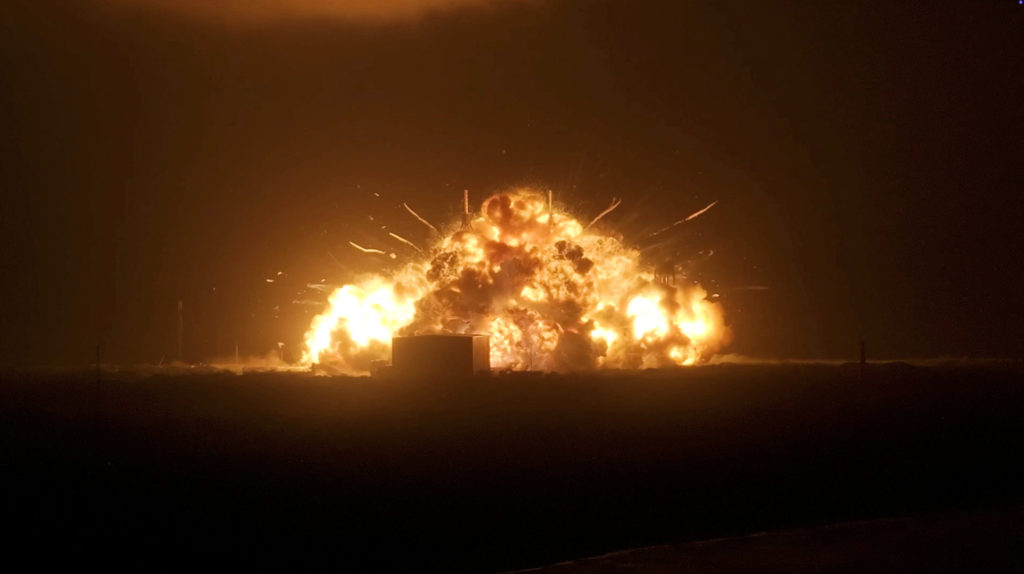
Last night, Blue Origin’s New Glenn rocket exploded on the launchpad during a test in Cape Canaveral, Florida. The company, owned by Jeff Bezos, said no one was injured and all personnel were accounted for.
But the rocket has a crucial role in NASA’s Artemis program to return American astronauts to the surface of the moon.
Here to walk us through what happened and its significance is our science correspondent, Miles O’Brien.
Miles, it’s always good to see you.
This was a massive explosion, though. The company said there was an anomaly during a test. What happened?
Miles O’Brien:
You might call that a euphemism, Amna, anomaly.
Yes, that was a major malfunction, for sure, and quite an impressive sight. First of all, let’s be clear. Nobody got hurt. Everybody was a long way away from this rocket as they were conducting what they call a hot-fire test, which is light up the engines, but don’t release the rocket. See how everything goes.
Obviously, things did not go well. They will investigate it. They will figure out what it is. Was it one of the engines? Was it something else? A lot of plumbing has to work well on a rocket in order for it to fly safely.
But crucially here, Amna, the issue is the destruction of the launchpad. That is a big deal, because they are complicated structures. It takes time to build them and to certify them, at least a year, maybe 15 months to build a new one.
And this is the only launchpad that the New Glenn rocket has to get to space.
Amna Nawaz:
And we should remind folks this was a Blue Origin rocket. The head of its competitor, SpaceX, Elon Musk, posted on X: “Sorry to see this. I hope you recover quickly.”
But, also, SpaceX’s Starship program had its own problems recently, right, Miles? Tell us about that.
Miles O’Brien:
Yes, a week ago.
Space is hard. Amna. We have said this many times. The Starship flew its 12th flight and underperformed yet again. In this case, the booster, which carries the ship to, in this case, near-orbit, as it came down, it basically lost control. And the FAA gets very concerned about that, because they’re concerned about public safety.
And if engines do not fire, and if it does not return in a controlled way, they declare it a mishap, which is what happened in this case. And so the Starship vehicle is also nonoperational now. So these two big vehicles that the commercial players are trying to build right now can’t do anything for NASA.
Amna Nawaz:
So what does all this mean for that Artemis program we mentioned, NASA’s effort to return astronauts to the moon?
Miles O’Brien:
Well, as you know, the astronauts are flying on the government rocket, the Space Launch System, which we saw fly around the moon not too long ago and enjoyed that.
But once the astronauts get into space, they are relying on the Starship and the New Glenn to get cargo down to the surface of the moon and ultimately get astronauts down there. The Starship will be modified to be a lunar lander, and New Glenn will carry a lander called Blue Moon, which will carry cargo and eventually, it is hoped, people.
So these are integral to the Artemis program and, in this case, could really slow down the process of getting Artemis back on track.
Amna Nawaz:
We have seen big setbacks here. They have — NASA’s been talking about another spaceflight mission, the next Artemis III mission, in 2027, and even talking about a sustained presence on the moon, a lunar base. What do these setbacks mean for those plans?
Miles O’Brien:
Yes, big plans, tight deadlines, and now not an operational heavy-lift vehicle in sight. So this is not a good equation.
Artemis III is supposed to fly about a year from now. It’s going to take at least a year, probably more, just to build a new launchpad for that New Glenn rocket, which is supposed to loft into space a lander, a moon lander, built by Blue Origin, which would rendezvous with the Artemis III Orion capsule.
Meanwhile, Starship not operational either. They have a lot of work to do before they’re going to be ready for that rendezvous mission as well, so a setback right there. But when you think about it, they’re talking about building a moon base there.
And, ultimately, this would involve hundreds of launches of these heavy-lift rockets, and nothing is operational right now. So, thinking about a moon base right now seems a little bit like the cart before the horse.
Amna Nawaz:
That’s our science correspondent, Miles O’Brien.
Miles, thank you so much. Great to speak with you.
Miles O’Brien:
You’re welcome, Amna.