The historic lunar flyby Artemis II mission is over. The crew splashed down in the Pacific Ocean on Friday night, and the crew is reportedly doing well.
The record-setting Artemis II mission came to an end on Friday evening after a textbook splashdown and a successful journey to the moon and back.
The crew journeyed 694,481 miles total on the mission, becoming the first humans to ever go that far into deep space, and the first astronauts to make it to the moon in more than 50 years.
During the 10-day mission, the crew and NASA provided some incredible photos, showing the world the moon and Earth in a way no one has ever seen.
NASA’s Orion spacecraft with Artemis II crewmembers NASA astronauts Reid Wiseman, commander; Victor Glover, pilot; Christina Koch, mission specialist; and CSA (Canadian Space Agency) astronaut Jeremy Hansen, mission specialist aboard is seen as it lands in the Pacific Ocean off the coast of California, Friday, April 10, 2026. NASA’s Artemis II mission took Wiseman, Glover, Koch, and Hansen on a 10-day journey around the Moon and back to Earth. Following a splashdown at , NASA, U.S. Navy, and U.S. Air Force teams are working to bring the crewmembers and Orion spacecraft aboard USS John P. Murtha. Photo Credit: (NASA/Bill Ingalls)
(NASA/Bill Ingalls / NASA)
3, 2, 1… liftoff!
It all started on April 1, when NASA Astronauts Reid Wiseman, Victor Glover, Christina Koch and Canadian Space Agency Astronaut Jeremy Hansen, lifted off from Kennedy Space Center aboard the Orion spacecraft they named “Integrity” and the SLS rocket, which carried them into space.
ARTEMIS II BRINGS PIECES OF THE PAST ON ITS HISTORIC DEEP SPACE VOYAGE
NEXT STOP, SPACE 🚀: Artemis II is roaring into space on a mission to make history after liftoff from Kennedy Space Center in Florida. This is humanity’s return to deep space, and a the beginning of a bold journey around the Moon. Stay locked with FOX Weather for every second of this historic mission.
The next hours were spent completing necessary engine burns to get the crew onto the correct path to complete a day of high-earth orbit prior to a translunar injection burn, putting them on course for the moon.
The crew and Mission Control at Johnson Space Center in Houston conducted tests on Orion to ensure its life systems capability, and troubleshooted a toilet issue with the crew.
Flight Day 2: On the way to the Moon
On April 2, Orion completed its translunar injection burn.
The astronauts also utilized their flywheel exercise device for the first time. Astronauts in space are required to do daily exercise, as the zero-gravity environment can cause muscle and bone loss.
NASA’S ARTEMIS PROGRAM: PAVING THE WAY FOR HUMANKIND’S RETURN TO THE MOON AND BEYOND
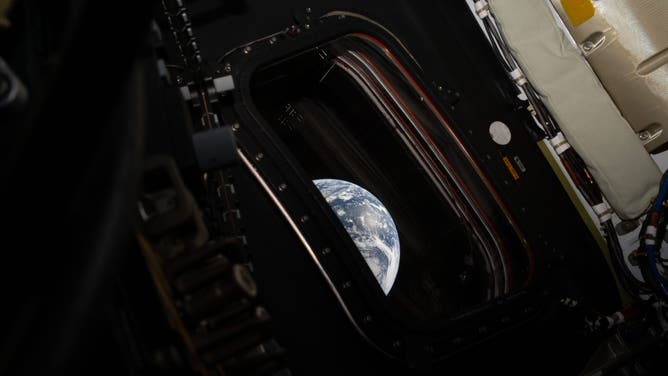
A view of Earth taken by NASA astronaut and Artemis II commander Reid Wiseman from one of the Orion spacecraft’s four main windows after completing the translunar injection burn on April 2, 2026.
(Reid Wiseman/NASA / FOX Weather)
Flight days 3, 4 & 5: Preparing for lunar flyby
The next few days were action-packed for the crew. They spent time preparing their cabin for the lunar flyby that took place on flight day 6, as well as doing other things necessary for the science of the mission.
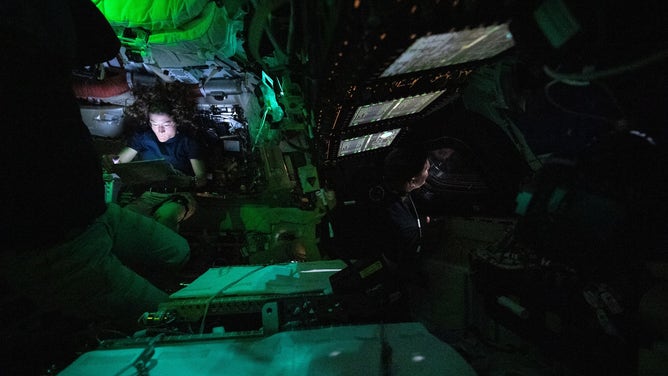
April 3, 2026: Astronaut Christina Koch is nestled into a corner of the Orion crew capsule, reading. The rest of the capsule is dark, but her face it lit by the glow from her tablet. Two of her other crew members can dimly be seen looking out the window and floating in the foreground
(NASA)
Mission specialists Christina Koch and Jeremy Hansen did a manual piloting demonstration of Orion to provide engineers with more data about the spacecraft’s piloting capabilities.
Additionally, the crew tested the Orion Crew Survival System Suits. They conducted a full sequence of suit operations, including putting on and pressurizing their suits, performing leak checks, simulating seat entry and assessing mobility and their ability to eat and drink, according to NASA.
HOW LIGHTNING STRIKING APOLLO 12 FOREVER CHANGED NASA’S LAUNCH WEATHER POLICIES
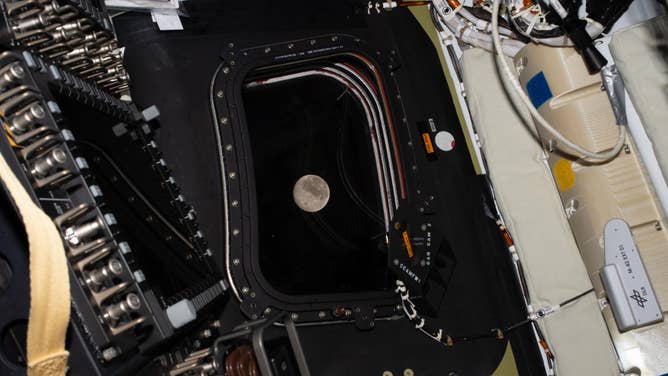
Before going to sleep on flight day 5, the Artemis II crew snapped one more photo of the Moon, as it drew close in the window of the Orion spacecraft. Orion and the four humans aboard entered the lunar sphere of influence at 12:37 a.m. EDT on April 6, at the tail end of the fifth day of their mission. That marked the point at which the Moon’s gravity had a stronger pull on the spacecraft than the Earth’s
(NASA / NASA)
Flight day 6: Historic lunar flyby
On Monday, April 6, the Artemis II crew made history, going deeper into space than any ever had as they completed the lunar flyby.
Stunning visuals came out of their time flying around the moon on flight day 6.
-
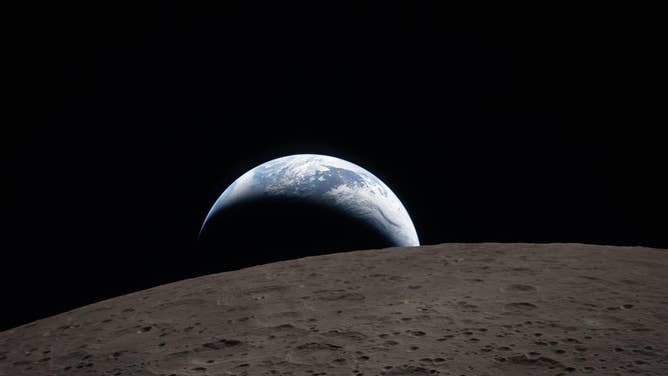
(April 6, 2026) – Earthset captured through the Orion spacecraft window at 6:41 p.m. EDT, April 6, 2026, during the Artemis II crew’s flyby of the Moon. A muted blue Earth with bright white clouds sets behind the cratered lunar surface. The dark portion of Earth is experiencing nighttime. On Earth’s day side, swirling clouds are visible over the Australia and Oceania region. In the foreground, Ohm crater has terraced edges and a flat floor interrupted by central peaks. Central peaks form in complex craters when the lunar surface, liquefied on impact, splashes upwards during the crater’s formation.
(NASA) -
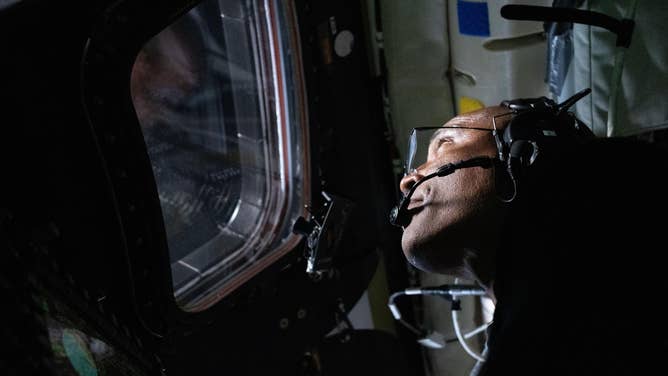
(April 6, 2026) – NASA astronaut and Artemis II Pilot Victor Glover pictured here in the Orion spacecraft during the Artemis II lunar flyby.
( ) -
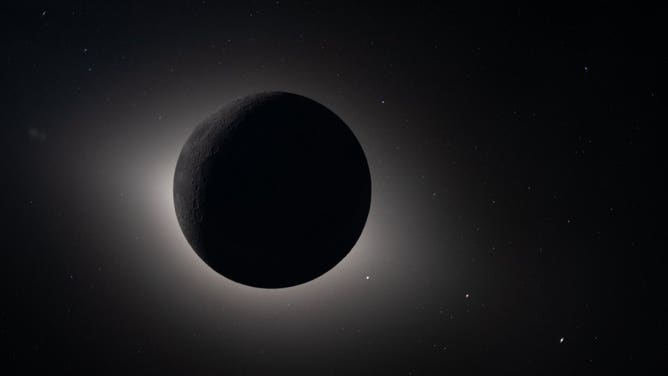
Captured by the Artemis II crew during their lunar flyby on April 6, 2026, this image shows the Moon fully eclipsing the Sun.
(NASA) -
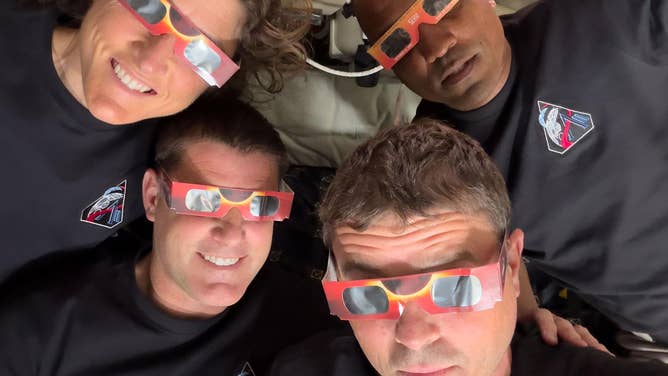
April 6, 2026) – The Artemis II crew – Mission Specialist Christina Koch (top left), Mission Specialist Jeremy Hansen (bottom left), Commander Reid Wiseman (bottom right), and Pilot Victor Glover (top right) – uses eclipse viewers, identical to what NASA produced for the 2023 annular eclipse and 2024 total solar eclipse, to protect their eyes at key moments during the solar eclipse they experienced during their lunar flyby. This was the first use of eclipse glasses at the Moon to safely view a solar eclipse.
( ) -
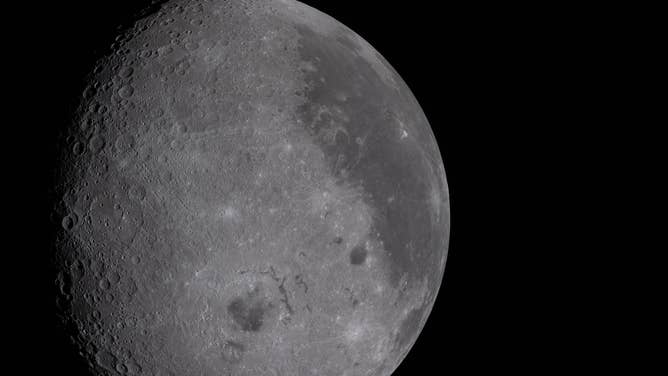
April 6, 2026) – On the first shift during the lunar flyby observation period, the Artemis II crew captured more than two-thirds of the Moon showcasing the intricate features of the nearside.
( ) -
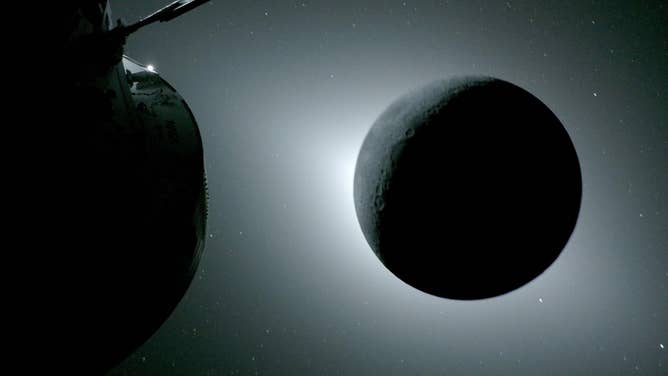
(April 6, 2026) – The Moon, seen here backlit by the Sun during a solar eclipse on April 6, 2026, is photographed by one of the cameras on the Orion spacecraft’s solar array wings. Orion is visible in the foreground on the left. Earth is reflecting sunlight at the left edge of the Moon, which is slightly brighter than the rest of the disk. The bright spot visible just below the Moon’s bottom right edge is Saturn. Beyond that, the bright spot at the right edge of the image is Mars.
( ) -
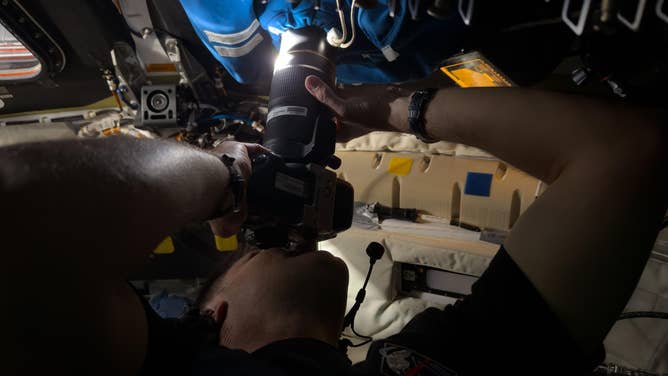
(April 6, 2026) – Astronaut Jeremy Hansen captures an image through the camera shroud covering window 2 of the Orion spacecraft.
( ) -
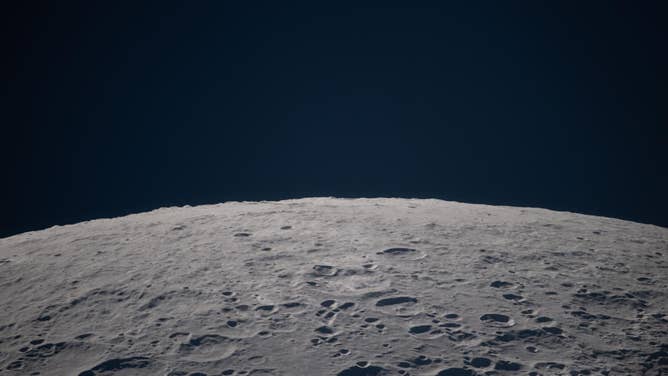
(April 6, 2026) – As the Artemis II crew passes the Moon during an observation period, the lunar landscape sharpens into focus: a terrain scattered with craters and shadows stretching beneath the black expanse of space.
( )
The crew entered a 40-minute communications blackout with Mission Control in Houston when they reached the far side of the moon, using that time to make detailed observations of geologic features on the lunar surface.
During their lunar flyby, they also witnessed a solar eclipse, and became the first people to wear solar eclipse glasses at the moon.
Flight Days 7, 8 & 9: Heading home and preparing for splashdown
Following the lunar flyby, the crew began their journey home.
On Day 7, the Artemis II team had a call with NASA’s Expedition 74 on the International Space Station. The call lasted 15 minutes, and the two teams spoke together about their meals and activities on the mission.
10 IMPORTANT ROCKET LAUNCHES IN THE HISTORY OF THE US SPACEFLIGHT
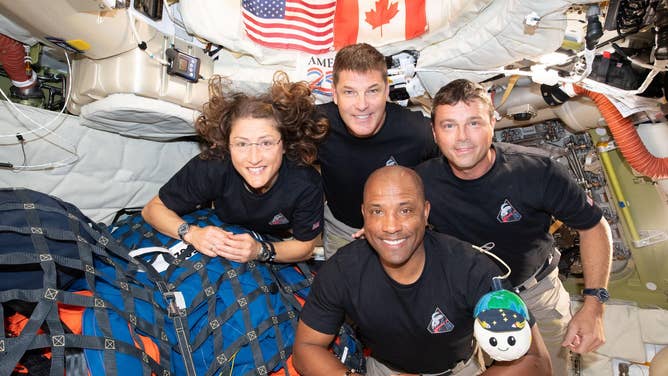
April 7, 2026) – The Artemis II crew – (clockwise from left) Mission Specialist Christina Koch, Mission Specialist Jeremy Hansen, Commander Reid Wiseman, and Pilot Victor Glover – pause for a group photo with their zero gravity indicator “Rise,” inside the Orion spacecraft on their way home.
(NASA)
On Flight Day 8, pilot Victor Glover and Commander Reid Wiseman had the chance to complete more manual piloting demonstrations aboard Orion.
The crew also had media availability, where news outlets were able to speak to the crew directly and ask them questions.
IS NASA CONSIDERING RECLASSIFYING PLUTO AS A PLANET IN OUR SOLAR SYSTEM?
They also tested their orthostatic garments which go under their spacesuits.
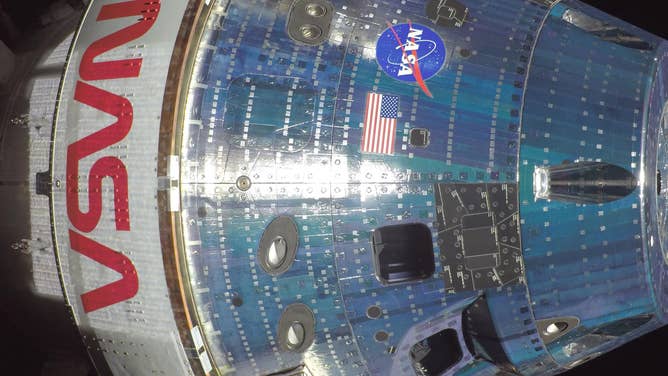
(April 7, 2026) – NASA’s Orion spacecraft is pictured here from one of the cameras mounted on its solar array wings. At the time this photo was taken at 8:33 a.m. ET, the Artemis II crew was in a sleep period ahead of beginning their seventh day into the mission.
(NASA)
On Flight Day 9, the crew began their final preparations for splashdown, including configuring their cabin.
Flight Day 10: Splashdown!
The final day of the Artemis II mission began with the crew waking up at 11:35 a.m. ET. They spent the first few hours of their day readying their cabin for splashdown, completed their final return trajectory correction burn and then got busy as the final few hours of the mission commenced.
The crew module separated from the service module right before entering Earth’s atmosphere. The Orion spacecraft did a final raise burn to lock in the final trajectory of splashdown.
NASA PAUSES GATEWAY LUNAR-ORBIT SPACE STATION TO BUILD LUNAR BASE ON THE MOON

AT SEA – APRIL 10: NASA astronaut Victor Glover, Artemis II pilot, left, and NASA astronaut Christina Koch, Artemis II mission specialist are seen sitting on a Navy MH-60 Seahawk from Helicopter Sea Combat Squadron (HSC) 23 on the flight deck of USS John P. Murtha after they and fellow crewmates CSA (Canadian Space Agency) astronaut Jeremy Hansen, Artemis II mission specialist, and NASA astronaut Reid Wiseman, Artemis II commander, were extracted from their Orion spacecraft after splashdown, Friday, April 10, 2026, in the Pacific Ocean off the coast of California.
(Bill Ingalls/NASA / Getty Images)
At 7:53 p.m., as the spacecraft went through Earth’s Atmosphere, the team entered a 6-minute communications blackout.
When they reemerged at about 8 p.m., they had minutes until their parachutes deployed, slowing their descent.
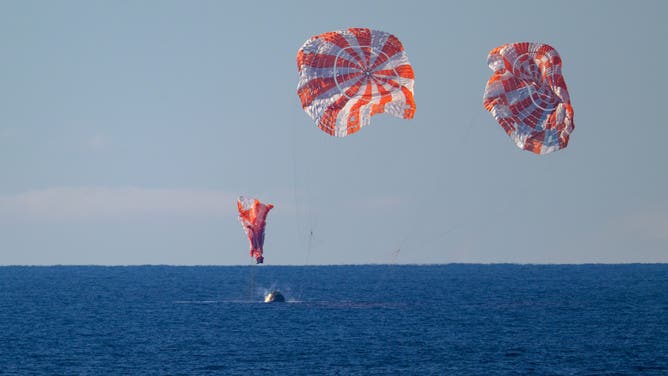
NASA’s Orion spacecraft with Artemis II crewmembers NASA astronauts Reid Wiseman, commander; Victor Glover, pilot; Christina Koch, mission specialist; and CSA (Canadian Space Agency) astronaut Jeremy Hansen, mission specialist aboard are seen as it lands in the Pacific Ocean off the coast of California, Friday, April 10, 2026.
(Photo by Bill Ingalls/NASA via Getty Images / NASA)
Everything went exactly as planned, with splashdown occurring at 8:07 p.m. ET.
The next few hours were spent powering down Orion, getting the crew off the ship and onto helicopters, where they were taken to the USS John P. Murtha and given a full medical exam.
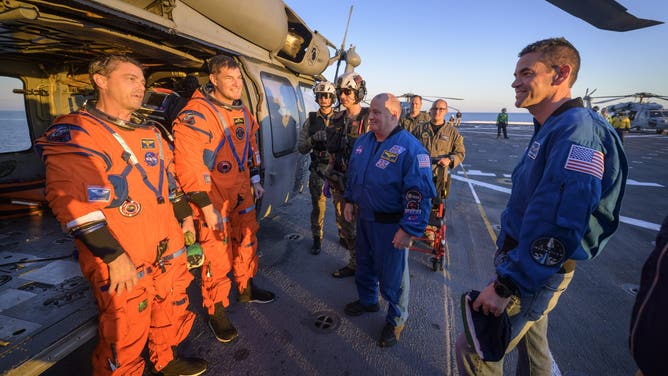
AT SEA – APRIL 10: NASA astronaut Victor Glover, Artemis II pilot, left, and CSA (Canadian Space Agency) astronaut Jeremy Hansen, Artemis II mission specialist, talk with NASA Administrator Jared Isaacman at their Navy MH-60 Seahawk from Helicopter Sea Combat Squadron (HSC) 23 on the flight deck of USS John P. Murtha after they and fellow crewmates NASA Astronauts Victor Glover, and Christina Koch were extracted from their Orion spacecraft after splashdown, Friday, April 10, 2026, in the Pacific Ocean off the coast of California. NASA’s Artemis II mission took the quartet on a nearly 10-day journey around the Moon and back to Earth. Following a splashdown at 5:07 p.m. PDT (8:07 p.m. EDT), NASA, U.S. Navy, and U.S. Air Force teams are working to bring the Orion spacecraft aboard
(Bill Ingalls/NASA / Getty Images)
As of Saturday morning, the crew was doing well.