Dear Tripped Up,
Last July, my wife and I traveled to Germany to visit Munich and the Bavarian Alps and drink good beer. (I co-own a brewery in Colorado.) We rented a car from Enterprise, which had an agency inside a hotel lobby, and picked up the car in an unmanned garage a few blocks away. I photographed the fuel gauge at pickup — the car had five-eighths of a tank of gas — and again when I dropped it off with three-quarters of a tank. But I was charged 94.50 euros, plus 20 percent tax, a total of about $131, for 25 liters of “missing” fuel. Furthermore, my original reservation said tax was included, but I was charged an additional €65.87 for tax on the final tab. I complained to Enterprise and filed a credit card dispute with American Express, but no luck. Can you help? Jack, Broomfield, Colo.
Dear Jack,
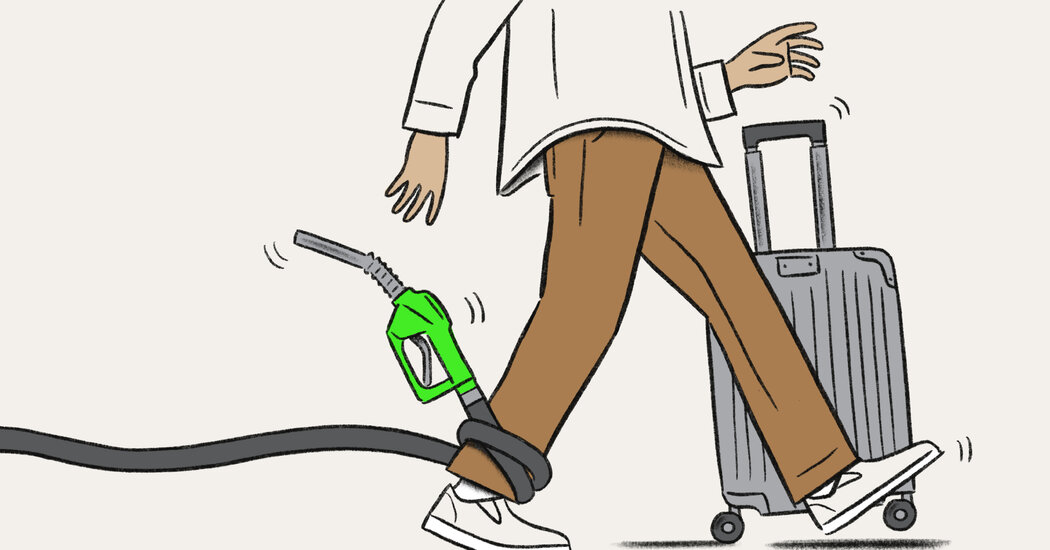
Why must rental car companies make the simple act of filling a gas tank so stressful? Their rates are so punitive — in your case, about $16.75 a gallon, if my double conversion of liters to gallons and euros to dollars is correct — that we would do anything to avoid them, including risking a missed flight to circle back if we miss that last gas station before the airport. (Note that a gallon of gas in Germany in July 2025 cost less than $8, on average.)
You weren’t even renting from an airport location, and you actually left the tank with slightly more gas than it started with. You took photos to prove it, and on top of that were charged too much in taxes — or so we both thought when we looked at your bill.
I got in touch with Enterprise, and the company quickly refunded you $131 for the extra gas. But they were right about the taxes: The original tax amount had been removed and a revised amount, including tax on the gas, was tacked on the end. I think the German-language bill tripped us both up.
“We’re committed to resolving any issues promptly and take all customer concerns seriously, investigating each one thoroughly,” wrote Danielle Stuart, an Enterprise spokeswoman, adding that a third-party supplier that cleans and refuels the company’s vehicles had failed to note that the car did not have a full tank when you picked it up. That’s why you were mistakenly charged.
It was an obvious injustice, and I’m happy I could help. But after re-examining your documentation and speaking with an expert, I think you might have resolved the issue without me, if you hadn’t shifted your tactics to a credit card dispute.
Here’s how: Your original emailed complaint to Enterprise, just two sentences long, said only that you thought you had been incorrectly taxed. You did not bring up the gas charge, because (as you later told me) you had not noticed it yet. But because the real issue was the gas, not the tax, your complaint was inaccurate, and Enterprise rightly rejected it.
Then, when Enterprise did not return your money, you went straight to American Express and filed a dispute — also known as a chargeback. Amex denied your first chargeback request. You then noticed the gas charge, and filed another dispute, asking for about $160 back. This time you cited both the extra gas charge and the taxes, and again the amount was incorrect. Importantly, you did not go back to Enterprise between disputes.
You told me in a follow-up email that you no longer have the complaints since the process was done within the American Express website and is no longer accessible to you. Fair enough. Let’s assume you made a solid argument and included the time-stamped, before-and-after fuel gauge photos, and thus should have received at least the $131 back.
So why might Amex have rejected your second dispute? I’m sure it did not help that you asked for $160 instead of the $131 you were entitled to, but I suspect the main reason was that you did not bring the issue back to Enterprise before filing your second chargeback request. It’s important to give the merchant a chance to solve the problem first, said Todd Ablowitz, who has worked extensively with chargebacks as a co-founder of the payment technology company Infinicept.
“You have to show you tried to get a refund and work it out with them,” he told me over the phone. That might include providing the bills with mistakes highlighted, back-and-forth emails, or screenshots of online chats and text messages. It could also include contemporaneous notes of phone conversations, with the dates of the calls and, if possible, the name of the agent you spoke with. For cases in which travelers are claiming inaccurate product descriptions — say, a resort that advertises a pool but does not have one — you might include a screenshot of the description along with photos of the hotel grounds.
As an arbitrator of consumer complaints, I would add that aggrieved customers should not overwhelm the poor souls who adjudicate chargeback requests. Keep your argument simple, and don’t muddy the waters with a pile of unnecessary documents. If you’re not confident in your writing skills, consider using generative A.I. to help make your argument brief and crystal clear.
But filing a credit card dispute should be the last move, not the first. There are reports of customers being blacklisted by some companies for what they determine to be frivolous or excessive chargebacks. Mr. Ablowitz notes that network rules do not allow a merchant to recharge a credit card after a chargeback, but I have heard plenty of stories where a company rebills customers and threatens collection proceedings if they refuse to pay.
On the other hand, if you do it right, the chargeback may be the most powerful tool available to customers in the United States, with its woeful consumer protections.
So if you hadn’t moved so quickly to dispute the charge, would it have come to a chargeback situation in your case, Jack? I can’t be sure. Normally, I would question Ms. Stuart’s statement about being “committed to resolving any issues promptly” and taking “all customer concerns seriously.” Based on my experience with other companies, customer service representatives often do exactly the opposite.
But in this case, the benefit of the doubt goes to Enterprise, since it never quite got a fighting chance to resolve your issue promptly.
If you need advice about a best-laid travel plan that went awry, send an email to [email protected].
Follow New York Times Travel on Instagram and sign up for our Travel Dispatch newsletter to get expert tips on traveling smarter and inspiration for your next vacation. Dreaming up a future getaway or just armchair traveling? Check out our 52 Places to Go in 2026.