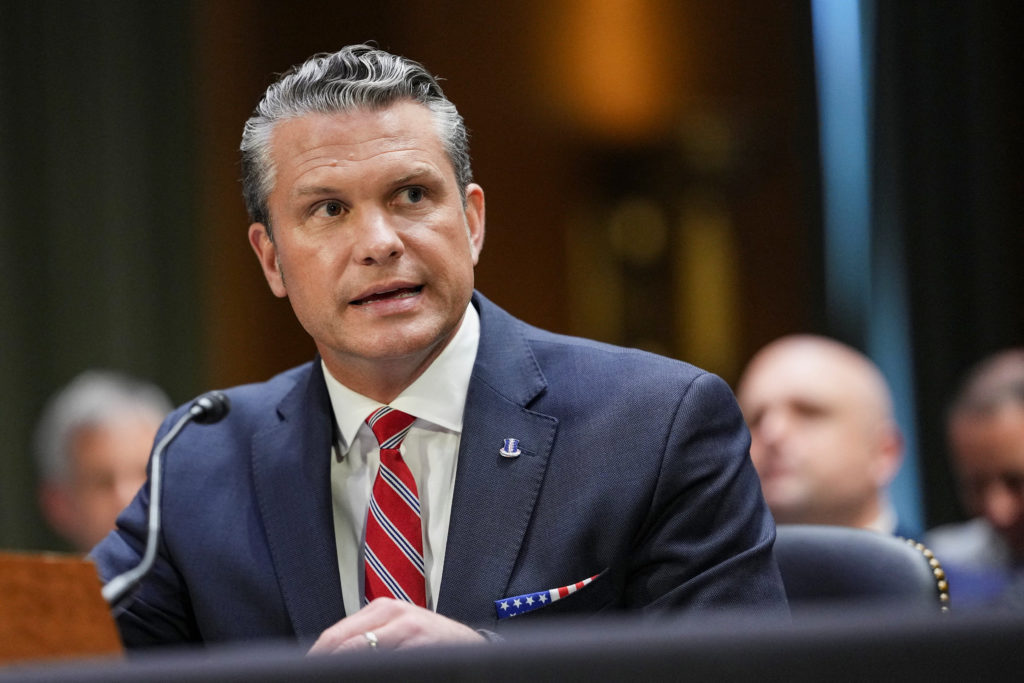
President Trump’s top military advisors were on Capitol Hill to make the case for the war in Iran, and additional money to fund the Pentagon. Secretary of Defense Pete Hegseth and Joint Chiefs Chairman Gen. Dan Caine argued for an additional $67 billion, what Hegseth called an urgent and necessary injection of funds. Nick Schifrin reports.
Correction: A graphic in this piece mistitled Sen. Mike Rounds. We regret the error.
Amna Nawaz:
Secretary of Defense Pete Hegseth and Joint Chiefs Chairman General Dan Caine argued for an additional $67 billion, what Hegseth called an urgent and necessary injection of funds.
Nick Schifrin has been tracking this all, and he joins us now.
So, Nick, what did Hegseth and Caine say about why those funds are needed, and how did senators respond?
Nick Schifrin:
Hegseth and Caine requested the additional money to restock weapons that have been used against Iran and to avoid budget shortfalls.
And there are apparently military shortfalls right now. Subcommittee Chairwoman Susan Collins of Maine said that there were — quote — “near-term solvency challenges” in some of the military services. So the Pentagon says this money is especially needed, especially after the war in Iran, which Hegseth said cost $37.5 billion up until today.
That’s up from $29 billion, their last estimate. But, frankly, 37.5 is probably an undercount itself. Democrats questioned their request. They said that many of the weapons requested today had already been requested by the Pentagon and that the money was earmarked, frankly, for administration priorities that had nothing to do with Iran, as Americans’ prices were rising.
So take a listen to New York Democrat Kirsten Gillibrand.
Sen. Kirsten Gillibrand (D-NY):
You are asking for unlimited money for bombs, when people can’t feed their families, and I don’t know how this administration intends to defend those decisions to the American people.
Pete Hegseth, U.S. Defense Secretary:
Not unlimited bombs, Senator. I’m asking for the right bombs at the right time to ensure we can deter our adversaries into the future, and that’s why this is a generational investment. And it was the previous administration that didn’t fund this department?
Sen. Kirsten Gillibrand:
Secretary Hegseth, the reason why people are so upset, the reason why they are so upset with you and this administration is because the words you have used in the past don’t add up.
Nick Schifrin:
Republicans argued, Amna, that the war in Iran is necessary and that if the U.S. were to pull back right now, Iran would charge tolls in the Strait of Hormuz and likely reconstitute its nuclear program.
So take a listen to South Dakota Republican Mike Rounds.
Sen. Mike Rounds (R-SD):
I think the decision to take out Iran’s nuclear program and their missile production capacity was the right one, and it should have been done a long time ago. But when the president did that, we also assumed that there would be risk involved.
Nick Schifrin:
And, on that point today, the Pentagon identified that Sergeant Michael Swinton, 30 years old from Fayetteville, North Carolina, was killed over the weekend in Iraq, in addition to two other Americans killed in Jordan, 1st Lieutenant 25-year-old Tyler James Feehan Private 19-year-old Isabella Gonzales.
Amna Nawaz:
Nick, as we have been reporting, the service members were killed as that war with Iran has essentially restarted now. Where is it now? Is it just continuing to escalate?
Nick Schifrin:
It’s definitely expanding, the war.
The U.S. has finished its 10th straight night of strikes, not only on military targets, but also, on infrastructure targets, including bridges, across Southwest Iran. And Iran attacked in the last 24 hours three tankers transiting the Strait of Hormuz, but also civilian targets inside of the Gulf allies along the Persian Gulf, including Kuwait.
A desalinization plant was struck, you see it there, multiple times in a row. Kuwait needs that plant in order to have water for its population. Now, that said, both sides are saying diplomacy is still open. We saw Iranian officials in Pakistan, one of the mediators, of course.
But, today, President Trump took a dim view toward diplomacy.
President Donald Trump:
I will tell you, they want to desperately meet. And until they’re ready to meet in a meaningful way, we have no interest in even…
Nick Schifrin:
No interest in stopping. No interest in diplomacy, what he finished there.
Another threat is the Iranian-backed Houthis in Yemen, and this is another example of the war expanding. They are now threatening to close the Bab al-Mandab, do you see that, 1,200 miles to the southwest of the Strait of Hormuz. The Bab al-Mandab is the gateway to the Red Sea.
Today, President Trump referenced a previous U.S. military campaign against the Houthis and said it could be repeated.
Donald Trump:
That was about 45 days of very powerful action we took against the Houthis, and we have had no problem with the Houthis. They have had no problem with us for a long period of time, including during this conflict. I think that if there is something like that, we will just have to take care of business.
Nick Schifrin:
Now, today, the Houthis did claim that they warned six ships heading toward the Bab al-Mandab and that those ships rerouted themselves. It’s not clear that’s true.
But even the threat, Amna, of the Houthis closing the Bab al-Mandab will force ships not to try and go there. And if the Strait of Hormuz and the Bab al-Mandab are both closed, it is clear that prices around the world will increase if that happens, especially gas prices here at home.
Amna Nawaz:
All right, Nick Schifrin beginning our coverage tonight.
Nick, thank you.
Nick Schifrin:
Thank you.