As Britain endures its third heatwave of the summer, many Brits will be worried about sunburn, sleep issues, and heatstroke.
Now, experts have revealed a new cause for concern – snakes.
The RSPCA has released new figures, revealing how incidents involving snakes spike during warm weather.
In 2025, the animal welfare charity received 1,485 reports involving snakes – 905 of which were between May and September.
‘We’re seeing a significant increase in reports involving snakes, with the highest numbers consistently taking place during the warmer months,’ said RSPCA Senior Scientific Officer Evie Button.
‘Snakes naturally become more active as temperatures increase and they are very skilled escape artists so we’re urging owners to take a few extra moments to check enclosures are secure and suitable for their particular species.
‘With such hot temperatures on the horizon, we’re issuing this snake safety warning.
‘Many of the incidents we deal with involve snakes that are believed to have escaped from their owners.’
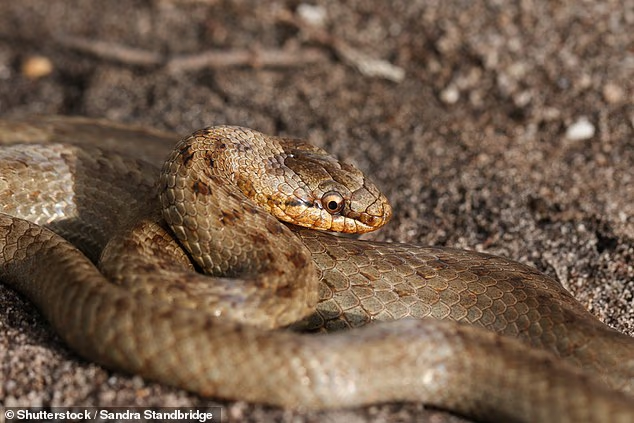
As Britain endures its third heatwave of the summer, many Brits will be worried about sunburn, sleep issues, and heatstroke. Now, experts have revealed a new cause for concern – snakes. Pictured: a smooth snake in heathland in the UK
According to the RSPCA, there were 1,485 reports involving snakes in 2025, up from 980 in 2024.
One fifth of the reports concerned snakes found loose or stray, while the other reports included a number of different types, such as requiring advice, sick/injured pets, those that were trapped, and intentional harm.
According to the charity, one of the main reasons why snakes escape at this time of year is that some owners take them outside to take advantage of the natural sunlight.
While this can be good for reptiles, if left unsecured, they can warm up and move very quickly on a sunny day.
And it’s not just pet snakes that Brits should be worried about.
The RSPCA also receives more calls about native wild snakes at this time of year, as they are naturally more active during the summer.
These often include grass snakes and adders that have been misidentified as stray exotic pets.
Ms Button explained: ‘Exotic pets such as snakes often end up in the RSPCA’s care after people realise they’re not easy to care for, or the novelty wears off.

According to the charity, one of the main reasons why snakes escape at this time of year is that some owners take them outside to take advantage of the natural sunlight. Pictured: an adder snake in North Wales
‘Pet snakes are completely dependent on their owners to provide the right accommodation, heating, lighting and diet, all of which need to replicate their natural habitat as closely as possible to keep them healthy and allow them to express their natural behaviours.
‘The needs of reptiles can be challenging to meet because they are just the same as they would be in the wild and their welfare depends on providing the right environment conditions.
‘The RSPCA urges prospective owners of reptiles such as snakes to thoroughly research the needs of the particular species and what is required in the care of the animal, using expert sources.
‘People should only consider keeping a snake if they can ensure they are fully able to provide for these needs.’
The warning comes shortly after a dad’s relaxing day of paddleboarding turned into a nightmare when he was bitten by the UK’s only venomous snake – and was left with an ‘elephant leg’ and unable to walk.
Zak Brown was paddleboarding with a friend at Cavenham Heath National Nature Reserve in Suffolk last month when he decided to pull over for a break.
The 39-year-old stepped onto the river bank where he inadvertently trampled on an adder lurking in the grass.
Within seconds, the business owner felt a sharp stabbing sensation on his left ankle and looked down to see a snake attached to his heel.
Describing the pain as ‘instant’ and ‘burning’, Mr Brown quickly realised he needed to seek medical treatment, but with no immediate way to leave the area, he and his companion had no alternative but to paddle for two hours back to the car.
After heading to hospital, he was given an injection of anti-venom and remained overnight for observation.
Doctors said Mr Brown was lucky the adder was just a juvenile, as the effects of venom from an adult snake may have been more serious.
The father of two says the pain was so ‘unbearable’ he was left unable to walk, and the snake’s fast-acting venom left his leg swollen and looking like it belonged to an ‘elephant’.