Early humans experienced a ‘growth spurt’ around two million years ago, making it easier for them to travel long distances, a new study has revealed.
Experts have discovered that our ancestors ‘jumped’ in size from around 88lbs (40kg) to 132lbs (60kg), achieving weights similar to many modern humans.
Other species of ancient human, meanwhile, stayed much smaller and only reached the height of a child.
This growth, may have made it easier to roam over much larger areas in search of food and a suitable habitat. It could also have helped our ancestors survive on a more varied diet.
The findings, published in the Proceedings of the National Academy of Sciences (PNAS), challenge conventional theories that humans grew gradually across the whole family tree.
Dr Thomas Puschel, co–author from the School of Anthropology and Museum Ethnography at the University of Oxford, said: ‘Our results suggest that human body size evolution was not simply a story of steady growth over time.
‘Although body mass generally increased throughout our evolutionary history, the most significant shift occurred later within the genus Homo.
‘This change coincided with broader developments in how our ancestors moved across landscapes and exploited their environments, pointing to a close relationship between body size and major ecological and behavioural transitions.’
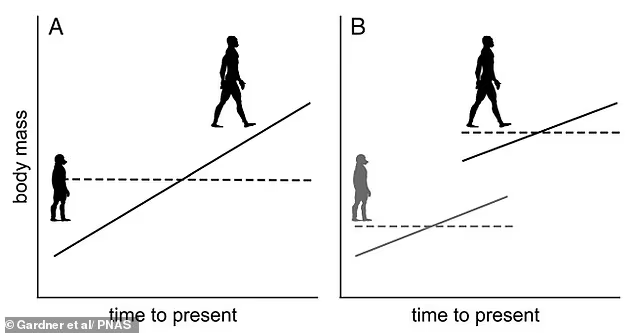
Scientists have long debated whether human ancestors grew steadily larger over time (A) or whether most of the increase happened later, with the emergence of larger–bodied members of the genus Homo (B)

‘The human lineage’: This illustration shows the closest extinct relatives of modern humans (homo sapiens, right)
For their study, the team, from the Universities of Reading and Oxford, looked at body weight from 386 fossils across 21 different species of hominins.
Hominins are the group that includes modern humans, extinct human species and all our immediate ancestors after we split evolutionarily from chimpanzees and bonobos.
They used statistical models to track how body size changed over millions of years.
Analysis revealed body weight steadily increased over time in our earlier relatives but then jumped in size around two million years ago with the emergence of our direct ancestors, Homo erectus.
Dr Jacob Gardner, lead author at the University of Reading, said: ‘For years, different studies have come to different conclusions about whether our ancestors steadily grew bigger over time or jumped in size at some key point in our Homo ancestors.
‘We think that’s because everyone was looking at slightly different pieces of a much bigger puzzle. When you put all the fossils together, examine multiple competing ideas, and account for how species are related to each other, a clearer picture emerges.
‘The answer is most likely a combination of these ideas.
‘The human story is not simply one of constant growth, but also of a major change that happened later, within our own genus, while other branches of the family, including some surprisingly small relatives, went their own way entirely.’

Home erectus (pictured) was the first human species to exclusively walk upright on two legs like humans do today
The researchers explained the timing of this growth spurt lines up with other changes in the Homo genus.
‘These ancestors were walking on two legs more efficiently than earlier hominins, eating more meat, and roaming over much larger areas in search of food and suitable habitat,’ they said.
‘The findings suggest that growing larger was closely tied to a wider shift in how these early humans lived.’
The study concludes: ‘Overall, these findings bring clarity to a fundamental question in human evolution.’
Homo erectus was the first human species to exclusively walk upright on two legs like humans do today. They lived in an area which initially covered Africa but later spread across large parts of Asia and even to the edges of Europe.
This was the first time a hominin, a primate closely related to humans, had ventured outside of Africa.
They were taller than previous hominins, with long legs that made them efficient walkers.
Their upright posture also freed up the use of their hands, which allowed big–brained Homo erectus to develop tools and become the first hominin to master fire.