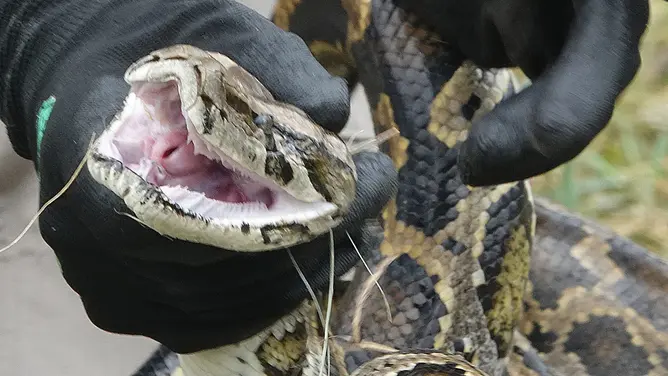
The annual Florida Python Challenge returns giving participants the opportunity to remove invasive Burmese pythons from the Everglades while raising awareness about the threat posed by nonnative species. Registered participants in this year’s challenge will have a chance to win a share of $25,000 in prizes.
EVERGLADES, Fla. – Experts across the Sunshine State are monitoring an increasing presence of the deadly Burmese Python in the Everglades.
The Burmese python is an invasive species that was first sighted in the Florida Everglades in the 1970s, likely due to the pet trade and accidental or intentional releases by pet owners.
These creatures are native to India and lower China.
Florida is home to more invasive animal species than any other U.S. state, except California, according to the Florida Museum of Natural History.
In a photo from June 3, 2021, a Burmese python is handled by FWC snake specialist McKayla Spencer in the Florida Everglades during the start of the python challenge.
(Joe Cavaretta/South Florida Sun Sentinel/Tribune News Service / Getty Images)
It is difficult to estimate the true population of Burmese pythons in South Florida, but conservatively, there are tens of thousands of these creatures throughout the Greater Everglades region.
Non-native Burmese pythons have established a breeding population in South Florida. They are among the most concerning invasive species because they compete with native wildlife for food, including mammals, birds, and other reptiles.
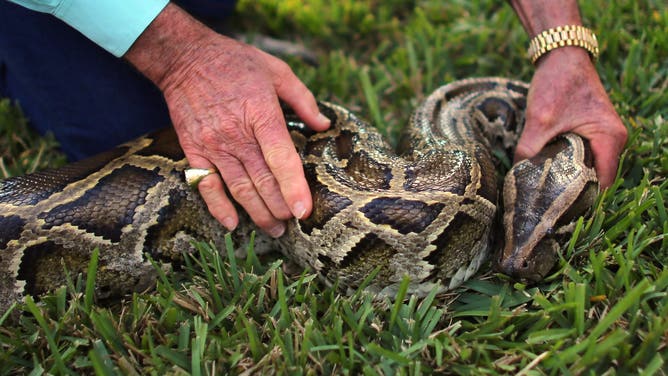
DAVIE, FL – JANUARY 12: A Burmese python is seen on display at the registration event and press conference for the start of the 2013 Python Challenge on January 12, 2013 in Davie, Florida.The Florida Fish and Wildlife Conservation Commission and its partners launched the month long 2013 Python Challenge to harvest Burmese pythons in the Florida Everglades, a species that is not native to Florida.The contest features prizes of $1,000 for catching the longest snake and $1,500 for catching the most.
(Joe Raedle / Getty Images)
In fact, a study spanning 1997 to 2012 found that animal populations such as raccoons declined by 99.3%, opposums by 98.9%, and bobcats by 87.5%, according to the United States Geological Survey.
These creatures also significantly reduce the prey available to native predators in the region.
In light of the growing problem over the last couple of decades, officials with the Florida Fish and Wildlife Conservation Commission offer a no-cost training program that aims to create a network of people able to search for, identify, capture, and humanely kill the invasive creatures.
SCIENTISTS MAKE RARE DISCOVERY IN ONE OF EARTH’S MOST EXTREME OCEANS
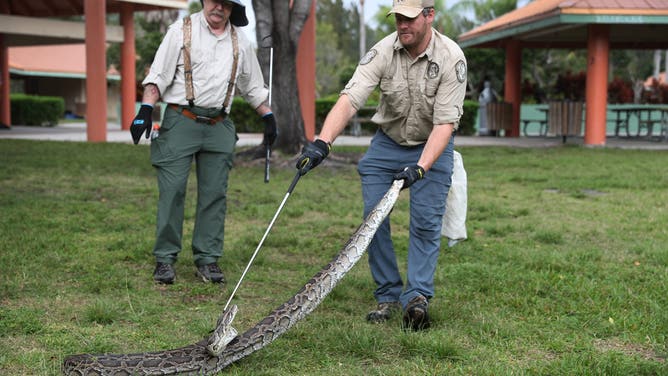
SUNRISE, FLORIDA – JANUARY 10: Rick Mayo looks on as Robert Edman, with the Florida Fish and Wildlife Conservation Commission, gives a python-catching demonstration before potential snake hunters at the start of the Python Bowl 2020 on January 10, 2020 in Sunrise, Florida. The Florida Python Challenge 2020 Python Bowl taking place a few weeks before the Super Bowl being held in Miami Gardens, is a 10-day competition to remove Burmese pythons from the Florida Everglades due to the threat to the delicate ecosystem that they pose as they have no predators and reproduce rapidly.
(Joe Raedle / Getty Images)
An effective way to promote and combat the growth of the reptile is the annual Florida Python Challenge, which offers three categories of rewards, including the chance to win up to $2,500 for the most pythons caught.
Despite the annual promotion, managing the populations of these large creatures is a year-round practice, as Burmese pythons have no natural predators, allowing rapid population growth.
DOZENS OF BABY SEA TURTLE NESTS LOST AS TROPICAL STORM BERTHA BATTERS FLORIDA COAST
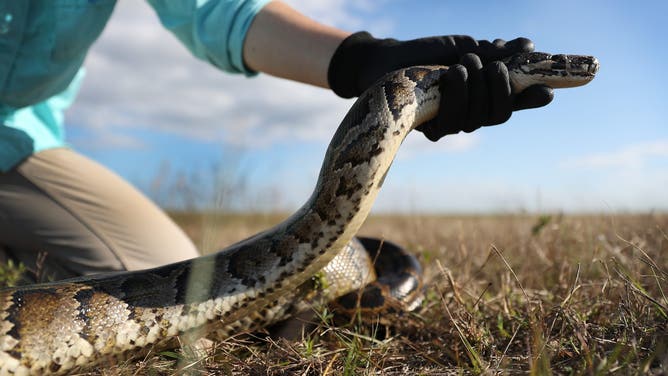
FORT LAUDERDALE, FLORIDA – MARCH 23: McKayla Spencer, with the Florida Fish and Wildlife Conservation as the Interagency Python Management Coordinator, works with a Burmese python used to train dogs to detect them in the Florida Everglades on March 23, 2021 in Fort Lauderdale, Florida. The Florida Fish and Wildlife Conservation Commission is using the dogs to sniff out Burmese pythons. A black lab named Truman and a point setter named Eleanor hunt five days a week with a dog handler and an FWC biologist to search for pythons on different public lands across south Florida. The FWC is implementing dog sniffing python hunters to help find and eliminate invasive Burmese pythons in the Everglades ecosystem.
(Joe Raedle / Getty Images)
This species can grow up to 20 feet long, live for over 25 years, and females can produce up to 100 eggs per year, which underscores the impacts these snakes have on the ecosystem.
THE TOP 10 WORST STATES FOR BATTLING MOSQUITOS THANKS TO HEAT AND HUMIDITY
The next steps in conservation efforts include implementing the use of innovative tools such as near-infrared cameras to help detect and remove these creatures as officials and everyday citizens try to do their part in combating the slithery invaders.