Geoff Bennett:
Earlier this week, we brought you a story of how specialized cameras and satellites are helping to spot and contain wildfires in the American West.
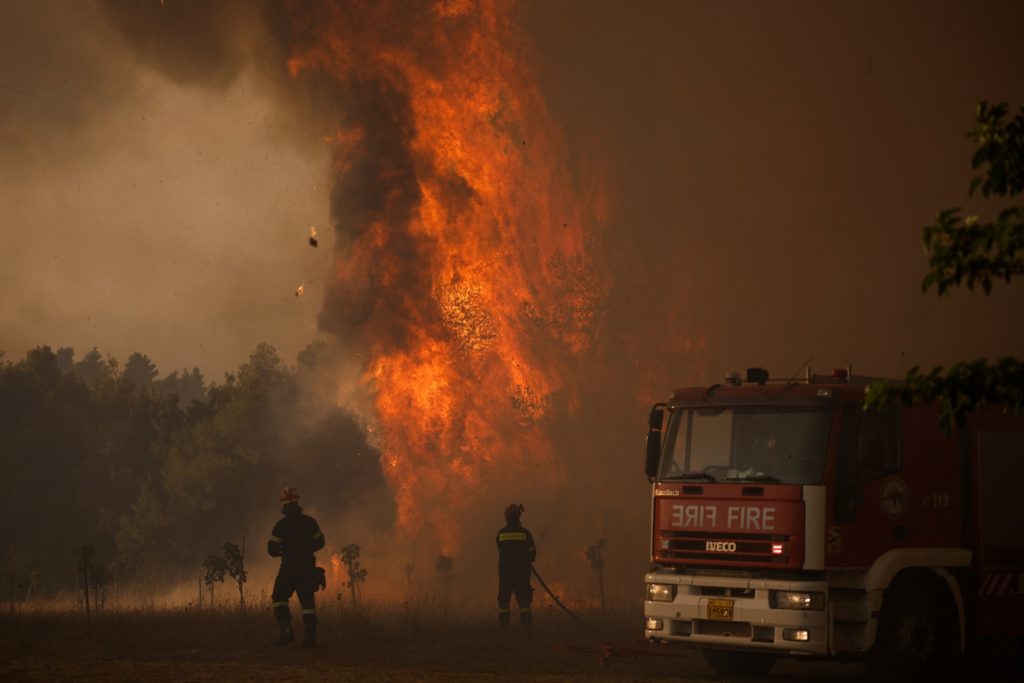
Now, similar satellite technology is being used in Greece to help fight another vicious wildfire season there, as Europe suffers blazes across the continent.
From the town of Mati, near Athens, here special correspondent Malcolm Brabant.
Malcolm Brabant:
Every summer, the people of Mati float lanterns out to sea to commemorate victims of the devastating 2018 wildfire. Officially, 104 people were killed in and around this beach resort. Some victims drowned after wading into the bay in a frenzied effort to escape flames and suffocating smoke.
Others were incinerated in their cars after the police made a catastrophic error by sending traffic directly into the inferno.
Kalli Anagnostou, President, Association of Relatives of the Deceased and Burn Victims: The only thing that you could hear was the wind and the fire reaching each one of us, and after other screams, the screams of help, the screams of terror, and the last screams of people who were dying of getting burned.
Malcolm Brabant:
The fire whipped down the hillside at a terrifying rate, forcing residents like Kalli Anagnostou to run for their lives.
Kalli fled on foot alongside her parents and 5-year-old son, who survived despite being badly burned.
Kalli Anagnostou:
I heard him then screaming, “I’m burning. I’m burning,” because I realized that his sleepers were sticking on the road, which was burning, and, along, his feet were melting.
Malcolm Brabant:
Now, with the wildfire season hitting its destructive stride, the Greek authorities hope that tragedies of Mati proportions will be consigned to the past by a new satellite fire detection system.
Man:
Three, two one. Ignition. And liftoff of Falcon 9.
Malcolm Brabant:
Launched in May, the rocket deployed four dedicated satellites that constantly scan the Greek landscape for hot spots with the potential to become conflagrations.
Col. Zisoula Ntasiou, Vice President, International Association of Fire and Rescue Services: I don’t remember working in a Hellenic Fire Service the last 25 years and thought when I began my career that the space will help us to extinguish fires.
So, only that thinking, it’s really exciting.
Malcolm Brabant:
Colonel Zisoula Ntasiou directs aerial firefighting operations in the Athens region, but is also global vice president of the International Association of Fire and Rescue Services.
Col. Zisoula Ntasiou:
We can have the information of starting fires very quickly, and this is something amazing, the early detection, because we know that, if we cut the fires in the early detection, we will cut it in the beginning. So, if we have more time, we can save properties. We can save lives. We can save the forest.
Malcolm Brabant:
So far, France and Spain have borne the brunt of this summer’s wildfire season, but now heat waves and strong winds have put Greece on the front line. Older satellite systems that provide general weather monitoring can sniff out football field-sized blazes.
But the new technology, stationed 360 miles above Greece employs high-resolution camera lenses, which it’s claimed offer greater precision.
Ioannis Lantouris, Head of Operations and Managing Director, OroraTech Greece: The smallest fire we can detect is around about four-by-four yards.
Malcolm Brabant:
As head of Greek operations for the OroraTech satellite company, Ioannis Lantouris oversees the low-Earth orbit constellation.
Ioannis Lantouris:
This is a satellite that essentially watches over the temperature of the Earth. So we take thousands of readings within one photo. We can get thousands of readings from each pixel. That data help us identify when and if there is a fire, and then, on that, based on that, to run our technology, our models, our predictions, and then provide that information to the user, all of that within a really, really fast time.
Malcolm Brabant:
How quickly can you alert fire brigades to a potential conflagration?
Ioannis Lantouris:
The quickest right now is about 20 to 30 minutes.
Malcolm Brabant:
Although the satellite system tracked two wildfires on the island of Crete this past week, two volunteer firefighters died after an apparent error of judgment, becoming trapped and overwhelmed by fast-moving flames.
Man (through interpreter):
I saw the boys with my own eyes. They made a mistake. They went there. Unfortunately, it was their mistake. I can’t say anything else. The situation is tragic, tragic, tragic. We see burnt houses, burn cars, burned animals. Unfortunately, these people will not come back.
Malcolm Brabant:
And this is the information that was received from the satellites that tracked the Crete fires. Artificial intelligence filtered out false alarms and flagged the hot spots as genuine threats. The second video shows how the first fire expanded. The satellite company says it spread incredibly quickly and reached its largest size within 48 hours of ignition.
Dimitris Papastergiou is Greece’s minister of digital governance.
Dimitris Papastergiou, Greek Minister of Digital Governance (through interpreter): I think we are simply showing the good side of technology and artificial intelligence. We must continue more dynamically. We want technology for people, technology that stands by people, technology that comes to provide real solutions to real problems.
Malcolm Brabant:
Greece’s eye in the sky is still some way from being the Holy Grail that provides real-time imaging of a fire’s progression. Although there is that time lag before information is passed to the fire service, the minister is genuinely excited.
Dimitris Papastergiou (through interpreter):
This allows aerial assets to arrive much faster at the fire scene to extinguish it or enables us to manage it right at the moment it breaks out.
Malcolm Brabant:
I know from personal experience that surviving a wildfire is a lottery. It’s human nature to want to stay put to try to save your home and your possessions. But wildfires are completely unpredictable and can change direction in an instant, especially on blustery, windy days like today. And so escape routes can become death traps.
Seventeen years ago, our home, six miles from Mati, was imperiled by a raging wildfire on nearby Mount Penteli. At 3:00 in the morning, we fled down the mountain with our family treasures, our son, our dog, and photograph albums.
Woman:
Well, so what really matters to us?
Malcolm Brabant:
How could we know that the fire would stop at our garden wall, sparing the house?
Right. We have been forced to abandon our home because the flames have gotten out to within about 200 meters of the back door, and the smoke was getting very unpleasant. Also, just behind us, the flames were licking up the hill and starting to attack some of the homes just around the corner from us. The fires have come over the hill from Penteli, which, wow, over there is just extraordinary.
Look at the flames over there. They’re beyond the tree line. So it looks as though we should be fairly safe to get out here. But look to your right, daisy. Look at — that’s what we’re leaving behind.
Woman:
Yes.
Malcolm Brabant:
That’s what we’re leaving behind. And this is a place of real natural beauty, and now it’s an ecological disaster.
The Greeks are worried that climate change-driven heat waves will burn more of the country this summer. Tinder-dry undergrowth is an accelerant that worries fire chiefs like Zisoula Ntasiou.
Col. Zisoula Ntasiou:
You don’t know where these fires are spreading. They are creating their own environment, and they can do whatever they want. They can increase the temperature. They can increase the wind.
So with the satellites and the hot spots, you can say you can see everyone now where this fire is going. And you can plan your strategy and send there and more resources.
Malcolm Brabant:
But having witnessed the earth’s power at its fiercest, the people of Mati are skeptical about technology’s ability to beat Mother Nature.
Kalli Anagnostou:
We cannot predict the human interference. And this is what needs to change. No system, no technology can be affected if we continue to make the same human errors.
Malcolm Brabant:
Still profoundly traumatized, the people of Mati are waiting for compensation for mistakes made by the Greek authorities. They are united in the hope that no other community will melt like theirs did.
For the “PBS News Hour,” I’m Malcolm Brabant in Mati, Greece.