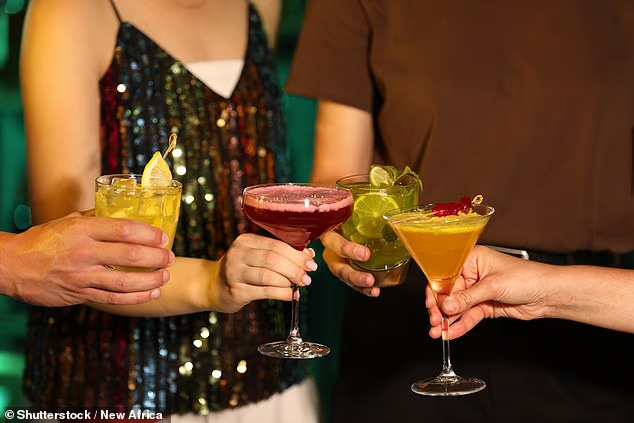
From downing shots of pickle juice to rubbing lemons on your armpits, many booze–loving Brits will try just about anything to avoid a hangover.
Now, a new anti–hangover method is emerging on social media, dubbed ‘zebra striping’.
The idea is simple – after every alcoholic drink, you opt for a non–alcoholic beverage, before returning to the booze.
Taking to Instagram, one fan said: ‘POV: you’ve got a 7pm girls dinner at Soho House, 9am reformer pilates, and a child who respects neither. Zebra stripe.’
Another explained: ‘When I go out and I have wine, after every glass of wine I will switch to a sparkling water. That way, you drink 50 per cent less, but you’re still being social the whole time – and you’re hydrated.’
And one joked: ‘Propaganda we are falling for: Zebra striping.’
So, does zebra striping really work? According to Cathy Montgomery and Abi Rose, psychologists from Liverpool John Moores University, the answer is yes – but there’s a catch.
‘Zebra striping can reduce hangovers if it leads you to drink less overall. But if you compensate for zebra striping by extending your night out or drinking stronger drinks, the benefits quickly disappear,’ they explained in an article for The Conversation.
A new anti–hangover method is emerging on social media, dubbed ‘zebra striping’. The idea is simple – after every alcoholic drink, you opt for a non–alcoholic beverage, before returning to the booze (stock image)

Recent market insights by KAM Insights suggest that zebra striping is on the rise in the UK, with 34 per cent of adults reporting they’ve tried it
Recent market insights by KAM Insights suggest that zebra striping is on the rise in the UK, with 34 per cent of adults reporting they’ve tried it.
If you’ve considered it, you’ll be happy to hear that the reseachers say that zebra striping really is a ‘useful pacing strategy’.
The human body metabolises alcohol at a rate of roughly one standard UK unit per hour.
If you drink faster than this, it raises your blood alcohol concentration (BAC), making you feel drunk – and increasing your risk of a dreaded hangover.
‘By alternating non–alcoholic alternatives with alcoholic drinks, zebra striping slows overall alcohol consumption,’ the pair explained.
‘This not only reduces your peak BAC (meaning you’re less intoxicated at any given point), it also tends to reduce the total number of alcoholic drinks consumed.’
As well as slowing your boozing down, zebra striping also helps to keep you hydrated.
‘Alcohol acts as a diuretic – meaning it makes us need to wee more often and causes fluid loss. This can contribute to dehydration and electrolyte imbalance,’ the researchers said.

From downing shots of pickle juice to rubbing lemons on your armpits, many booze–loving Brits will try just about anything to avoid a hangover (stock image)
‘Alternating alcohol with water or soft drinks on a night out should help offset some of the dehydration that drinking causes.
‘This may help with some common hangover symptoms, such as thirst, dizziness and headaches.’
However, if you want to reap the most benefits, it’s best to opt for uncarbonated drinks.
The team advised: ‘Carbonated drinks speed up the absorption of alcohol into the blood stream, increasing BAC more rapidly.
‘This is because the bubbles increase pressure in the stomach and force alcohol into the small intestine.
‘Fizzy soft drinks won’t get you more drunk overall, but they may make you drunk faster.’
Zebra striping clearly has benefits – but these all depend on how long your night out is, and the strength of your alcoholic drinks.
The experts added: ‘The bottom line is that the severity of a hangover is closely tied to the amount of alcohol consumed.
‘The more you drink and the higher your BAC, the greater the likelihood and intensity of hangover symptoms.’
While the results might vary, zebra striping will definitely come in handy if you feel social pressure to drink.
‘Holding a drink can reduce social pressure to keep drinking,’ the team added.
‘This makes it easier to moderate your alcohol intake, especially in societies like the UK where social drinking is seen as the norm.’