Niger’s government has widened its blame to unnamed neighbours a week after the assault on a military base.
Published On 5 Sep 2026
France has dismissed as “pure fantasy” Niger’s claim that Paris helped incite a mutiny in which soldiers stormed a military airbase and the presidential palace in the capital, Niamey.
French Foreign Minister Jean-Noel Barrot made the comment on Saturday, a week after the August 29 assault and a day after Niger’s ruling military council met for the first time since the unrest and repeated its accusations against France.
Recommended Stories
list of 2 itemsend of list
“This operation, with its international ramifications, was instigated and sustained by a vast network of collusion headed by the French regime of Mr [Emmanuel] Macron,” said Soumana Boubacar, Niger’s government spokesperson, in a statement read out on TV on Friday.
“Traitorous and renegade elements, to whom promises of great things were made, were tasked with carrying out unfulfilled ambitions of Macron and his cronies in our country,” he claimed, saying such “undermining manoeuvres will always fail”.
In response to the accusations, France’s Barrot dismissed the claims and told RFI radio on Saturday: “There never was any intention, nor means that France would have mobilised.”
The exchange marks the latest strain in a relationship that has soured sharply since General Abdourahamane Tchiani seized power in a 2023 coup and turned to Russia for military backing instead of France, Niger’s former colonial power.
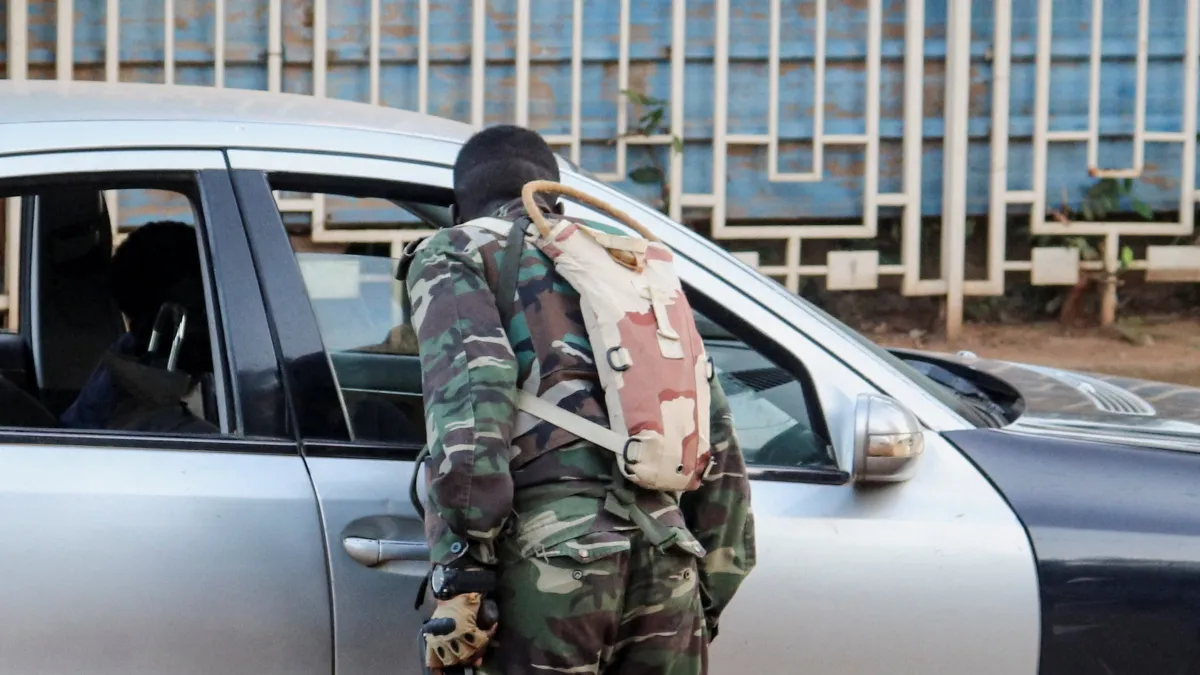
The mutiny last week began at Base 101, a military facility inside Niamey’s international airport, when soldiers turned on their commanders and opened fire at several sites in the city.
Fighting spread to the presidential palace and knocked the state broadcaster off air for hours, before Niger’s army, helped by Russian paramilitary fighters known as Africa Corps, retook the base the next day.
State media said hundreds of soldiers took part, and dozens were killed or arrested.
Niger’s government has since widened its accusations beyond France, saying unnamed “African brothers” served as a bridge for the plot, after state television aired a video of an air force captain naming Benin, Chad, Ivory Coast and the regional bloc ECOWAS as backers of the attack.
Benin’s government has rejected the claim, with a spokesman saying “no one in their right mind” believes it.
In that same meeting, Niger’s government acknowledged for the first time that civilians had died in the violence.
That admission came amid a pattern in which Tchiani, who has not appeared in public since the mutiny, has blamed France and other West African states for unrest without producing evidence, which analysts say is aimed more at shaping opinion at home than any legal case.
The pivot to Russia has done little to stop attacks by fighters linked to al-Qaeda and ISIL (ISIS), leaving front-line soldiers who have suffered heavy losses increasingly frustrated, a grievance analysts regard as the true driver of the mutiny.
Relations with Paris have soured further still over Niger’s seizure of uranium assets from French nuclear firm Orano.