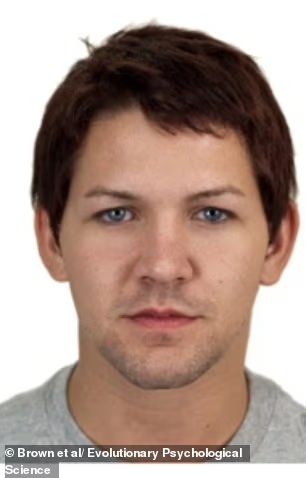
Forget the dad bod – it seems having a ‘dad face’ can be attractive to women, too.
A new study has found that face shape can influence how people judge a man’s parenting abilities, even before they know anything about him.
Researchers analysed facial width-to-height ratio – a measurement that compares the horizontal distance from a person’s cheek to cheek to the vertical distance from the upper lip to the brow.
They discovered that men with wider faces are viewed as more capable of protecting children.
This could be because these men are perceived as being stronger and more aggressive, the scientists said.
And it could go some way to explaining why broad-faced men – including Chris Hemsworth and David Beckham – regularly feature in ‘sexiest celebrity dad’ lists.

As part of the study, participants were asked to rate male faces including those which were wider (left) and narrower (right)
The study was carried out by a team from the University of Arkansas at Fayetteville.
In one experiment, more than 100 participants were asked to evaluate 20 neutral photographs of male faces, rating how effective each would be at protecting and nurturing his children.
Analysis revealed that men with wider faces were rated as more effective at protection, with an average score of 4.23 out of seven, compared to 3.84 for men with narrower faces.
However, there was no difference in the nurturing ratings for each group.
In a second experiment, participants were asked to select up to five men who would be best at protecting offspring.
Men with wider faces were picked much more often, the researchers found – and were also perceived as being stronger and more aggressive.
‘The effects in this study are fairly large, which may reflect an apparently loud signal value in the faces,’ lead author Mitch Brown told PsyPost.
‘Ancestral conditions likely saw individuals having to infer information relatively quickly without having the chance for fuller interactions, which may lead to an advantage in forming stereotypes with minimal information.’

Analysis revealed that men with wider faces were rated as more effective at protection, with an average score of 4.23 out of seven, compared to 3.84 for men with narrower faces

The findings could go some way to explaining why broad-faced men – including Chris Hemsworth – regularly feature in ‘sexiest celebrity dad’ lists
The researchers explained that alongside good genes, humans consider prospective mates’ capacity and motivation for investing in their children.
‘Though debate exists about how paternal investment contributes to offspring survival, paternal care among humans remains extraordinary,’ they wrote in the journal Evolutionary Psychological Science.
‘Our findings provide a consistent pattern of perceivers viewing high facial width-to-height-ratio men as advantaged in offspring protection.’
They explained that men’s social status often depends on how physically capable they are in a fight or conflict.
‘The advantages afforded to formidable men would lead to women recognizing the benefits of such men in parenting decisions and valuate the potential benefits for families,’ the paper concludes.
‘Namely, perceivers ascribe greater effectiveness in, and motivation for, offspring protection among [wide-faced] men, which shapes a coalitional preference for such men as fathers.’
A recent study suggested that the popularity of the ‘dad bod’ could be waning. For years the softer, more relaxed outline synonymous with Vince Vaughn, Seth Rogen and David Harbour has been depicted as the ideal body shape.
However, research now suggests women prefer a leaner, more athletic build like that sported by Brad Pitt
Men, meanwhile, still seem to favour women who are a bit curvier, such as Kelly Brook, Beyoncé and Nigella Lawson.
The results suggest that when it comes to attraction, people are more likely to be drawn to the middle ground rather than extremes that are promoted by social media.
And it reveals that ultra-slim or hugely muscular bodies are still being out-competed by more natural shapes.
‘The most interesting thing about this analysis is that people were not choosing the most extreme body types that we are normally led to believe is the ideal,’ a spokeswoman from SoloFun, which commissioned the study, said.
‘People attracted to men, for example, preferred a lean body type, whereas people attracted to women leaned more towards a softer, curvier body type.’