Charles Darwin famously claimed that fire was the greatest of all human inventions, with the exception of spoken language.
Now, scientists claim that these two great human innovations could be two sides of the same coin.
Researchers say that human speech was born when our ancient ancestors started gossiping and trading stories around the campfire late into the night.
More strikingly, they argue that firelight itself could have been ‘critical’ to the evolution of sophisticated language that separates us from our primate relatives.
Humans’ ability to control fire allowed us to cook and make more sophisticated tools, but it also extended early humans’ wakeful period roughly four hours past sunset.
The researchers say that the end-of-the-day campfire would have been one of the first times that the whole community could come together without pressing practical needs.
Just like many campers still do today, that would have been the perfect moment to exchange news about what had happened in the day and tell stories.
According to lead author Professor Catherine Hobaiter, a psychologist and neuroscientist from the University of St Andrews, this could have been the first step towards a more complex, abstract system of communication.
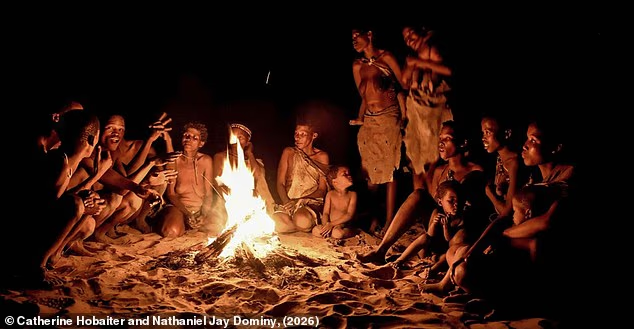
Researchers say that human speech was born when our ancient ancestors started gossiping and trading stories around the campfire late into the night. Pictured: The Ju/’Hoansi-San in Namibia telling stories by the fire
Most previous theories suggest that language gradually emerged out of calls and gestures, like those used by gorillas and chimpanzees.
However, new evidence about primates’ complex social lives and impressive abilities is now casting doubt on this idea.
Professor Hobaiter says: ‘Decades of research with other species has shown us that you don’t need language to learn from each other, to organise where and when to forage, to learn cultural knowledge about tools and songs, to co-ordinate.’
Chimpanzees, for example, are perfectly capable of teaching each other how to make tools, organise patrols of their territory, wage ‘war’ against other groups, and maintain a complex social order without anything resembling a language.
‘It starts to look like human language didn’t evolve for anything very useful,’ says Professor Hobatier.
‘While other species share all these skills, there is a fundamental puzzle: we struggle to find evidence of key differences between human and ape communication, and yet we are surrounded by evidence of human distinctiveness.’
The big problem, therefore, becomes how we can find where human language might have started if not as a way of solving practical problems.
The clue came from a 2014 study that recorded the daytime and nighttime conversations of the Ju/’hoansi foragers in southern Africa.

Previous studies have shown that daytime talking in hunter-gatherer groups is used for practical matters which can be completed without spoken language, whereas talks by the fire are reserved for stories

Scientists say that the spectrum of firelight (illustrated) is perfectly suited to sitting up and talking into the night
This revealed that daytime conversations were reserved for practical, mundane topics, whereas fireside time was almost entirely devoted to storytelling.
If gestures already cover our ancient ancestors’ practical needs during the day, Professor Hobaiter’s suggestion is that language emerged at night during these campfire story sessions.
This argument is made more compelling by the fact that firelight itself appears to be uniquely well suited to promoting human socialising.
Light of any kind activates specialised sensors in our eyes that suppress the production of melatonin, the hormone that tells your body it’s time to sleep.
These receptors are especially sensitive to blue light, which is why looking at your phone before bed tends to wreck your sleep.
Firelight, however, contains almost no blue light whatsoever and, therefore, can enable people to stay up later without disrupting their sleep.
The scientists also suggest that fire’s hypnotic flickering could be key in getting people ‘on the same emotional wavelength’.
Co-author Professor Nathaniel Dominy, an anthropologist from Dartmouth College, says: ‘Firelight is the product of a chemical reaction, and you might think it is extremely well studied, and it is, but not the properties that draw our attention and focus; that instil harmony and cooperation.’

Since firelight contains almost no blue light, it doesn’t suppress the production of melatonin. This means it enables people to stay up and talk without disrupting their sleep
Fire’s shifting light triggers neurons in the brain’s visual cortex, the area associated with vision, to synchronise their firing with the frequency of the flickering.
When people all sit and watch the fires together, this could cause their neurons to synchronise.
Studies have linked this neural synchrony to increased empathy, mutual liking, social connectedness, and better teamwork.
By fostering a deep sense of social connection, this subtle neurological quirk could have helped pave the way for more complex forms of communication.
Although the researchers say we can only speculate as to what those first stories might have been about, these fireside tales could be the origin of humanity’s incredible language skills.