There’s nothing more annoying than cancelling plans because rain is forecast, only to be greeted by blue skies and sunshine.
Now, a study has revealed why inaccurate weather forecasts make us so emotional.
Scientists from Pohang University of Science and Technology investigated how forecast errors triggered emotional responses from the public during Typhoon Khanun – a powerful tropical cyclone that swept Japan and Korea in 2023.
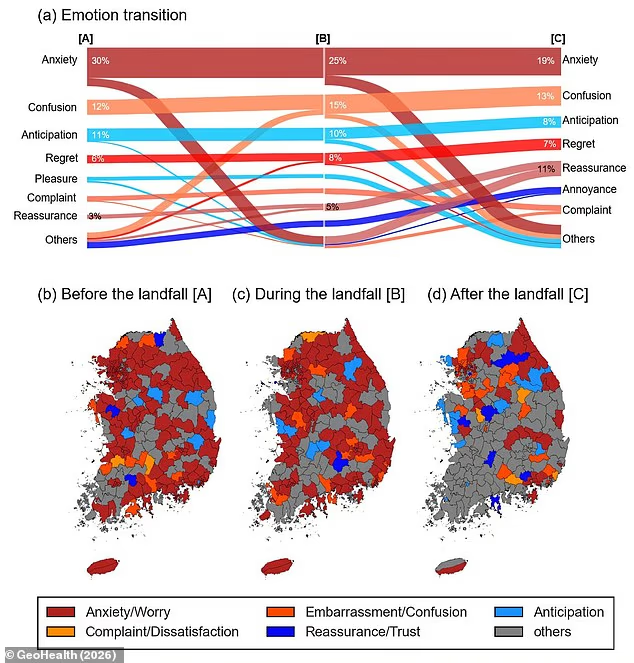
According to their analysis, in regions where rainfall was overestimated, anxiety, worry and fatigue spiked.
However, in areas where rainfall was underestimated, there was a surge in confusion, embarrassment, and sadness.
The news will come as no surprise to many people, who often take to social media to vent their frustrations over inaccurate weather forecasts.
‘Forecasts promised some sun this weekend and none arrived. Frustrating,’ one user vented on Reddit.
Another added: ‘Many many years ago you used to be able to rely on the weather reports or even the apps. But now they are so inaccurate it’s actually really frustrating.’
Scientists from Pohang University of Science and Technology investigated how forecast errors triggered emotional responses from the public during Typhoon Khanun – a powerful tropical cyclone that swept Japan and Korea in 2023

In the eastern and southeastern regions of the Korean Peninsula, rainfall was underestimated, causing confusion, embarrassment and sadness. Pictured: rescue workers in Daegu, South Korea
Around the world, many people check the weather on a daily basis – particularly amid extreme weather, such as the current UK heatwave.
However, exactly how mismatches between expectation and reality affect our emotions has remained a mystery until now.
To get to the bottom of it, the researchers analysed rainfall records from 613 weather stations during Typhoon Khanun.
They also used AI to assess more than 43,000 online posts at that time.
The results revealed ‘clear spatial differences in forecast performance.’
In the western and metropolitan areas of the Korean Peninsula, rainfall tended to be overestimated, leading to a spike in anxiety, worry and fatigue among residents.
But over in the eastern and southeastern regions, rainfall was underestimated, causing confusion, embarrassment and sadness.
According to the researchers, the findings suggest that forecast accuracy is not only a technical issue, but also an important factor in the public’s emotional wellbeing.
Dr Karu Kim, the lead author of the study, said: ‘This study demonstrates that in disaster situations, it is important not only to improve forecast accuracy but also to develop risk communication strategies that effectively convey uncertainty to the public.’
The news comes shortly after scientists from the University of Reading revealed the most accurate weather app in the UK.
If it’s the best temperature forecasts you’re after, the experts advise using the Met Office.
However, if you’re more interested in rain predictions, it’s better to use BBC Weather.
Dr Rob Thompson, who led the research, said: ‘Whether you use BBC Weather or Met Office for checking the weather, you’re in good hands.
‘The forecasts are reliable for several days, helping you to know what clothes to pack for a weekend trip or when to expect a frost in the garden.
‘BBC Weather appears to be slightly better at predicting rain, although its variability means forecasting rain is much harder than temperature and needs more data to draw firm conclusions.
‘As we would expect, we also find that the further ahead the forecast, the more uncertainty there is.’