Thursday, April 23, 2026
No Result
View All Result
LJ News Opinions
  • Home
  • U.S.
  • Politics
  • World News
  • Business
  • Entertainment
  • Sports
  • Technology
  • Health
  • Opinions
  • Home
  • U.S.
  • Politics
  • World News
  • Business
  • Entertainment
  • Sports
  • Technology
  • Health
  • Opinions
No Result
View All Result
LJ News Opinions
No Result
View All Result
Home Technology

Explorers stumble across a secret ISLAND in Antarctica’s ‘danger zone’ – after initially mistaking it for a dirty iceberg

by LJ News Opinions
April 10, 2026
in Technology
0
Share on FacebookShare on Twitter


Scientists exploring the Weddell Sea in the Antarctic were in for a surprise after stumbling across a secret island in an area marked a ‘danger zone’. 

A 93–strong team on board the Alfred Wegener Institute’s (AWI) icebreaker, Polarstern, made the discovery after rough weather conditions forced them to seek shelter next to Joinville Island. 

There, they spotted a strange brown landmass, which turned out to be a previously undiscovered island. 

‘On our route, the nautical chart showed an area with unexplored dangers to navigation, but it wasn’t clear what it was or where the information came from,’ explained Simon Dreutter, a specialist in underwater mapping at AWI. 

‘I scoured all the coastlines we had here in the bathymetry lab and went back to the bridge. 

‘Looking out of the window, we saw an “iceberg” that looked kind of dirty. 

‘On closer inspection, we realised that it was probably rock. 

‘We then changed course and headed in that direction and it became increasingly clear that we had an island in front of us!’ 

Scientists exploring the Weddell Sea in the Antarctic were in for a surprise after stumbling across a secret island in an area marked a ‘danger zone’

After spotting the landmass, the team carefully steered Polarstern towards it, eventually coming within 150 metres

After spotting the landmass, the team carefully steered Polarstern towards it, eventually coming within 150 metres

After spotting the landmass, the team carefully steered Polarstern towards it, eventually coming within 150 metres. 

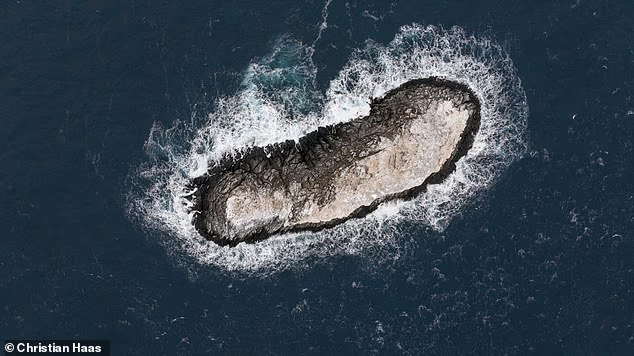
Using a drone, they were able to explore the island from above, confirming its surprisingly large size. 

The island measures 130 metres long, 50 metres wide, and protrudes about 16 metres out of the water. 

This makes it around the same length as the Great Pyramid of Giza. 

The experts are unclear why the island is marked as a danger zone on the nautical chart, but not as a coastline in other data sets. 

‘On the satellite images analysed, the island could hardly be distinguished from the numerous icebergs drifting around in the immediate vicinity due to its ice cover,’ they added. 

However, before the island can be added to maps, it must be named. 

While the team are undecided on what to name the island, many eager fans have already thrown a number of suggestions in the ring on X (formerly Twitter). 

Using a drone, they were able to explore the island from above, confirming its size. The island measures 130 metres long, 50 metres wide, and protrudes about 16 metres out of the water. This makes it around the same length as the Great Pyramid of Giza

Using a drone, they were able to explore the island from above, confirming its size. The island measures 130 metres long, 50 metres wide, and protrudes about 16 metres out of the water. This makes it around the same length as the Great Pyramid of Giza

The experts are unclear why the island is marked as a danger zone on the nautical chart, but not as a coastline in other data sets

The experts are unclear why the island is marked as a danger zone on the nautical chart, but not as a coastline in other data sets

A 93-strong team on board the Alfred Wegener Institute's (AWI) icebreaker, Polarstern, made the discovery after rough weather conditions forced them to seek shelter next to Joinville Island

A 93–strong team on board the Alfred Wegener Institute’s (AWI) icebreaker, Polarstern, made the discovery after rough weather conditions forced them to seek shelter next to Joinville Island

One user on X suggested: ‘They should call it Eisberg.’

‘It should be called Lummerland,’ another added, in reference to the fictional, two–mountain island from Michael Ende’s children’s book Jim Button and Luke the Engine Driver. 

And one joked: ‘Bird Rendezvous Island’.

The news comes shortly after a secret islet appeared off the coast of Venice.

Previously, the islet, called Bacan, would only form in the summer months before being swept away by winter’s storm surges.

But thanks to a new flood barrier this cherished refuge for tourist–shy residents has become a permanent fixture of the lagoon with its own flourishing ecosystem.

Measuring 250 metres long and 10 metres wide, the sandbank is covered with a layer of thick vegetation.

Bacan is now home to a range of marsh plants like samphire, rushes, native flowers, and small, salt–resistant cedars called tamarisk.

With new roots holding the soil in place, the island has not vanished since 2020 when the flood barrier’s operators were away on holiday during a winter surge.

However, even as residents celebrate the birth of a new beach, some experts warn that this could be a troubling sign for Venice’s fragile ecosystem.

SEA LEVELS COULD RISE BY UP TO 4 FEET BY THE YEAR 2300

Global sea levels could rise as much as 1.2 metres (4 feet) by 2300 even if we meet the 2015 Paris climate goals, scientists have warned.

The long-term change will be driven by a thaw of ice from Greenland to Antarctica that is set to re-draw global coastlines.

Sea level rise threatens cities from Shanghai to London, to low-lying swathes of Florida or Bangladesh, and to entire nations such as the Maldives.

It is vital that we curb emissions as soon as possible to avoid an even greater rise, a German-led team of researchers said in a new report.

By 2300, the report projected that sea levels would gain by 0.7-1.2 metres, even if almost 200 nations fully meet goals under the 2015 Paris Agreement.

Targets set by the accords include cutting greenhouse gas emissions to net zero in the second half of this century.

Ocean levels will rise inexorably because heat-trapping industrial gases already emitted will linger in the atmosphere, melting more ice, it said.

In addition, water naturally expands as it warms above four degrees Celsius (39.2°F).

Every five years of delay beyond 2020 in peaking global emissions would mean an extra 8 inches (20 centimetres) of sea level rise by 2300.

‘Sea level is often communicated as a really slow process that you can’t do much about … but the next 30 years really matter,’ said lead author Dr Matthias Mengel, of the Potsdam Institute for Climate Impact Research, in Potsdam, Germany.

None of the nearly 200 governments to sign the Paris Accords are on track to meet its pledges.

Source link

Tags: dailymailsciencetech
LJ News Opinions

LJ News Opinions

Next Post

Mickey Moniak says he'd cut off a finger to play in the MLB playoffs

Recommended

German nurse jailed for murder may face inquiry into 100 more deaths

3 months ago

See it: Fisher caught on camera in Cuyahoga County in over 100 years

4 months ago

Popular News

    Connect with us

    LJ News Opinions

    Welcome to LJ News Opinions, where breaking news stories have captivated us for over 20 years.
    Join us in this journey of sharing points of view about the news – read, react, engage, and unleash your opinion!

    Category

    • Business
    • Entertainment
    • Health
    • Opinions
    • Politics
    • Sports
    • Technology
    • U.S.
    • World News

    Site links

    • Home
    • About us
    • Contact

    Legal Pages

    • Privacy Policy
    • Cookie Privacy Policy
    • Terms of Use
    • Disclaimer
    • California Consumer Privacy Act (CCPA)
    • DMCA
    • About us
    • Advertise
    • Contact

    © 2024, All rights reserved.

    No Result
    View All Result
    • Home
    • U.S.
    • Politics
    • World News
    • Business
    • Entertainment
    • Sports
    • Technology
    • Health
    • Opinions

    © 2024, All rights reserved.