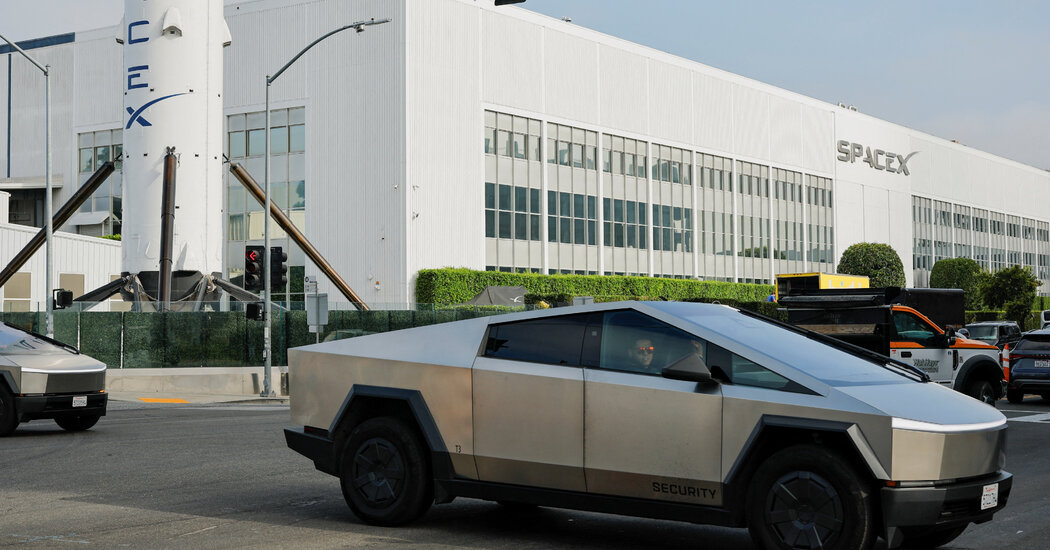
SpaceX held the biggest initial public offering of all time, but Wall Street may be expecting something even bigger from Elon Musk, the rocket company’s chief executive.
Many of his fans and investors expect him to merge SpaceX with Tesla, the maker of electric cars where he is also chief executive, joining most of his businesses into a single roughly $4 trillion tech conglomerate, a sort of Elon, Inc.
Investors, analysts and even a top SpaceX executive have talked about the merits of such a deal on social media, in research notes and in a TV interview. The two companies have long shared executives and other resources and are jointly developing multibillion dollar projects.
Because Mr. Musk controls SpaceX and is Tesla’s largest shareholder, he would essentially be making a deal with himself. That would raise legal issues and probably prompt lawsuits claiming that he ran roughshod over the interests of other shareholders.
But no legal action is likely to stop Mr. Musk, legal experts say. Corporate law in Texas, where Tesla and SpaceX have their corporate domiciles, makes it very difficult for unhappy investors to challenge management decisions.
Tesla relocated to Texas from Delaware last year after Mr. Musk expressed dismay about a state court ruling — later overturned — that challenged a 2018 pay package that helped pad the fortune of the world’s richest person. SpaceX moved to the Lone Star state, from Delaware, in 2024.
“Basically he’s gotten to the point where he can do almost anything he wishes,” said Charles Elson, the founding director of the Weinberg Center for Corporate Governance at the University of Delaware.
In Delaware, any aggrieved shareholder can take a company to court. To file a lawsuit in Texas, shareholders must hold at least 3 percent of a company’s stock.
The only shareholders likely to come close to that threshold are large investment firms like Vanguard and Fidelity that do not usually engage in such lawsuits.
Shareholders can band together to form a 3 percent bloc, but even that is a formidable hurdle. At Tesla’s current market value of $1.5 trillion, dissident investors would have to collectively own shares worth $45 billion.
“You’re looking at a truly huge amount of stock,” said James Spindler, a professor of corporate law at the University of Texas School of Law. “This is a pretty big impediment.”
Tesla and SpaceX did not respond to requests for comment. A representative of Tesla’s board of directors declined to comment. SpaceX did not respond to a request for comment.
Experts expect that SpaceX, as the larger company by market valuation, would offer to trade its shares for Tesla shares to form the new company.
The sprawling conglomerate’s activities would potentially include rocket building; artificial intelligence; the satellite internet service, Starlink; electric car and truck manufacturing; battery production; solar energy hardware; and the social media site, X. Products under development across the two companies include orbital data centers, self-driving taxis and humanoid robots.
Under Texas law two-thirds of Tesla shareholders would have to approve the merger. Mr. Musk already controls about 20 percent of the votes. Many of the remaining shareholders have a deep admiration for Mr. Musk and recently approved a pay package for him worth almost a trillion dollars, if he meets ambitious goals.
Tesla’s board of directors also has a history of backing Mr. Musk’s ideas. The carmaker and SpaceX have long had some of the same people on their boards, many of whom have long friendships or business relationships with Mr. Musk.
On Wednesday, SpaceX named Roelof Botha, who previously worked with Mr. Musk at PayPal and whose venture capital firm has invested heavily in other Musk companies, to its board.
Mr. Musk “has got this cheering section who will follow him to the gates of Hades or gates of heaven, wherever he leads them,” Mr. Elson said.
But if the terms of an acquisition are too favorable to SpaceX, Tesla shareholders could balk, Eric Talley, a professor at Columbia Law School, said.
“There is going to be a limit to how much he can lowball the Tesla shareholders before he starts to lose the room,” Mr. Talley said, referring to Mr. Musk.
Gwynne Shotwell, president and chief operating officer of SpaceX, has not discouraged merger talk. Combining SpaceX and Tesla “might make Elon’s life a little easier,” she told CNBC last week. “There’s no question that there are synergies between Tesla and SpaceX in our futures.”
SpaceX’s regulatory filings acknowledge the possibility of a merger, warning that acquisitions or partnerships “may present significant challenges, including aligning operations, systems, and cultures, which could result in inefficiencies, increased costs, or failure to realize anticipated benefits.”
The rocket company already has various links to Tesla. They plan to jointly produce A.I. chips at a proposed factory called Terafab and develop A.I. software through another project called Macrohard.
Tesla had also invested in xAI, Mr. Musk’s A.I. company, which was merged with SpaceX earlier this year, and sold hundreds of millions of dollars worth of batteries and cars to the rocket maker over the last two years, according to SpaceX’s I.P.O. filing.
“We plan to explore other areas of strategic collaboration with Tesla in the future,” the document said.
From a SpaceX perspective, any merger would need the blessing of only one person: Mr. Musk. The trillionaire has more than 82 percent of the shareholder votes in his company because he owns a special class of share that gives him 10 votes to every one vote assigned to the class of shares other investors own. The company also has entered into various agreements designed to preserve his power.
Brian Quinn, a professor at Boston College Law School, said that because Mr. Musk had such a large share of votes at SpaceX, acquiring Tesla, which does not have two classes of stock, would potentially allow him to keep majority voting control over a combined company.
“If you think that the next thing to happen is that SpaceX will acquire Tesla, having a buffer is valuable,” he said, referring to Mr. Musk’s large voting stake in SpaceX.
Some investment managers who own Tesla and SpaceX shares say a merger just makes sense.
Tesla’s expertise in semiconductors and data center construction would mesh with SpaceX’s plans to build data centers in space, said Tasha Keeney, director of investment analysis and institutional strategies at ARK Investment Management. Ark’s funds own both stocks.
SpaceX has reduced the cost of sending cargo into space, a prerequisite to building solar-powered orbiting data centers. If SpaceX succeeds in proving the space data center concept, Ms. Keeney said, its A.I. unit would gain a competitive advantage against Anthropic, OpenAI and other companies in artificial intelligence.
But she said that ARK Invest would prefer that the merger take place after Tesla has become the dominant company in self-driving taxis. Tesla has been testing small numbers of such taxis in Texas and San Francisco and has begun manufacturing a Cybercab designed to operate without a driver.
“It would be good for shareholders to see that take off before the merger,” Ms. Keeney said. “But we think it makes sense in general.”
Lawyers, politicians and some shareholders will probably try to block the merger, even if doing so would be difficult.
Shareholders might claim fraud in federal court if they can demonstrate that Mr. Musk or the Tesla or SpaceX boards withheld information ahead of shareholder votes. But such a suit would probably succeed only if the merged company is a flop and shareholders lose money, experts said.
“As long as he keeps running the business well and the stock price keeps going up, that is a pretty good bar to bringing a securities fraud suit,” Mr. Spindler of the University of Texas said.
Federal regulators could, in theory, try to block the merger on antitrust grounds because both companies are in the artificial intelligence business.
Regulators could also object on national security grounds. “It’s hard to ignore the national security implications for a deal involving two significant companies that combine A.I., robotics, communications and space,” Mr. Talley said.
But U.S. regulators are unlikely to object while Donald Trump is president, Mr. Talley added. Mr. Musk has donated hundreds of millions of dollars to Republican candidates, including Mr. Trump, and the administration has declined to challenge several other big deals.
European officials could also try to raise antitrust objections to the deal, as they have with Google, Meta and Apple. But it might be tough to prove that a combined SpaceX and Tesla would dominate any industry.
Probably the biggest obstacle to a merger would be plunging share prices.
“When it’s a bull market everybody’s pretty happy because everybody’s making money,” Mr. Elson, the Delaware governance expert, said.
Lauren Hirsch contributed reporting from New York.