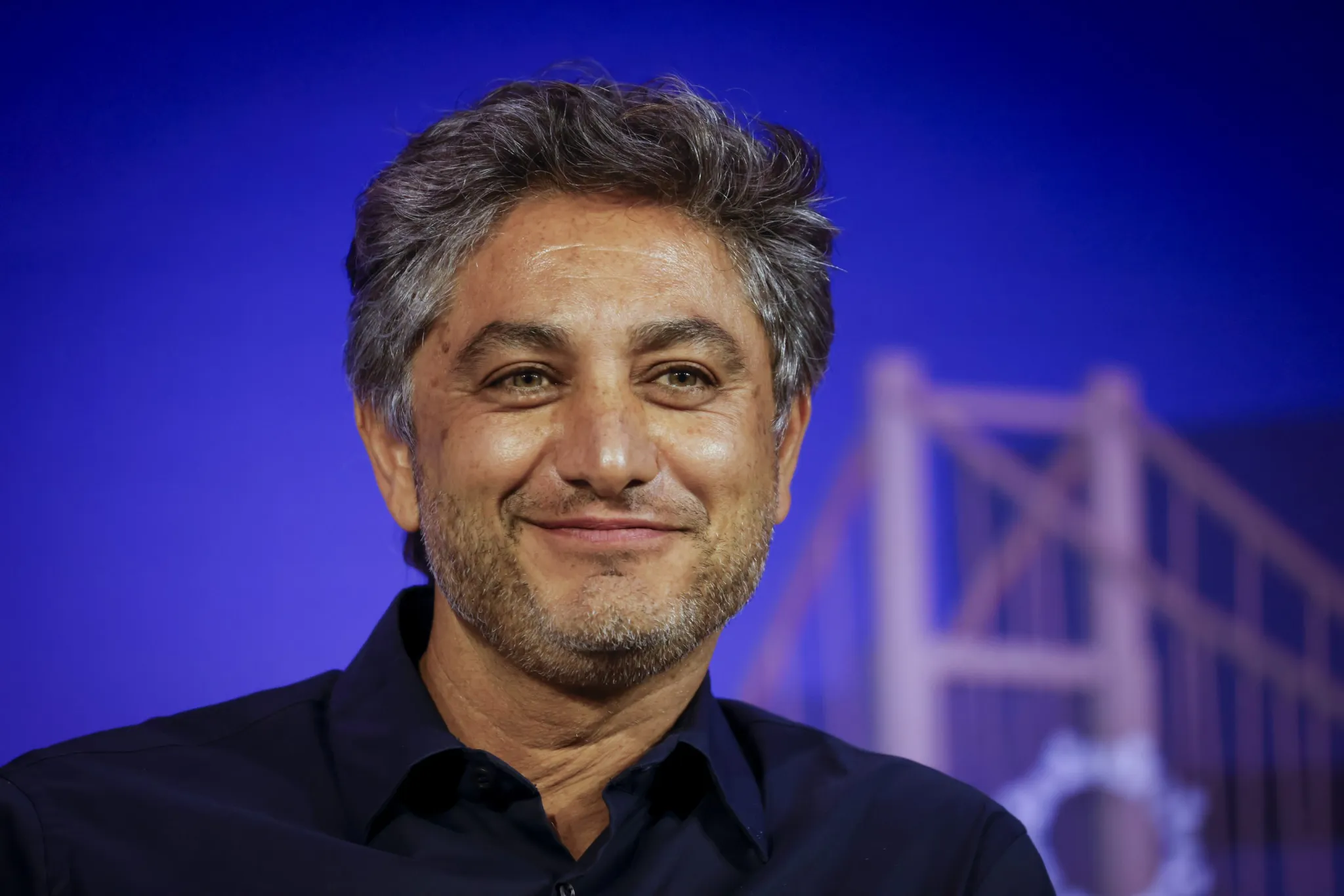
His name is Antonio Gracias, a handsome private equity investor from Detroit. The two met through the Silicon Valley web at the turn of the century, and soon Gracias—at 55, just one year older than Musk—lent Musk $1 million in his early days at Tesla, when the company was teetering on the edge of bankruptcy.
The two have been best friends ever since. Gracias was a groomsman at Kimbal Musk’s wedding, the families have vacationed together, spent the holidays together, and even traveled to David Copperfield’s private island in the Bahamas.
And Gracias trailed Musk through all of his ventures. He’s sat on the boards of Tesla—where he spent eight years as lead independent director—SpaceX, SolarCity, Neuralink, and The Boring Company. His firm, Valor Equity Partners, was one of Tesla’s earliest institutional investors and has put money into nearly every Musk company.
Gracias even followed Musk into the federal government, taking a role at the Department of Government Efficiency before resigning in July amid scrutiny over managing $2 billion in public pension assets while serving as a government employee.
Now, with SpaceX preparing for the largest IPO in history, Gracias’ loyalty is about to pay off.
His Valor entities collectively hold more than 500 million shares of SpaceX Class A stock—roughly 7.3% of the company, making him the second-largest individual shareholder after Musk. At the $1.75 trillion valuation Bloomberg and Reuters have reported SpaceX is targeting, Gracias’ stake will be worth around $90 billion. At $2 trillion, it climbs past $140 billion. Either way, the IPO will make him one of the 50 wealthiest people alive.
He’s also earning it.
Three leases, $20 billion, one board member
Last October, SpaceX’s S-1 shows, an xAI subsidiary called CTC signed an equipment lease agreement with Valor for AI infrastructure hardware—specifically, the GPUs needed to power xAI’s data centers. (xAI was a separate Musk company at the time; SpaceX absorbed it in February.) In January, CTC signed a second lease with Valor. In April, a third.
Together, the three agreements obligate the company to pay Valor close to $20 billion over their terms. And SpaceX guarantees the payments—meaning if the xAI subsidiary can’t cover them, SpaceX itself is on the hook. That guarantee is unusual on its own: It suggests xAI couldn’t get this kind of financing on its own credit, and needed its parent company to step in. Indeed, the new filing shows xAI was ridden with debt, including secured senior notes at a 12.5% interest rate—distressed-borrower pricing that shows the company was struggling to access typical financing routes.
Once SpaceX goes public, all that liability transfers to public shareholders, who will inherit billions in obligations from a deal struck while the company was still private.
So far, the Valor entities have collected roughly $885 million from the leases in 2025, and another $857 million in just the first two months of 2026.
The structure is unusual enough that SpaceX’s auditor, PwC, refused to treat it as a normal lease, and instead called it a “failed sale leaseback.” In a typical sale-leaseback, one party sells an asset to another, then leases it back. Here, that meant CTC—the xAI subsidiary—”sold” the GPUs to Valor, then leased them back for use in its own data centers. For the deal to count as a real sale, Valor needed to actually obtain control of the GPU. But the terms of the arrangement, in PwC’s view, meant CTC retained effective control of the assets, making Valor just like a regular lender, with the GPUs serving as collateral.
In other words, SpaceX and xAI structured the deals in a way that, if accepted, would have kept the financing off SpaceX’s balance sheet. But it appears as if PwC refused. The auditors concluded the transactions were loans in substance, not leases, and forced SpaceX to record the debt anyway. The $9 billion now sits on SpaceX’s balance sheet as related-party debt payable to the firm of one of SpaceX’s own directors.
Neither Valor Equity Partners nor SpaceX responded to Fortune’s request for comment.
‘That’s the worst’
The arrangement alarmed two top corporate governance experts who Fortune spoke with.
Nell Minow, a chair of ValueEdge Advisors, called the Valor leases “deeply troubling”—both for what they suggest about SpaceX’s numbers and for what they suggest about its governance. Asked where the arrangement falls on the spectrum of related-party deals she’s seen across four decades of corporate governance work, Minow didn’t hesitate.
“That’s to me, that’s the worst,” she said. “They wouldn’t know an arm’s-length transaction if they saw one.”
An “arm’s-length transaction” is the standard corporate governance jargon for a simple test: Would the terms hold up if the two parties were strangers, with no shared interest in cutting each other a favor? It’s how public companies prove to investors that insiders aren’t quietly enriching themselves through company business—and it’s exactly that assurance that SpaceX’s S-1 doesn’t give for the Valor deals, she suggests.
Robert Willens, an accounting and tax expert at Columbia Business School, spotted that same gap. Public companies typically include a sentence in their related-party disclosures promising the terms are “no less favorable” than what an unaffiliated party would have gotten. SpaceX uses exactly that language in the section of the S-1 describing its dealings with Tesla, another Musk company. But it doesn’t use it in the section describing the Valor leases.
“If they don’t say it explicitly, you have to be led to believe that maybe they’re not being as careful as they are in the first agreement, and that they very well might be agreeing to terms that are less favorable than they would be with an unrelated party,” Willens said. “They know how to say it when they want to say it.”
If the Valor terms aren’t arm’s-length, Willens said, the lease payments could function as a “disguised dividend”; extra money flowing to Gracias not because the GPUs are worth what Valor is charging, but because he’s a powerful insider. The S-1 also doesn’t disclose whether Gracias recused himself from the board’s approval of any of the three deals, an omission both Minow and Willens said is notable for a $20 billion related-party transaction.
Public capital, private control
Minow said the arrangement is typical of SpaceX, which wants “the access to capital of a public company” but “the control of a private company.” It will actually be a “controlled company” under Nasdaq rules—exempt from requirements that a majority of its board be independent. Gracias himself is being seated on the compensation and nominating committee. The company reincorporated in Texas in 2024 after Musk personally lobbied state legislators to weaken shareholder protections; shareholder disputes are now subject to mandatory arbitration; and under SpaceX’s charter, Musk can only be removed from his leadership positions by holders of Class B stock, the majority of which he controls.
And all of it is happening just as Nasdaq has changed its rules to ensure millions of Americans will own SpaceX whether they want to or not. In March, the exchange rolled out a new “Fast Entry” rule letting large IPOs join the Nasdaq 100 after just 15 trading days; down from a typical period of three months to a year. For comparison, Facebook waited seven months, while Airbnb waited a year, and Tesla waited three. Reuters reported that fast index inclusion was a condition of SpaceX’s Nasdaq listing.
The consequence: Every fund tracking the Nasdaq 100—including the $385 billion Invesco QQQ and trillions in other ETFs and retirement accounts—will be forced to buy SpaceX stock weeks after it lists, regardless of price or governance. Goldman Sachs analysts estimate the rule change could trigger up to $60 billion in forced buying across the Nasdaq 100 ecosystem.
“I wish they were as good at engineering,” Minow said of SpaceX, “as they are at cutting off every possible avenue of independent oversight.”