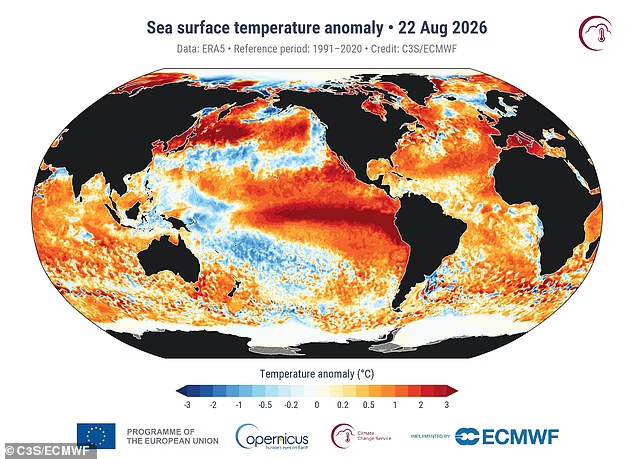
As the ‘Superest of all Super El Niños’ takes shape, a new study has found that El Niño events have been ramping up for decades.
Scientists from the University of Michigan examined corals in the Galapagos Islands to estimate the strength of previous events.
Their analysis revealed that El Niños have become nearly 40 per cent stronger in the last 40 years than the previous 1,000.
‘We don’t see a time in the past where El Niños have been as strong as today,’ said lead author Professor Julia Cole.
‘We show that the strength of El Niño changes in parallel with the warming of global temperature.
‘Our findings tell us that the big El Niño events of the last 40 years are not normal in the context of the last thousand years.’
The study comes shortly after experts warned that the current El Niño will wreak havoc on Britain this winter.
Professor Bill McGuire, Professor Emeritus of Geophysical Hazards, said: ‘Powerful El Niños typically bring mild, stormy Autumns and early Winters to the UK, followed by bitter cold, although this isn’t set in stone.’
As the ‘Superest of all Super El Niños’ takes shape, a new study has found that El Niño events have been ramping up for decades

Scientists from the University of Michigan examined corals in the Galapagos Islands to estimate the strength of previous events
The El Niño Southern Oscillation is a naturally occurring climate cycle that shifts from hot El Niño years and cool La Niña years once every two to seven years.
As we enter an El Niño phase, the powerful trade winds that normally blow hot water across the Pacific towards Australia weaken, or even reverse.
That prevents cool waters welling up from the deep ocean below and causes hot water to collect near the surface off the west coast of South America.
Eventually, that warm water starts to spread out, raising the average global temperature and causing major disruptions to weather patterns around the globe.
In their new study, the researchers set out to understand how El Niños have changed through the years.
The team sampled cores from 13 corals in the Galapagos Islands, ranging from ancient boulders to living colonies.
Because El Niño events occur every few years, the researchers focused on core samples that spanned at least 20 years.
Their analysis revealed that strong El Niños occurred in the last 40 to 50 years.

Ancient corals like these at Urvina Bay in the western Galápagos preserve a history of ocean temperature going back millennia
But prior to that time, there was a ‘pretty consistent pattern of lower intensity El Niños’.
‘We kept adding records thinking well, this is going to get more complicated, but it really didn’t,’ Professor Cole said.
‘This is such a clear story.’
To understand why El Niños are getting stronger, the researchers used climate models that simulate the last 1,000 years, using histories of volcanic eruptions and solar variability.
The models found no evidence that natural processes could create such large changes – suggesting global warming is largely to blame.
Professor Cole added: ‘El Niño is a really big source of climate extremes, and so if it’s getting stronger, the impacts are getting stronger.
‘Impacts like droughts, floods, wildfire and food insecurity.
‘Changes in the hydrologic cycle also lead to issues like damage to infrastructure: floods that wipe out homes, highways or railroads, or to health effects, such as diseases like cholera.
‘We believe global warming is supercharging El Niño, and if that’s true, then we expect stronger climate extremes that will amplify ecological, infrastructural and human losses.
‘No country has the resources to be fully protected from these impacts.
‘This is one more reason we need to move away from fossil fuels, the root cause of the problem.’