Scientists have captured the first image of a rare ‘minimoon’ that loops around the Earth like a dance partner.
Asteroid 2016 HO3, also known as Kamoʻoalewa, is locked into an orbit around the sun while tracing a circle around our planet.
It was first spotted around a decade ago by the Pan–STARRS 1 asteroid survey telescope on Haleakala, Hawaii.
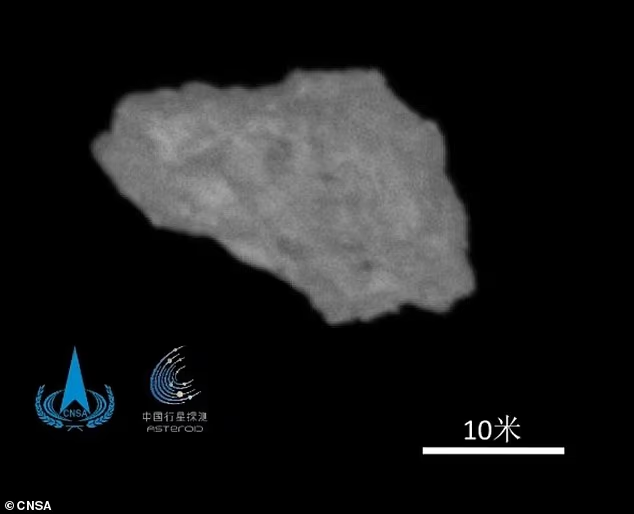
Now, a probe sent by the China National Space Administration (CNSA) mission has just returned its first picture of our small celestial neighbour.
The image shows a grey space rock with jagged edges, with the vastness of space as a backdrop.
While it is too distant to be considered a true satellite of our planet, it is the best and most stable example to date of a near–Earth companion, or ‘quasi–satellite’.
‘After a 400–day, one billion–kilometre (621 million–mile) journey, the Tianwen–2 probe recently made a successful encounter with asteroid 2016 HO3, reaching a distance of 20 kilometres (12.4 miles) from the asteroid to begin scientific exploration. During its approach to the asteroid, the probe acquired image data,’ CNSA said in a statement.
As part of its mission, Tianwen–2 will conduct in–orbit observations of the rock and even collect samples to bring back to Earth.
This is the first image of the rare ‘minimoon’, 2016 HO3, that loops around the Earth like a dance partner

Kamo’oalewa, whose name alludes to an offspring that travels on its own, was discovered by the PanSTARRS telescope in Hawaii in 2016. Its orbit in relation to Earth and the sun is pictured
Tianwen–2 launched on 29 May 2025 from the Xichang Satellite Launch Center as part of CNSA’s first asteroid sample–return mission.
After its long journey from Earth, the probe made its first optical detection of Kamoʻoalewa on June 6, and by June 19, it had approached to within 1,242 miles (2,000 km).
By July 2, it was just 12.4 miles (20km) away from the asteroid – close enough to capture an image clearly showing the space rock, which is believed to be 130 to 328 feet (40 to 100 metres) in diameter.
The probe’s mission was described in a paper published in Space Science Reviews earlier this year.
‘Among the known near–Earth asteroids, 2016 HO3 is an exceptionally rare Earth co–orbital object,’ physicist Rongqiao Zhang, of the Lunar Exploration and Space Engineering Centre in Beijing, and his colleagues, wrote.
‘As an Earth quasi–satellite, its orbital period is close to that of Earth, enabling low energy transfer…and providing favourable conditions for tracking, control, and communication.
‘Its unusual orbit, enigmatic origin and largely uncharacterized physical properties make it a compelling candidate for addressing fundamental questions about the origins of Earth’s quasi–satellites and the dynamical evolution of their orbits.’
The asteroid is one of only seven Earth quasi–satellites identified to date – but it is the closest at around 25.8 million miles (41.6 million kilometres) away.

As part of its mission, Tianwen–2 will conduct in–orbit observations of the rock and even collect samples to bring back to Earth

After launching from Earth (1) the probe travelled to the quasi–moon for analysis and to collect samples (2–4). After spending nine months at this asteroid, Tianwen–2 will drop off a capsule of samples from the quasi–moon during a flyby of Earth (5–6) before continuing to main–belt comet 311P (7–9)
The samples that the probe sends back to Earth will help confirm whether 2016 HO3 is a fragment of the moon, which has been suggested in previous studies.
Renu Malhotra, a University of Arizona space expert, said analysis of light reflected from the space rock suggests it’s made from the same material as minerals in lunar rocks from NASA’s Apollo missions.
When the asteroid was first discovered, Paul Chodas, manager of NASA’s Centre for Near–Earth Object (NEO) Studies, said: ‘Since 2016 HO3 loops around our planet, but never ventures very far away as we both go around the sun, we refer to it as a quasi–satellite of Earth.
‘Our calculations indicate 2016 HO3 has been a stable quasi–satellite of Earth for almost a century, and it will continue to follow this pattern as Earth’s companion for centuries to come.’
In its yearly trek around the sun, asteroid 2016 HO3 spends about half of the time closer to the sun than Earth and passes ahead of our planet, and about half of the time farther away, causing it to fall behind.
Its orbit is also tilted a little, causing it to bob up and then down once each year through Earth’s orbital plane.
In effect, this small asteroid is caught in a game of leapfrog with Earth that will last for hundreds of years.
The asteroid’s orbit also undergoes a slow, back–and–forth twist over multiple decades.
‘The asteroid’s loops around Earth drift a little ahead or behind from year to year, but when they drift too far forward or backward, Earth’s gravity is just strong enough to reverse the drift and hold onto the asteroid so that it never wanders farther away than about 100 times the distance of the moon,’ Dr Chodas said.
‘The same effect also prevents the asteroid from approaching much closer than about 38 times the distance of the moon. In effect, this small asteroid is caught in a little dance with Earth.’
After spending nine months at this asteroid, Tainwen–2 will drop off a capsule of samples from the quasi–moon during a flyby of Earth.
Then, it will continue on to main–belt comet 311P, which is past Mars.