Earth’s population’s currently sits at 8.3 billion people – but it’s set to get much bigger.
That’s according to scientists from Flinders University, who have estimated the peak population for our planet.
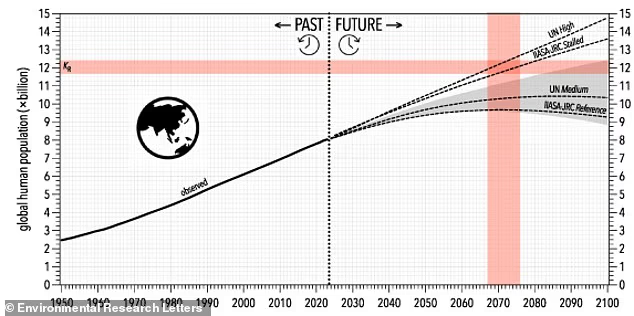
Based on current trends, the researchers say that the number of people on Earth could hitting a staggering 12.4 billion by the late 2070s.
This is ‘dangerous’, according to the experts – who warn we’re already pushing Earth past its breaking point.
‘The truly sustainable population is much lower and closer to what the world supported in the mid–twentieth century,’ said Professor Corey Bradshaw, lead author of the study.
‘Our calculations show a sustainable global population closer to about 2.5 billion people if everyone were to live within ecological limits and comfortable, economically secure living standards.’
Based on the findings, the researchers say that ‘major changes’ are urgently needed.
‘Humanity’s current path will push societies into deeper crises unless we make major changes,’ Professor Bradshaw added.
Based on current trends, the researchers say that the number of people on Earth could hitting a staggering 12.4 billion by the late 2070s

Earth’s population’s currently sits at 8.3 billion people – but it’s set to get much bigger (stcok image)
For the study, the researchers set out to understand the impact Earth’s growing population is having on food security, climate stability, and human wellbeing.
The team examined more than 200 years of global population data and used ecological growth models to track how population size and growth rates have changed over time.
Their results uncovered a ‘clear biological signal’ that humanity is already living beyond what Earth can support.
‘Earth cannot keep up with the way in which we are using resources,’ Professor Bradshaw said.
‘It cannot support even today’s demand without major changes, with our findings showing that we are pushing the planet harder than it can possibly cope.’
Before the 1950s, population growth sped up as human abdundance increased – with more people leading to more rapid technological development.
This pattern then broke down in the early 1960s, marking what the researchers call a ‘negative demographic phase.’
‘It means that adding more people no longer translates into faster growth,’ Professor Bradshaw added.

If the human population does hit 11.7–12.4 billion, it could have a devastating impact on our planet. The study found a ‘strong link’ between increasing population size and rising global temperatures (pictured), larger ecological footprints, and higher carbon emissions during the negative phase
If the human population does hit 11.7–12.4 billion, it could have a devastating impact on our planet.
The study found a ‘strong link’ between increasing population size and rising global temperatures, larger ecological footprints, and higher carbon emissions during the negative phase.
Professor Bradshaw said: ‘Humanity’s current path will push societies into deeper crises unless we make major changes.
‘The planet’s life support systems are already under strain and, without rapid shifts in how we use energy, land, and food, billions of people will face increasing instability.
‘Our study shows these limits are not theoretical but unfolding right now.’
Based on the findings, the researchers are calling for societies to rethink how they use land, water, energy and materials.
‘Smaller populations with lower consumption create better outcomes for both people and the planet, Professor Bradshaw explained.
‘The window to act is narrowing, but meaningful change is still achievable if nations work together.’