The earliest inscription declaring Jesus as God, uncovered in Israel, has revealed more secrets about early Christian history.
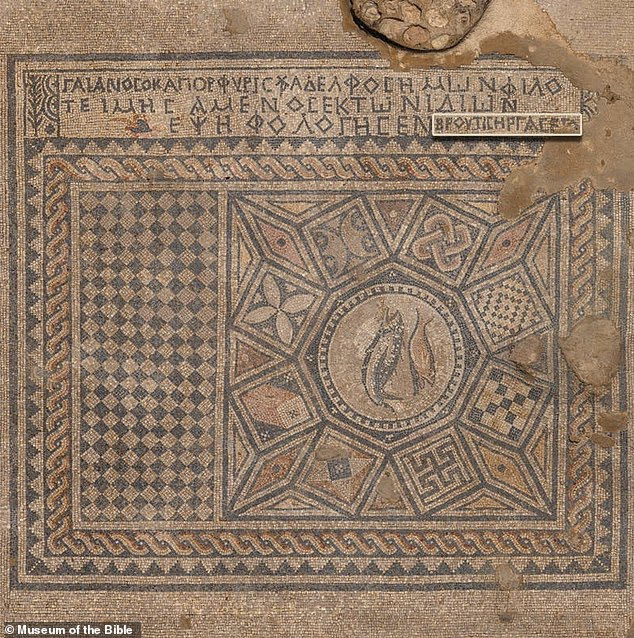
The 1,800-year-old mosaic, discovered by an inmate of the Megiddo prison in 2005, features the ancient Greek writing: ‘The god-loving Akeptous has offered the table to God Jesus Christ as a memorial.’
Together, there are several Greek inscriptions on the mosaic, with one naming the Roman centurion Gaianus, who researchers believe was an army officer who helped fund or support the 203 AD worship site where the mosaic was found.
Researchers continue to analyze the mosaic, saying in a recent study that the presence of a Roman centurion suggests Christianity had spread into the ranks of the Roman military far earlier than many historians once believed.
The Roman Empire officially adopted Christianity as its state religion on February 27, 380 AD. Centurions were respected officers who commanded dozens of soldiers, meaning Gaianus would have held both authority and influence within Roman society.
Researchers said his involvement challenges long-held assumptions that early Christians were primarily poor or marginalized outsiders during this period.
Instead, the inscription suggested individuals connected to the Roman establishment were already supporting Christian worship by the early third century.
That discovery offered rare physical evidence that belief in Jesus had reached powerful circles within the Roman world decades before Christianity became legal across the empire.
The Megiddo Mosaic (pictured) was unearthed during the expansion of a high-security prison in Israel. The mosaic had an inscription at the top (pictured) that said: ‘The god-loving Akeptous has offered the table to God Jesus Christ as a memorial’
The mosaic was the floor of an early Christian worship hall, often described as one of the earliest known church floors, though it was likely a house-church–style worship space and not a later formal basilica.
The floor has been hidden under the prison since it was discovered in 2005, but has now been lent to the Museum of the Bible in Washington DC.
The inscription naming the Roman officer states: ‘Gaianus, also called Porphyrius, centurion, our brother, has made the mosaic at his own expense as an act of generosity.’
The team also found a nearby Roman camp, providing more support for the peace between the two groups.
‘Gaianus is a Latin name, but his colloquial name, Porphyrius, is Greek. This could indicate that he came from one of the eastern provinces,’ according to the Museum of the Bible.
‘The fact that he did not use his full Roman name may also indicate that Gaianus dedicated this mosaic in a personal, rather than an official, capacity.
‘While “brother” is the common way Christians have always referred to each other, it is not certain that Gaianus was a Christian.
Professor Christopher Rollston with the George Washington University said in a recent study that ‘Gaianus also called Porphyrius’ resembles the language used in the New Testament to describe the apostle Paul.

There is an inscription naming Roman centurion Gaianus, which experts believe shows Romans believed in Jesus hundreds of years than previously believed
In the Book of Acts, Paul is referred to as ‘Saul also called Paul,’ a phrase that demonstrates how individuals in the ancient world often maintained both a traditional name and a more widely recognized one used in non-Jewish communities.
Paul was born a Roman citizen who actively arrested Christians, imprisoned them, and approved of their execution. The Bible says he encountered Jesus following the resurrection, and that is when he converted to Christianity.
While he is known as Paul to Christians, researchers have noted that Paul did not change his name after converting to Christianity.
Historical evidence suggests that he used both names throughout his life, Saul in Hebrew-speaking settings and Paul when interacting with Gentiles, or non-Jewish audiences.
Rollston said this same ‘double-name phenomenon’ was common across the ancient world, particularly among Jewish communities living outside Israel.
He explained that the use of two names often reflected cultural adaptation, allowing individuals to maintain their religious identity while functioning within a broader political or cultural system.

The mosaic was the floor of an early Christian worship hall, often described as one of the earliest known church floors, though it was likely a house-church–style worship space and not a later formal basilica
In the case of the Megiddo mosaic, this naming pattern suggests that Gaianus may have been a figure of significance operating within Roman society, potentially explaining his role in funding or supporting the early Christian worship site.
Further linguistic analysis revealed additional details about the inscription, including abbreviated words commonly used in Roman military contexts.
Rollston confirmed that the shortened form used to describe Gaianus’ rank, centurion, matches known abbreviations used in ancient Roman inscriptions.
The name of the artisan who set, or made and placed, the mosaic was included, Brutius, which researchers believe was another Roman.
The prayer hall, or church, was likely abandoned and covered up because the Roman Empire’s Sixth Legion was transferred to Transjordan, a region located to the east of the Jordan River.
The mosaic also contained the names of five women, highlighting the important role women played in the church.
Aside from Akeptous, who was mentioned for her donation of a table to the prayer hall, the mosaic’s inscription also says to ‘remember Primilla and Cyriaca and Dorothea and lastly, Chreste.’
The names of the women suggest they played a prominent role in the early Christian community at a time when female donors were not always publicly recognized.