NASA astronaut Reid Wiseman predicted he would go to the moon nearly a decade ago after a fortune cookie foretold a ‘visit to a strange place’.
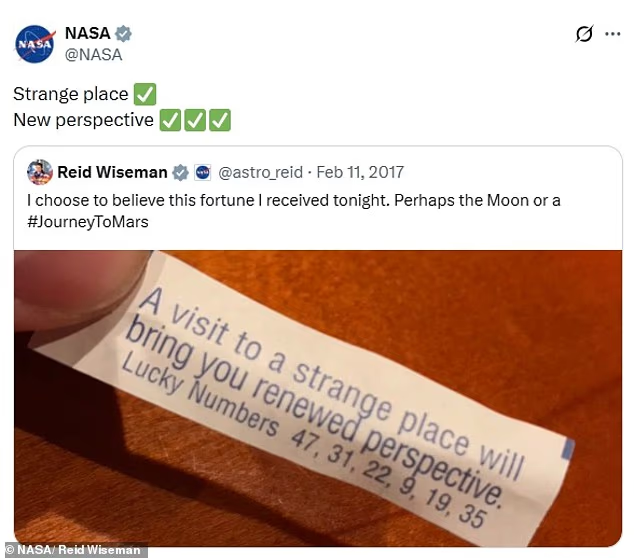
A newly unearthed tweet shows the Artemis II commander holding a small slip of paper containing a ‘prophecy’ back in 2017.
It reads: ‘A visit to a strange place will bring you renewed perspective,’ along with some lucky numbers.
Wiseman shared the picture on X with the caption: ‘I choose to believe this fortune I received tonight. Perhaps the moon or a #JourneyToMars.’
While many see fortune cookies as a bit of a novelty – or something to joke with friends about – this one appeared to foretell destiny.
This week, Wiseman became one of four astronauts to set a new distance record after travelling further from Earth than anyone before amid a mammoth mission around the dark side of the moon.
The Orion crew completed a six–hour flyby around our celestial neighbour on Monday, becoming the first humans in more than half a century to witness the distant hemisphere with the naked eye.
Last night NASA reshared Wiseman’s historic tweet, adding ticks next to ‘Strange place’ and ‘New perspective’ to indicate the prophecy had come true.
A newly unearthed tweet shows the Artemis II commander holding a small slip of paper containing a ‘prophecy’ back in 2017

This week Wiseman (pictured) became one of four astronauts to set a new distance record after travelling further from Earth than anyone before amid a mammoth mission around the dark side of the moon
Space fans took to the comments to express their delight at how well the fortune had aged.
‘That’s one fortune cookie that delivered on a cosmic scale,’ one wrote.
Another added: ‘Nine years later, the fortune came through in the most epic way.’
Others joked they had bought a lottery ticket with the numbers printed on the small piece of paper.
Some people pointed out that number 47 – the first one to appear on the slip – is considered lucky and a highly significant number across many cultures.
The number 22 is also widely considered a lucky and highly powerful number in numerology. It is believed to represent the ability to turn ambitious dreams into reality.
After slingshotting the moon and breaking the Apollo 13 distance record, Wiseman and the rest of the Artemis II crew are now ‘homeward bound’.
One of the most significant moments of the journey was when the team requested to name a ‘bright spot’ on the moon after Wiseman’s late wife, Carroll.

Weisman with his late wife Carroll and two daughters. Carroll, a nurse in a newborn intensive care unit, passed away in 2020

The ‘bright spot’ is an unnamed fresh crater on the boundary between the near side and the far side of the moon
The emotional request was made on Monday night during their lunar flyby, after they identified several newly–formed and unnamed craters on the lunar surface.
During a chat with mission control, Canadian astronaut Jeremy Hansen said: ‘Our science team helped us out with a couple of relatively fresh craters on the moon that have not been previously named.
‘And our crew would like to propose a couple of potential names for those areas.
‘A number of years ago we started this journey in our close knit astronaut family and we lost a loved one.
‘Her name was Carroll. The spouse of Reid. The mother of Katie and Ellie. And we would like to call it Carroll.’
As Wiseman and others wiped away tears, the four astronauts pulled together in a silent, floating embrace.
The feature is on the boundary between the near side and the far side of the moon.
‘At certain times of the moon’s transit around Earth, we will be able to see this from Earth,’ Hansen said. ‘It’s a bright spot on the moon.’

Reid Wiseman, commander of Artemis II, is now a single parent to his daughters, Ellie and Katherine
Carroll Taylor Wiseman, a nurse in a newborn intensive care unit, died at the age of 46 in 2020 following a battle with cancer.
Commander Wiseman, a former fighter pilot, has been raising their two daughters on his own since then.
Ahead of the mission, which will see the astronauts complete a mammoth 685,000–mile (1.1 million km) round–trip to the moon, Wiseman revealed he had discussed death plans with his children.
Wiseman said that as a single father raising two teenage daughters, they understand the risks of the mission but also share his belief in the importance of exploration and humanity’s drive to push beyond the unknown.