Middle East oil has long been a linchpin of the U.S. dollar’s status as the dominant currency in global trade and reserves, but President Donald Trump’s war on Iran could open the door to China’s currency, according to Deutsche Bank.
In a note on Tuesday, analysts pointed out that the current “petrodollar” regime goes back to a deal struck in 1974 when Saudi Arabia agreed to price its oil in dollars and invest surpluses in U.S. assets.
And because oil is a core input to global manufacturing and transport, supply chains have a natural incentive to dollarize, the note added. Indeed, Mideast oil and gas is used to make petrochemicals, fertilizer, and even helium, which is critical to chipmaking.
“The world saves in dollars in large part because it pays in dollars,” Deutsche Bank said. “The dollar’s dominance in cross-border trade is arguably built on the petrodollar: globally traded oil is priced and invoiced in USD.”
In exchange for Saudi Arabia recycling its dollars back into the U.S., Washington guaranteed the kingdom’s security, which also involved stationing troops in the region, providing advanced weapons, and ensuring free navigation in the Strait of Hormuz.
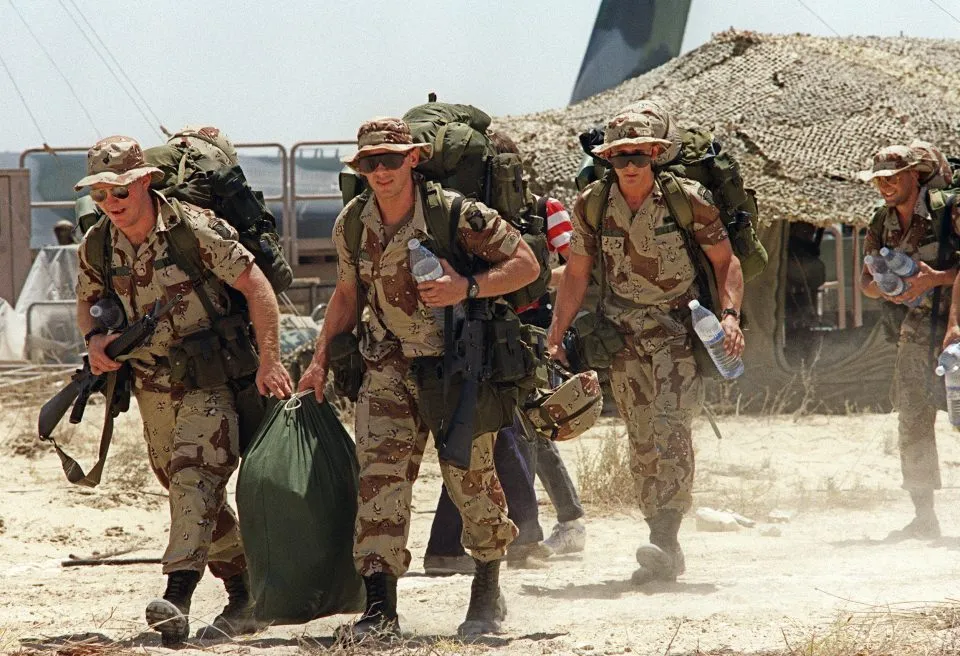
That security shield was on display in 1990, when Saddam Hussein invaded Kuwait and threatened Saudi Arabia. The U.S. assembled a massive international coalition to quickly defeat Iraq and lower oil prices.
Fast forward to today, and America’s role in the Mideast looks vastly different. While the U.S. and Israeli militaries have severely degraded Iran’s capabilities, the regime still retains enough to combat power to selectively close off the Strait of Hormuz—unless countries negotiate safe passage and pay in Chinese yuan.
At the same time, Iran’s swarms of missiles and drones have inflicted significant damage on U.S. aircraft, radars and bases, while American air-defense systems have failed to completely protect Gulf allies’ critical energy infrastructure.
But even before the Iran war, the petrodollar regime had come under pressure, Deutsche Bank noted. U.S. sanctions on oil from Russia and Iran created an illicit trade that relied on other currencies, like the yuan.
Saudi Arabia also joined mBridge project, a central bank digital currency initiative led by China that takes on the dollar-payment infrastructure.
“The current conflict may expose further fault lines, by challenging the US security umbrella for Gulf infrastructure and the maritime security for global trade in oil,” analysts warned.
GERARD FOUET/AFP via Getty Images
Until the U.S. can neutralize Iran’s salvos, the Gulf will continue to be pummeled. Not only are their oil shipments bottled up in the Persian Gulf, output has been slashed as supplies have nowhere to go.
Efforts by Gulf states to diversify from oil and become international finance and tourism hubs are also at risk amid the Iranian bombardment.
“Damage to Gulf economies could encourage an unwind in their foreign asset savings,” Deutsche Bank said. “In this context, reports that the passage for ships through the Strait of Hormuz may be granted in exchange for oil payments in yuan should be closely followed. The conflict could be remembered as a key catalyst for erosion in petrodollar dominance, and the beginnings of the petroyuan.”
Any loss of the dollar’s “exorbitant privilege” would also ripple through other areas of global finance, including the bond market. Due the dollar’s status as the world’s reserve currency, the federal government has long been able to issue debt at rates lower than investors would otherwise allow.
To be sure, dollar doomsayers have consistently been proven wrong, and the greenback has surged against other top currencies during the Iran war.
But there’s an even bigger potential threat to the dollar’s dominance than China’s currency: a permanent shift away from globally traded oil and gas.
With energy prices sky high, countries in Asia that rely heavily on Mideast supplies are scrambling to ration oil and gas while turning to coal, nuclear power, and renewables.
Demand for electric vehicles is also up across the globe, with Deutsche Bank saying energy choices of the Global South, Europe and North Asia will be key to track.
“A move away from oil could be as powerful as the pressure to price it in other currencies,” it added. “A world that becomes more self-sufficient in defence and energy could also be a world that holds less USD reserves.”