Dogs really are man’s best friend, new research has confirmed once again.
A study has found that dogs are able to tell the difference between humans’ happiness, anger, fear and sadness from facial expressions alone.
Researchers – as well as pet owners – have long known that pooches are remarkably good at picking up on human emotions.
But new brain scans, captured by scientists at the University of Vienna, now reveal exactly how our furry friends pull off this remarkable trick.
Scientists found that seeing a human smiling lights up a unique region of a dog’s brain, which doesn’t react to negative facial expressions.
Meanwhile, negative emotions are processed differently across the entire brain – revealing that a dog’s world is far more complex than ‘good’ and ‘bad’.
Lead author Dr Raúl Hernández–Pérez, of the University of Vienna, told the Daily Mail: ‘Dogs are remarkably successful at living and cooperating with us, and emotional cues are an important part of that communication.
‘While we cannot know the subjective emotional experience of dogs, their brain responses can tell us something about the cognitive and affective processes involved.’
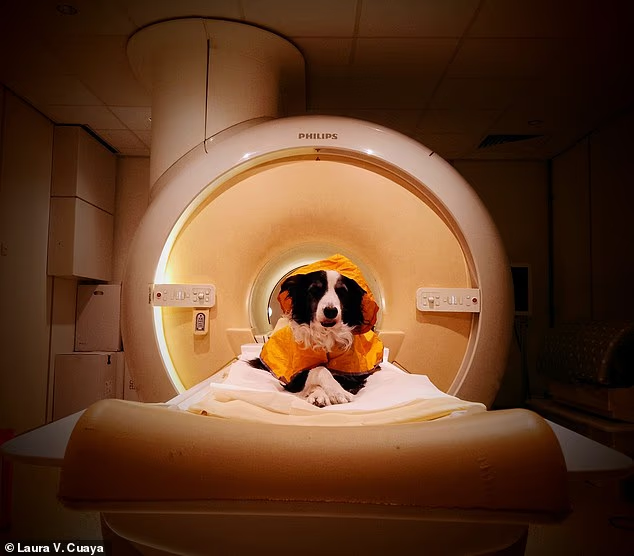
Brain scans reveal that dogs are able to tell the difference between humans’ happiness, anger, fear, and sadness from facial expressions alone. Pictured: One of the study participants sits in an MRI machine
Researchers recruited eight pet dogs who had been specially trained to lie still during a type of brain scan called an fMRI (Functional magnetic resonance imaging).
This meant that the dogs could stay awake throughout the entire process, allowing scientists to show them pictures of smiling faces and watch how their brains reacted.
The researchers found that smiling faces were processed in the temporal cortex and caudate nucleus, two areas of the brain associated with higher cognitive and reward processing.
Co–author Dr Laura Cuaya, of the University of Vienna, says: ‘The activity in the caudate nucleus is particularly interesting.
‘It suggests that happy human faces may have emotional significance for dogs.’
Previous studies have shown that the caudate nucleus was activated when dogs anticipated a food reward, heard praise in a positive tone, saw their owners, or even smelled a familiar person.
What made this finding so interesting is that the faces being shown were strangers, which suggests that human happy expressions might have a positive value for dogs even when they aren’t familiar with the person.
This showed that dogs were able to tell when humans were happy but it didn’t reveal anything about how they dealt with negative emotions.

Researchers found that seeing a human smile lights up particular regions of a dog’s brain (pictured), which aren’t activated by negative emotions
In a follow–up test, the researchers put 12 dogs through an fMRI and showed them pictures of humans who were angry, sad, or afraid.
These emotions didn’t activate unique regions, but whole–brain analysis showed distinct patterns of brain activity that separate fear, sadness, and anger.
The researchers think that dogs might have evolved the ability to distinguish human facial expressions as they evolved alongside us for tens of thousands of years.
Dr Hernández–Pérez says: ‘During domestication, dogs became increasingly exposed to the human social world, a new and highly complex environment that required them to adapt their social skills to interact successfully with people.
‘Dogs that were better able to pick up on human social and emotional cues may have had an advantage when cooperating with humans.’
Although scientists can’t use this information to work out how dogs subjectively feel, it does offer a fascinating insight into how the ability to perceive emotion develops.
When scientists compare humans with primates, they are looking at species that share a common evolutionary lineage.
However, dogs represent a different story altogether.

Researchers recruited pet dogs that have been trained to lie still in an MRI machine. This allowed scientists to make brain scans while their participants (pictured) were still awake

Seeing negative emotions produced distinct patterns of brain activity that distinguished fear, anger, and sadness
‘Dogs and humans are evolutionarily distant species with very different brains, yet both can extract meaningful information from human emotional signals.
‘This gives us an opportunity to study how a very different brain adapted to function in a complex human social environment, and how neural systems can become specialised for navigating social relationships and communicating across species,’ says Dr Hernández–Pérez
In a blow for cat lovers, this research comes after scientists found that felines were largely incapable of distinguishing human emotions from limited cues.
Unlike their canine counterparts, cats can’t tell the difference between laughs, sobs, screams or shouts, reacting to each in exactly the same way.
While human voices almost always put the cat in a state of heightened alertness, the emotion behind the noise made absolutely no difference.
The researchers, therefore, suggested that cats aren’t able to distinguish humans’ moods by listening to their voice alone.