Amna Nawaz:
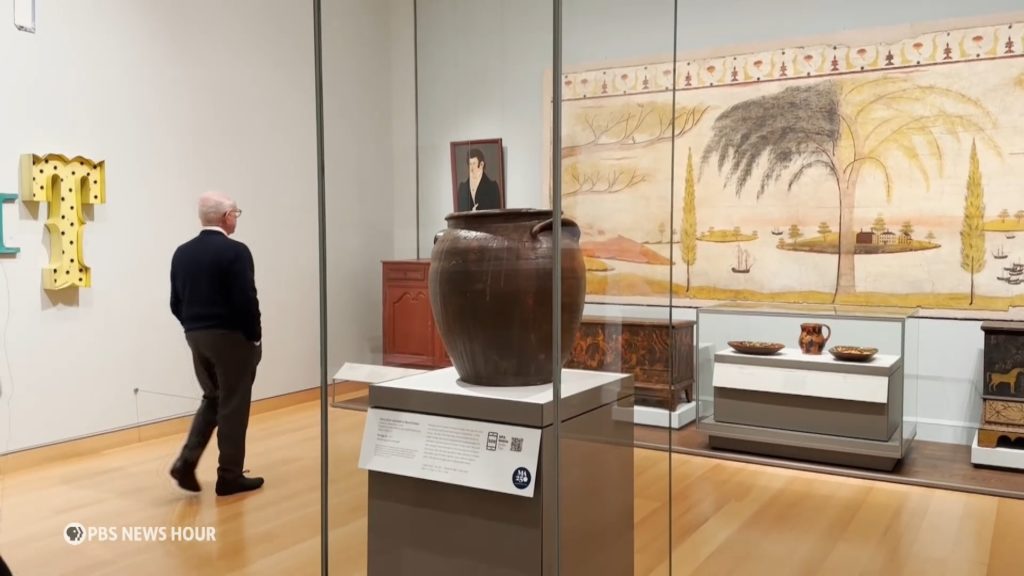
The descendants David Drake, known as Dave the Potter, have traced their lineage back to the once-enslaved potter and launched an effort to reclaim his work. So far, the family has recovered six pieces of Drake’s highly valued glazed stoneware, and they’re working with museums to bring even more back into the family’s hands.
They say the effort has not only reconnected them with their family’s legacy, but also raised broader questions about art ownership and restitution.
Geoff Bennett spoke recently with Pauline Baker and her son, Yaba, the third and fourth great grandchildren of David Drake. It’s part of our arts and culture series, Canvas.
Geoff Bennett:
Pauline and Yaba Baker, welcome to the “News Hour.”
Yaba Baker, Descendent of David Drake: Well, thank you.
Pauline Baker, Descendent of David Drake: Thank you. Nice to be here.
Geoff Bennett:
May I call you by your first name?
Pauline Baker:
Sure.
Geoff Bennett:
All right.
So, Pauline, let’s start with David Drake himself. Who was he? And what do we know about his life as an enslaved potter in early 19th century South Carolina?
Pauline Baker:
Well, they say he was born around 1801. He was enslaved. He also was known as a typesetter. that also was in his line of work, because he was enslaved by Abner and Harvey Drake. Harvey was more into the ceramics part, but Abner owned a newspaper, The Hive.
They think that is the reason why he learned to read and to write as well as he did.
Yaba Baker:
Dave became a master potter, and he made these ceramic jars that were really used for everyday use because they didn’t have refrigerators back then.
But he added his signatures and his poems to the jars, which make — became an art. And to see it transform over 150 years to be artwork that is valued so high, it’s just — I’m just floored by it to even think about it.
Geoff Bennett:
I mean, that’s what made his work so extraordinary…
Pauline Baker:
Yes.
Geoff Bennett:
… is that he would inscribe his work with his name, or in some cases poetry.
Yaba Baker:
Poetry, yes.
Geoff Bennett:
… at a time when enslaved people were prohibited from learning how to read and write.
Pauline Baker:
Yes, anti-literacy laws prevented all other slaves other than Dave, who had the courage to write, but I think he was encouraged to write because of his loss of family, his loss of friends that he had no control over.
Because, if you were in his shoes, I can’t imagine not knowing where my son was or where my friends or my kinfolk were.
Geoff Bennett:
Last year, the Museum of Fine Arts Boston, they returned stoneware to your family. This is the first time the U.S. has ever returned artwork made by an enslaved person to that person’s descendants. Take us back to that moment.
Yaba Baker:
It was an amazing moment, because we didn’t know how long it was going to take.
So, once Boston agreed to do it, we were overwhelmed with joy because we felt like it was a full circle moment for Dave, because Dave actually wrote on one of his spots: “Where is all my relations? Where’s all my relations? Goodwill…”
Pauline Baker:
“Goodwill to all.”
Yaba Baker:
“Goodwill to all the nations.”
So for a man to be enslaved and still write poetry about God and write poetry about goodwill to all men, it is an amazing person to do that. So clearly he was trying to connect back to his family. So we feel the Boston MFA Museum really did justice to Dave.
Geoff Bennett:
There’s a difference between having his work displayed in a museum or in a collection and having it belong to his family. What does ownership mean to you?
Pauline Baker:
It means legacy. It means we are receiving what he wanted us to receive. It’s a legacy to us to be able to say to our children, as it normally would have been, because, if you were in my shoes, would you — how would you feel about this situation?
Yaba Baker:
I think ownership goes in a lot of directions, right?
The legacy of my kids has changed. They now have Dave as an ancestor. The actual ownership of the pots also changes their legacy because they’re assets. And the people who owned them before use them as assets. We’re not asking for anything that hasn’t been done before.
Museums have policies in place right now for ethical restitution.
Geoff Bennett:
You now have six of his pieces. How do you go from those six to acquiring the rest of his work?
Yaba Baker:
Very good question. We actually have contacted all the museums who actually are holding the artwork. We’re in different stages with those museums.
My aunt now, 87, aunt Daisy, Daisy Whitner. My uncle’s 84, John Williams. My mom’s — she don’t mind me saying her age. She’s 79.
(Laughter)
Yaba Baker:
And we don’t want to lose another elder before we get all the pots back. So we would like to have all the pots back by 2027 if we could.
Geoff Bennett:
And, Ms. Pauline, when your son says that these are assets, we should put a number on that. One of these pots sold for more than $1.5 million.
Pauline Baker:
Yes, it did.
Geoff Bennett:
Tell me more about that.
Pauline Baker:
Someone selling something and getting a profit, I have no problems with, but acknowledge and do right by us as well, because that’s an asset for your family, which should be an asset for my family, because, if your descendant, if your parent had a property or art, they pass it on.
That hasn’t happened with us.
Geoff Bennett:
How does it strike you that this work created by an enslaved man who could not profit from his own labor is now not only worth enormous sums, but so culturally valuable?
Pauline Baker:
I think he is getting the recognition that he always desired. And, of course, the — being well-known, his works are being known, because he put a lot into it.
Yaba Baker:
I think his story could be inspirational not just to African Americans, but to everybody. I think we all have felt voiceless at a point in time. Who was more voiceless than a slave?
And he still took the time to learn his craft very well, to take risk, to put it out there, and here we are 150 years later. Everybody should take from that, no matter where you are stationed in life, you can be inspired by Dave that your circumstances don’t dictate the results.
Geoff Bennett:
Yaba and Pauline Baker, thank you so much for sharing your story. I appreciate it.
Pauline Baker:
Well, thank you for having us. We appreciate coming.
Yaba Baker:
Thank you very much. We appreciate it.