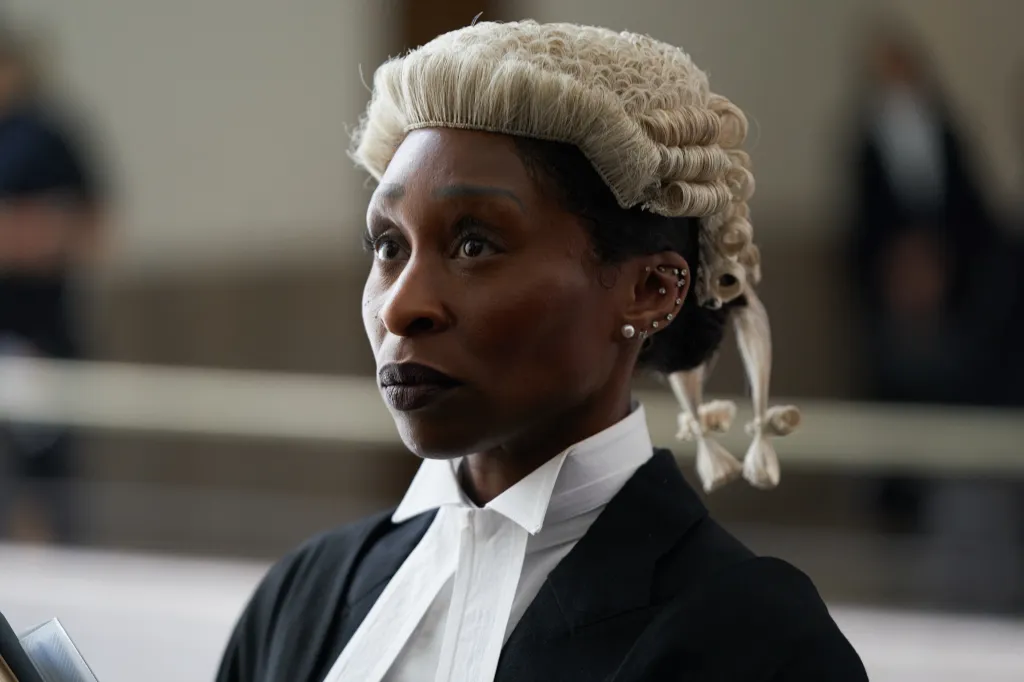
In 2022 Jodie Comer took the theatrical world by storm in Suzie Miller‘s one woman play, Prima Facie which won Olivier Awards for the London West End production including Best Actress for Comer who repeated her triumph the next on Broadway and won the Tony Award. Now for whatever reason Comer did not reprise her role for the film version which has been opened up as a screenplay by the playwright Suzie Miller and directed by Susanna White in a nod to more conventional courtroom dramas. Taking it from the spare stage and the inner thoughts voiced by Comer’s English Barrister, and trying to keep the same idea through the extensive use of voice over thoughts of the Erivo character, Tessa is a gamble that perhaps doesn’t have the same power of the stage production.
Prima Facie means a legal claim that has sufficient evidence to proceed to trial or judgment. In this case that claim comes from a lawyer who finds herself the victim of what she describes as sexual assault, a rape by a colleague with whom she has a consensual sexual relationship that crossed the line one night. What makes this unique is that Tessa is a dedicated Barrister who often defends men charged with sexual assault, using every trick in the legal book to get them off. The film opens depicting her efforts in the courtroom, as well as in her personal life so we get to know her as the successful professional she is.
Soon though she starts up a romantic relationship with a longtime colleague, a nice fellow lawyer and seemingly good guy, Julian (Daniel Ings). As he asks for her help one night after hours in the office, it leads to much more and her inner thoughts saying, “I really want this”, as the two draw closer with surefire energy leading to their first sexual encounter. It appears this pair of colleagues are the perfect match and on a second date they skip the formalities and end up at her place after a nice dinner out, first stopping for a couple of bottles of wine he purchases. She already had poured down a lot of Sake, and now is freely drinking wine. They have sex, it goes well, but as the night wears on Julian notices she is not in bed. Instead he finds her on the floor of her bathroom, clearly ill no doubt from all the drinking, and he picks her up and carries her back to bed.
It is here he makes a very bad decision to insist they go for another round of sex, but she is sick and doesn’t want to. Selfishly he proceeds anyway ignoring her clear lack of desire. Nevertheless he prevails, rolls over and falls asleep. Disturbed by all of this she quietly gets up and leaves in the pouring rain, first arguing with a cabbie and then just urging him to take her to the nearest police station where she recounts what happened and labels it rape. The next day at the office Julian can’t understand where she went (it was her apartment after all) or why she is suddenly so cold to him, “what did I do wrong?” he asks. Once he finds out she has filed a rape charge against him, he sees his whole life and career could possibly be destroyed. Colleagues wonder why she would do this, and soon she has requested a transfer to another legal office. Some years pass and the case is finally ready for trial. Tessa is about to find out what it is like to be on the other side in a case like no other, two lawyers against each other in ways they never had to do defending others.
The voice over device really comes into play here as Tessa knows exactly the drill victims of sexual assault will be put through and thinks to herself she is so aware they will never trap her. She fears though losing to the very methods she once employed herself. The main defense attorney, Hugh Dalton KC (an excellent Simon Russell Beale) even accuses her of setting Julian up so that she could get a job in another jurisdiction, and he also repeatedly points out this affair was consensual, not the usual case we see in violent sexual assault cases (at least those depicted in movies), but director White, in trying to show there is a broad range to the definition of rape, has presented this one not as black and white but with shades of gray. Julian is never seen as a bad person, but one who genuinely likes and is attracted to Tessa, thus his failure to recognize doing anything wrong that night. For him the worst was he was insensitive to her wishes and pushed way too far, but he is not portrayed as evil or abusive here, just a guy who made a very bad call after drinking too much on a night they both drank too much. He also happens to be the son of a top judge who sits in the rafters with his family cheering him on as he stands trial but never testifies. It is all on the victim it appears, and that is clearly Miller’s point (she also has a legal background herself) as well as the startling statistics that show the overwhelming number of verdicts in sexual assault cases do not favor the accuser. Tessa’s abrupt change probably has as much to do with what physically happened to her as the psychological pain of the realization she has been on the wrong side of justice too often in these cases in court.
Prima Facie, as it has done on stages around the world, will no doubt spark conversation and arguments afterward, and it will be interesting to see what impact this film version has as the assaulter in this case is not presented as someone who would ever knowingly do a rape, again at least the way we are used to seeing in Hollywood movies. Shades of gray is what White wants and gets, but perhaps unlike on stage with just Tessa, the film in making this more seem like something out of Billy Wilder’s 1957 classic, Witness For The Prosecution just doesn’t have the same visceral impact. We find ourselves asking why Tessa would turn all these lives upside down, and more pointedly is all it worth it in a legal system that doesn’t always deliver justice, a fact Tessa knows better than anybody.
Erivo , as she proved in Harriet is a fine dramatic actor and does what she can with the ambiguity of a role where the legal chairs are suddenly turned. The rest of the cast is also fine including Ings who believably shows why Tessa could fall for Julian. The problem is he doesn’t ever come off dark enough to indicate he is hiding some sort of alternate villainous personality capable of intentional sexual assault. Am I missing something? I didn’t see the play. Maybe it was presented differently there. The impact of a one person stage play, versus a fully opened up film version can be a wide chasm. Another new film this year, Josephine, which also deals with this issue in a courtroom made me angry that lawyers could argue on behalf of, in that black and white case, a vicious rapist. I was disturbed, whereas with Prima Facie I just have more questions. Maybe that is the point.
The list of reforms to the legal system sparked in part by Miller’s play is impressive, but I can’t help but think in this more literal film version something may have gotten lost in translation. Still if it can help the cause, and the clear injustice for rape victims everywhere, more power to Miller and White in trying to bring this issue to a wider audience.
Producers are Greer Simpkin, Kevin Loader, David Jowsey
Title: Prima Facie
Festival: Toronto – Gala Presentations
Director: Susanna White
Screenplay: Suzie Miller
Cast: Cynthia Erivo, Daniel Ings, Toheeb Jimoh, Noma Dumezweni, Simon Russell Beale, Elliot Levy, Khalid Abdalla.
Running Time: 1 hour and 46 minutes