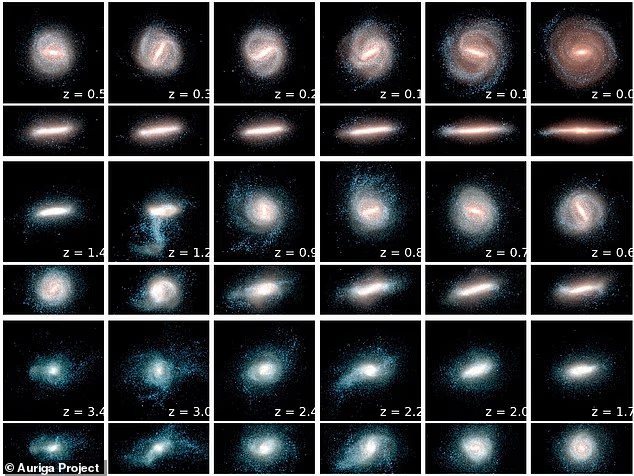
While the Milky Way might look calm and stable today, scientists say a grand display of cosmic gymnastics once turned our galaxy upside down.
Researchers have discovered that the Milky Way once underwent a dramatic ‘major disc flip’.
At some point in the distant past, the vast stellar disc changed orientation by more than 90 degrees – dragging our solar system along for the ride.
According to the results of a new study, this likely happened after a violent head–on collision with another drifting galaxy.
About 10 to 11 billion years ago, the Milky Way smashed into a massive dwarf galaxy known as Gaia–Sausage–Enceladus, or the Gaia Sausage for short.
We already know this impact knocked billions of stars into looping sausage–shaped paths, but researchers now say it may have also flipped our galaxy.
Lead author Dr Kirill Batrakov, of Durham University, says: ‘We already know that the Milky Way had a massive head–on collision.
‘So, we think that the Milky Way disc likely flipped in the past.’
Scientists say the Milky Way underwent a dramatic ‘disc flip’ in the distant past. These pictures show a simulation of a Milky Way–like galaxy undergoing a similar flip, starting from the oldest image (z=3.4) to its final position (z=0)
This revelation about our galaxy’s past transformations actually emerged from the quest to solve one of the Milky Way’s greatest puzzles.
The majority of the stars in our galaxy are located in the flat spiral disk, a region about 120,000 light–years in diameter and 1,000 light–years thick.
This is surrounded by the sparsely populated stellar halo, an enormous region roughly 300,000 light–years across, but extending over a million light–years in diameter at its absolute outer limits.
This is largely made up of stars that have been pulled into the Milky Way from other galaxies over time through galactic mergers.
What makes the Milky Way’s stellar halo so unusual is that it rotates incredibly slowly compared to other galaxies.
The European Space Agency’s Gaia mission found that it could take up to a billion years for a star in this outermost region to make its way around the galactic core.
Until now, researchers have had no idea why this would be the case.
In their paper, presented this week at the Royal Astronomical Society’s National Astronomy Meeting in Birmingham, researchers analysed the simulated evolution of 25 Milky Way–like galaxies.

Scientists think that this ancient flip could explain why the stellar halo, the outermost disc of the galaxy, rotates so slowly. Pictured: An artist’s impression of the Milky Way seen from above

The flip may have been caused by a collision between the Milky Way and a dwarf galaxy called Gaia–Sausage–Enceladus between 10 and 11 billion years ago. Pictured: Artists’ impression of the collision with the simulated positions and motions of the stars in Gaia–Enceladus shown with yellow arrows
The scientists followed these simulated galaxies’ evolution over billions of years and watched how they changed.
They discovered that the galaxies with the slowest stellar halos had two things in common: they had all had a head–on collision with another galaxy, and they had all undergone a major disc flip.
The fact that the Milky Way has both a glacial stellar halo and a head–on collision in its ancient past, therefore, makes it likely that the galaxy also underwent a disc flip.
This means that the galaxy we recognise today might have looked and behaved dramatically differently several billion years ago.
‘A disc flip also means most of the Milky Way’s stars once moved on very different trajectories than they do today – possibly even our own Sun,’ says Dr Batrakov.
‘Meaning our “stable” spot in the galaxy might not have been so stable for the Solar System’s whole lifetime.’
Since we live inside the Milky Way, we can study its workings better than any other galaxy in the cosmos, making it the perfect laboratory for testing ideas about galaxy evolution.
With this extra knowledge about our own galaxy’s history, scientists can start to make more sense of the baffling variety of cosmic structures out in the universe.

These images show the evolution of a Milky Way–like galaxy that did not have a collision with another galaxy and, therefore, did not experience a disc flip
Dr Batrakov adds: ‘Finding that its disc flipped adds a new chapter to that story, one we must account for when placing the Milky Way in a broader context of other galaxies.
‘What excites me the most is that this complex history can be reconstructed just from present–day observations.’
The researchers also found that the Milky Way’s stellar halo is closely linked to the rotation of the invisible, but critical, dark matter halo.
This hidden disc of undetectable matter makes up the majority of the mass in the galaxy and holds the structure together like a gravitational glue.
That means understanding the origin of our own slow–moving stellar halo could help shed light on one of science’s greatest mysteries.