This story is published in partnership with Inside Climate News, a nonprofit, independent news organization that covers climate, energy and the environment, and Texas Newsroom, a public radio journalism collaboration that includes NPR, KERA in North Texas, Houston Public Media, KUT News in Austin and Texas Public Radio in San Antonio. Sign up for the ICN newsletter here.
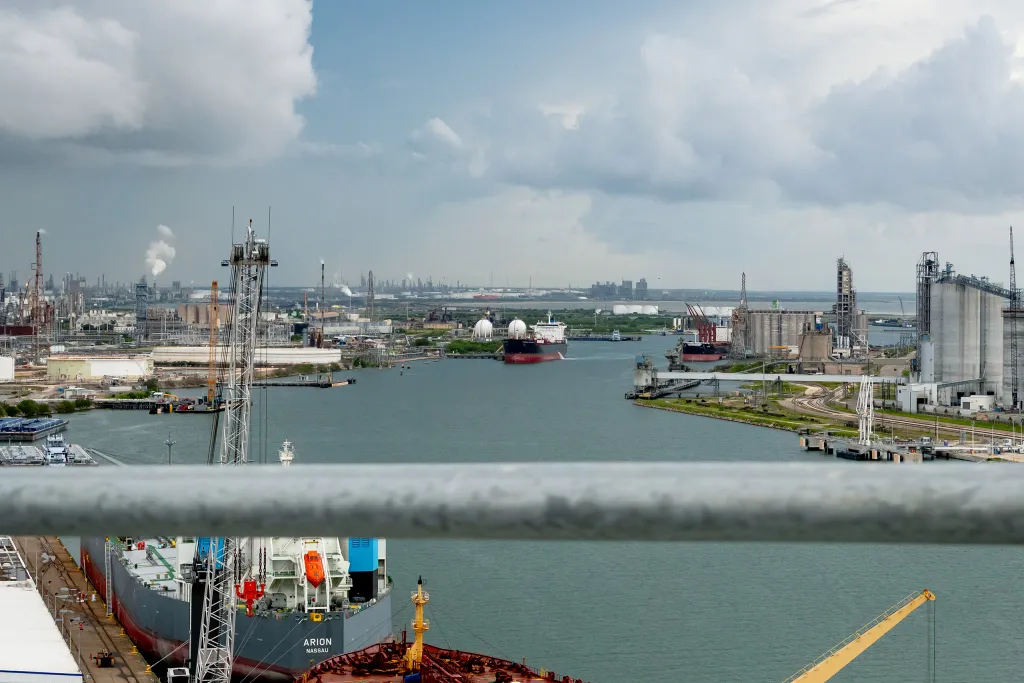
For at least a decade, Corpus Christi sold water to a handful of large industrial plants at a steeply discounted rate, according to documents and interviews with city officials. Residents and businesses paid more than $100 million to subsidize water for some of the world’s richest energy companies, the city’s rate models show.
Three years ago, Corpus Christi doubled the companies’ water rates in an effort to correct the imbalance. But the companies, including Valero, Citgo and LyondellBassell, protested to state regulators, sparking a legal battle that will come to a head today as a public hearing over the matter begins in front of an independent state agency in Austin.
The outcome will have major implications for Corpus Christi, which is facing an unprecedented water supply crisis, as well as the energy companies that have long dominated its economy. If the companies prevail, Corpus could be forced to refund them tens of millions of dollars even as it desperately seeks funding for new water projects and raises rates on the rest of the region’s consumers.
“I’m holding my breath,” said Sylvia Campos, a City Council member who campaigned on raising industrial water rates. “Let’s hope that we don’t have to pay them back.”
Valero, Citgo and LyondellBassell, which buy water directly from Corpus Christi’s water utility to operate oil refineries and petrochemical plants just outside city limits, commented through an industry group they have formed called Affordable Water for Corpus Christi.
“The issue before the Public Utility Commission is whether the City’s rates were developed using a fair, evidence-based and legally compliant methodology,” said Heath Armstrong, a lawyer for the group.
Campos responded: “They know very well how long they’ve gotten away with not paying their fair share.”
The industry group’s arguments for lower water rates are spelled out in thousands of pages of documents filed with the Public Utility Commission of Texas, a state regulator headed by a panel of gubernatorial appointees. In one filing, a consultant wrote that the group’s members should get a discount for water because they shouldn’t have to pay for “distribution infrastructure they do not own, maintain, or benefit from in the same way as inside-city users.”
Kamil Taras, the city’s assistant director for finance and administration, said that’s not the case. Industrial facilities benefit from the entire water distribution system that the city’s water utility manages, he said, not just the portion outside city limits that connects them to its treatment plant.
“They just want to pay for the one single line that they’re connected to, and that’s it,” Taras said, referring to the companies’ argument. “It doesn’t work like that in the municipal water world.”
Earlier this year, the companies demanded that Corpus Christi refund almost $80 million of their water-rate increases, according to a recent city memo that summarized the utility commission filings. The commission’s staff then looked at the evidence separately and recommended a refund of just $6 million, the city memo explains.
Taras said the industry coalition led by Valero recently offered to settle the case for $4 million, but the city chose not to settle and instead to go to the next step: a public hearing that will resemble a trial at an agency called the State Office of Administrative Hearings.
At that hearing, which will take place over three days this week, Corpus Christi officials and the companies will argue their respective positions in front of a state official called an administrative law judge. The judge will then make a recommendation, but the final say rests with the utilities commission.
Peter Zanoni, Corpus Christi’s city manager, said he hopes the city can preserve the rate increases because “the large industry is not paying their fair share” for water.
He added, “It’s not fair to the retired family or the hardworking family that might have one parent and two, three jobs for them to support multibillion-dollar corporations and pay their water bills.”
Water systems face funding shortfall
Even as they’re being challenged on the rate increases they already implemented, Corpus Christi officials say they’ll have to continue raising rates to pay for a host of new water projects. It’s a common need across Texas: The state’s latest water plan, released in May, estimated it could cost Texans $174 billion to avoid water shortages in the next 50 years.
“The only thing that’s keeping Texas from meeting its water needs is money,” Republican state Sen. Charles Perry, chair of the Senate Water, Agriculture and Rural Affairs Committee, said during a hearing in May.
Perry made it clear that many communities need to be prepared to pay a lot more for water, maybe even “double what we’re paying. But that’s the cost of new water in Texas,” he said.
Corpus Christi city officials say that’s exactly what they’ve been trying to do. And they’ve focused on large industrial users because those companies were for years paying a far lower rate for water than most residential and business consumers.
In 2016, for instance, the companies — collectively referred to as “OCL (outside city limits) large-volume customers” — paid about $2 per 1,000 gallons of water, while many other residential and commercial customers inside the city paid three times that rate. All the rates went down slightly over the next few years, city data show, but the disparities persisted.
In 2023, the city commissioned a study to determine if those rates were an accurate reflection of the amount of money Corpus Christi spent sending water to different types of customers. The city wanted to know: Is it actually cheaper to provide water to the large industrial plants, which could justify their lower rate?
The answer was a resounding no. In a presentation to City Council members, the study’s authors wrote that “Large Volume was under-recovering its cost of service” by $15 million. In other words, the city was losing $15 million a year providing water to its biggest industrial users. Smaller commercial businesses, on the other hand, were overpaying for water by about $9 million, the study found.
For Zanoni, the study confirmed what he had long suspected — even from his days in San Antonio, where he worked before becoming Corpus Christi’s city manager.
“Folks told me in San Antonio that one issue in Corpus Christi is that the large industry is not paying their fair share,” he said. “And the residents and the commercial accounts are paying the burden for water for industry.”
So in the fall of 2023, Corpus Christi’s City Council agreed to double water rates for the select group of large-volume users that had long enjoyed a discount. The change “basically corrected that under-collection,” according to Tamas, the city’s assistant finance director. The new rates raised Valero’s annual water bill from $9 million to $18 million, Taras said.
The vote by City Council was 8-to-1 in favor, notable in a city where industrial giants loom large over local politics. Six months later, the companies filed their protest. Council Member Roland Barrera, who cast the sole vote against, said in an interview he agreed that the industrial water rate needed to rise, but not so steeply and suddenly.
“My objection was to the drastic increase that we implemented one year to another,” he said. “If we want to remain a manufacturing community, which we’ve been for over 70 years, we have to have some level of predictability.”
Barrera said the discounted industrial water rates were intended, in part, to help Corpus Christi attract investment from companies that build thirsty facilities like refineries or chemical plants. Otherwise, he said, they might have chosen to locate in larger petrochemical complexes of regions with more abundant water, like Houston or Louisiana.
The companies have argued that they deserve the discount because they’re in much closer proximity to Corpus Christi’s water treatment plant and therefore don’t use as much of its distribution system as other consumers.
But that’s not how water delivery works, Zanoni said. “The entire city grid is interconnected,” he said. If something were to malfunction in the water distribution pipes at one end of the city — say, at a water tower far away from Valero — the water pressure all the way at the other end, at the company’s oil refinery, would also be impacted.
Corpus Christi’s new industrial water rates reflect an equitable distribution of costs, Zanoni said, and remove the burden on small businesses that have historically subsidized the big corporations.
“We’re getting sued because we’re trying to charge a fair rate to the big industry,” Zanoni said. “Industry in this case is not being a good partner with the city.”
Avery Thompson contributed to this report.
Disclosure: Valero has been a financial supporter of The Texas Tribune, a nonprofit, nonpartisan news organization that is funded in part by donations from members, foundations and corporate sponsors. Financial supporters play no role in The Texas Tribune’s journalism. Find a complete list of them here.
Source link