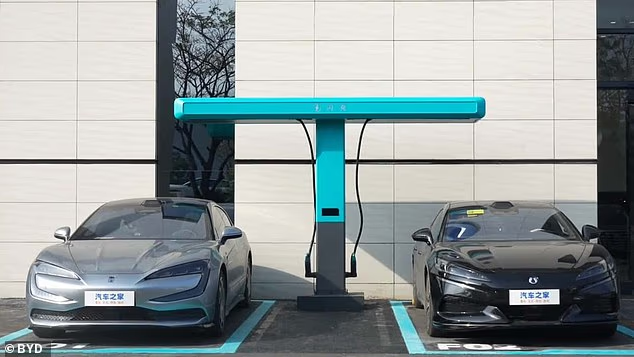
China‘s answer to petrol stations is coming to Britain, in the form of ultra-fast charging points.
BYD has announced plans to install 300 ‘flash chargers’ in the UK by the end of this year, rising to 600 by 2027.
These futuristic devices will be installed in retailers for Denza, a BYD sub–brand, retail outlets, and in existing charging point operator sites.
And the Chinese EV giant says it will be able to charge your car as fast as you can fill a tank with petrol.
This extreme speed is down to the staggering 1.5 MW of power pumped through the new charger.
That is 10 times more output than the 150 kW rapid chargers used by most EVs, such as Teslas, and enough to power around 5,000 homes.
Any EV with a standard CCS connection will be able to plug in, charging as fast as its battery safely allows.
However, BYD says that its own proprietary software and new Blade Battery 2.0 will be needed to reach the maximum power intake possible.
BYD has announced plans to install 300 ‘flash chargers’ in the UK by the end of this year, rising to 600 by 2027
The flash charger plans were announced at an event in BYD’s London headquarters, as the company targets an ambitious expansion in the UK.
BYD is already the biggest EV brand in the UK, with a seven per cent market share.
But the company has big plans to expand its foothold by breaking down the barriers preventing petrol and diesel owners from switching to electric.
In practice, that means slashing the price of new EVs while making charging faster and more affordable.
This new generation of ultra–fast chargers is at least four times faster than anything available to British drivers and aims to make charging as quick and easy as filling up with fuel.
Stella Li, executive vice–president of BYD, told The Times: ‘This will be a game–changer. Nobody has time to wait for 30 minutes or – sometimes in the winter – almost one hour to charge.
‘Normally, when you go to the gas station you will spend five to ten minutes there, right? This is exactly like the timing [of the flash charger].’
The car–maker plans to spend nearly €2 billion (£1.73 bn) developing infrastructure in Europe for its ‘flash charging technology’, aiming to build 3,000 stations across the continent by 2027.

The Chinese EV giant says it will be able to charge your car as fast as you can fill a tank with petrol. This extreme speed is down to the staggering 1.5 MW of power pumped through the new charger

The chargers will be placed in existing charging point operator locations, retail outlets, and retailers for the BYD sub–brand Denza
The most challenging aspect of this rollout will be to provide often remote charging stations with the vast amount of energy required.
While it could take years to obtain a connection to the national grid, BYD says it has a way around these issues.
Instead of drawing directly from local power networks, BYD will install batteries on site to store all the power needed.
These batteries can then be recharged overnight when power is cheaper, cutting costs for drivers and avoiding excess strain on local production.
BYD is targeting a cost of 50p per kWh, slashing around 30p off the rates currently charged by most charge point operators according to AutoExpress.
The only hitch is that there are no cars currently on UK roads capable of handling that much energy.
The fastest batteries in current EVs are used by Porsche, Hyundai, and Kia, which can accept just 0.35 MW.
However, in the future, cars with ultra–fast charging capabilities will become more common.

BYD is delivering 300 Flash Charging units. With two connectors per device, this means 600 chargers

The Denza Z9GT is currently the only car capable of using the flash chargers’ full power, and it is not yet available in the UK
The Denza Z9GT is currently the only vehicle which will be able to use the flash chargers’ full potential.
This car can charge from 10 per cent to 70 per cent in as little as five minutes, while a full charge from 10 to 97 per cent takes nine minutes.
Even in cold temperatures down to –30°C (–22°F), a full charge will take just 12 minutes.
This high–end EV is not yet available in the UK, but it is expected to cost around £100,000 on launch.
This comes after the Chinese battery giant CATL revealed its latest generation of ‘Shenxing’ lithium–iron–phosphate batteries, which charge from 10 per cent to 98 per cent in just six minutes and 27 seconds.
A more standard charge from 10 per cent to 80 per cent takes just three minutes and 44 seconds.
Or, if you only have a minute to spare, you can still power your car back up to 35 per cent in under 60 seconds.