It’s usually found in tropical and subtropical regions, including Central and South America, the Caribbean, the Indian Ocean islands, South and Southeast Asia, and Africa.
But Chikungunya virus could soon spread to Europe and North America, a new study has warned.
Scientists from Zhejiang Chinese Medical University in Hangzhou, China, say that climate change is creating the perfect conditions for two mosquito vectors in major cities.
‘Climate change affects chikungunya mainly by changing where its mosquito vectors can live,’ explained Dr Yang Wu, an author of the study.
‘In our study, the Asian tiger mosquito was especially important, explaining more than 70% of the predicted distribution of the virus.
‘Because this mosquito can tolerate cooler conditions better than the yellow fever mosquito, warming may allow it to establish in places that used to be too cold.
‘When suitable mosquitoes become established, the chance of local chikungunya transmission increases.’
While the virus is rarely fatal, it can cause prolonged joint pain and disability – with the word ‘Chikungunya’ meaning ‘to become contorted’ in the Kimakonde language.
Scientists from Zhejiang Chinese Medical University in Hangzhou, China, say that climate change is creating the perfect conditions for two mosquito vectors in major cities across Europe and North America

Chikungunya is a disease dating back to 1952, which is caused by a virus spread by Aedes mosquitos
Chikungunya is a disease dating back to 1952, which is caused by a virus spread by Aedes mosquitos.
Despite there being approximately 33,000 cases so far this year, Chikungunya is one of the most neglected tropical diseases in the world, according to the World Health Organisation.
Currently, most disease outbreaks occur in tropical and subtropical regions.
However, by 2100, that could change, according to Dr Ye Xu, one of the authors of the study.
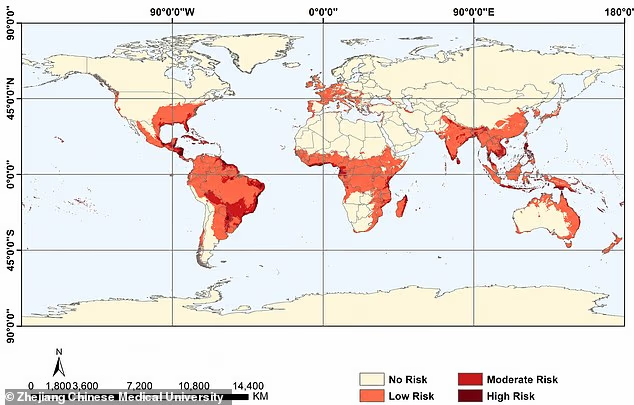
‘At present, 139 countries or regions – accounting for 21.3% of the world’s land area – are risk zones for the chikungunya virus,’ she said.
‘But we show that under climate change models, the virus will further expand northward into temperate regions, especially northeastern North America, central Europe, and East Asia.’
In their study, the team modelled how the range of the yellow fever mosquito (Aedes aegypti) and the Asian tiger moth (Aedes albopictus) – the two known vectors of the virus – will change as temperatures rise.
Worryingly, the models suggest that north–central Europe, northeastern North America, and eastern Asia are set to become ‘future hotspots’ for the virus.

Worryingly, the models suggest that north–central Europe, northeastern North America, and eastern Asia are set to become ‘future hotspots’ for the virus
‘The public does not need to panic, but health systems should prepare early,’ Dr Xu said.
‘For example, public health officials can act now by tracking Aedes mosquitoes, training doctors to recognize chikungunya quickly, strengthening mosquito control, and setting up rapid–response plans before outbreaks occur.
‘These steps are especially important in temperate regions where the disease has not been a routine public–health concern.’
‘Limiting further global warming and investing in basic preparedness could reduce the chance that future expansion turns into large outbreaks.’
While the study did not pinpoint the UK as a future hotspot, figures have shown that cases are already on the rise here.
In 2024, there were 112 confirmed and probable cases of chikungunya reported among travellers returning to England, Wales and Northern Ireland – nearly 1.5 times the number reported in 2023.
According to the UKHSA, travel to India accounted for the majority of these cases, followed by travel to Pakistan and Brazil.
It explained: ‘There is currently no risk of onward transmission of chikungunya in the UK, as there is no evidence of invasive species of mosquito established in the UK.
‘While invasive mosquitoes could currently establish in parts of the UK, climate change is likely to increase suitability for these species.’