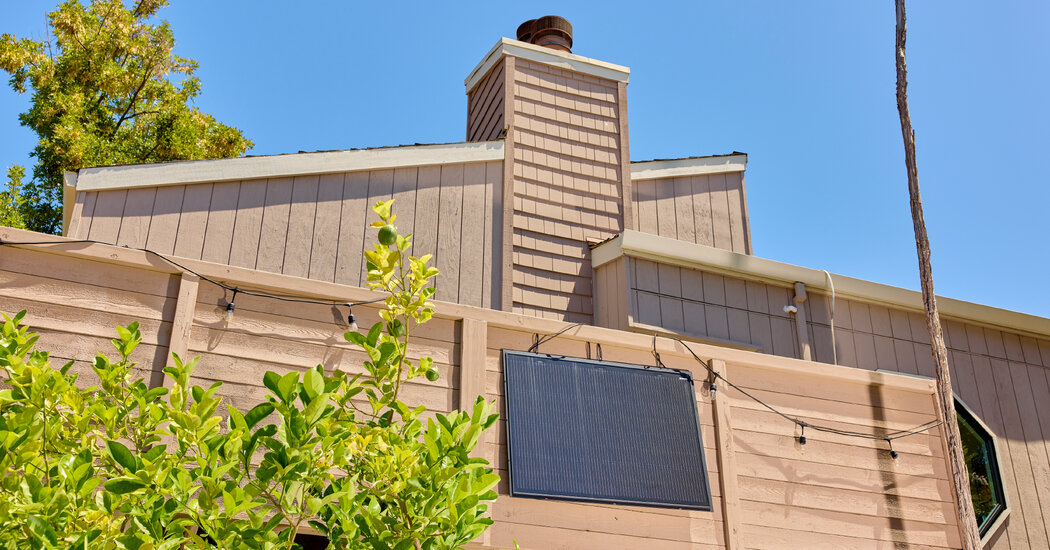
California lawmakers passed a bill late Wednesday that would allow residents to install solar panels that can be plugged into standard electrical outlets in a bid to lower their electricity costs and reduce their contribution to climate change.
The bill passed with broad bipartisan support in both chambers of the Legislature despite opposition from the state’s investor-owned utilities, highlighting the growing political salience of energy affordability. California has the highest residential electricity rates in the 48 contiguous states, and those prices have climbed sharply in recent years.
If Gov. Gavin Newsom, a Democrat, signs the measure, California will become one of nearly a dozen states that have legalized plug-in solar systems, often referred to as balcony solar. These systems, typically made up of a handful of panels, first became popular in Germany, where the panels are sold online and in stores. Last year, Utah became the first state to legalize use of the plug-in solar. Other states that have passed similar laws include Colorado, Maryland and Virginia.
Mr. Newsom has not said whether he will sign the bill. Before the bill’s passage Wednesday, his office said it typically did not comment on pending legislation. Plug-in solar bills are also awaiting the approval of governors in New Jersey and New York.
The cost of electricity has become one of the biggest concerns in this year’s midterm elections, along with the surge in the price of gasoline caused by the war with Iran. Electricity rates became a major focus of the campaigns for governor last year in New Jersey and Virginia.
Electricity rates have been climbing steadily nationwide in recent years, driven partly by the growth of power-hungry data centers and rising spending on power lines and other equipment by electric utilities. The average price for electricity nationwide rose 5 percent in June compared with a year earlier, reaching $183 a month for the typical household that uses 1,000 kilowatt-hours of electricity, according to the Energy Information Administration.
Plug-in solar systems typically are much smaller than conventional rooftop installations, but they can be set up much more quickly and, where legal, can be installed without the approval of local building departments and utilities. But as a result of their small size, plug-in systems can typically defray only a small portion of most people’s electricity costs. The savings tend to be greater for people who live in energy-efficient apartments or houses that use relatively little electricity.