
Amna Nawaz:
Fallout from the third alleged assassination attempt of President Trump, another indictment of a former FBI director, and a consequential Supreme Court ruling made it a busy week in politics.
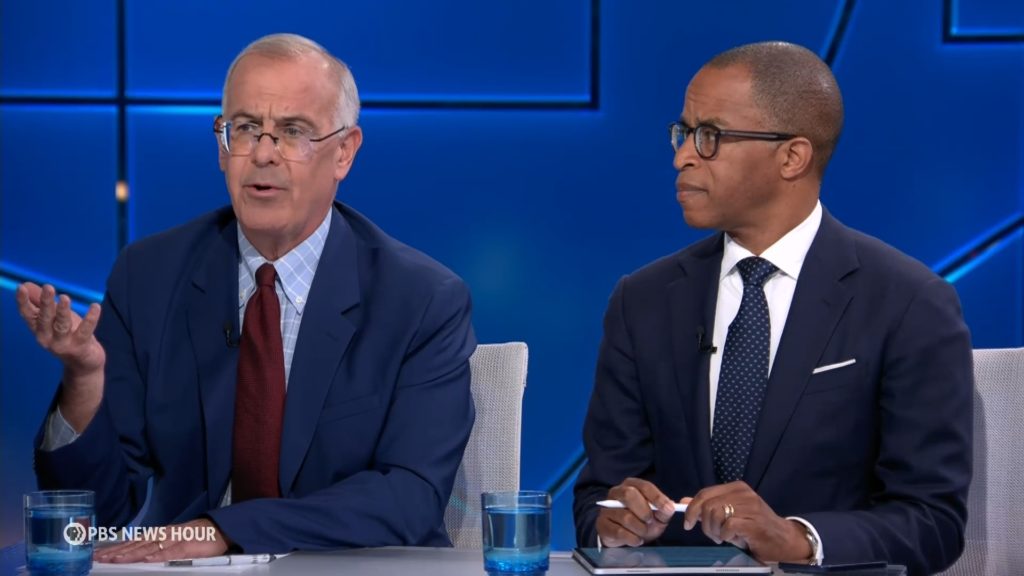
To discuss that all, we turn now to the analysis of Brooks and Capehart. That is “The Atlantic”‘s David Brooks and Jonathan Capehart of MS NOW.
Great to see you both.
Jonathan Capehart:
Hey, Amna.
David Brooks:
Good to see you.
Amna Nawaz:
Let’s start with the White House Correspondents’ Dinner because we know a lot more now than we did a week ago, when it first happened. We know about the suspect, his alleged plans. We have seen the video examined from multiple angles.
We have also seen conspiracy theories abound that it was a staged event to distract from President Trump’s low approval ratings or help him to fuel this argument to build a ballroom.
But, David, almost a week after the event, how are you looking back on it and what it meant and what it changed, if anything?
David Brooks:
I look at it as part of a climate of rising violence, both against — obviously against Donald Trump, but against all of us, against a climate of verbal violence that seems omnipresent.
There are certain moments in history when you get these rising climates of violence. I’m thinking of the period around the French Revolution. I’m thinking of Reconstruction. I’m thinking the 1970s. The older viewers, if we have any, may remember the Baader-Meinhof Gang, the Red Guards.
When I was a little kid in Grace Church School in New York, I overheard the Weathermen accidentally blow themselves up in the townhouse. That was a period. You get these moments when there’s low sense of legitimacy for ruling institutions and a great sense that we don’t have any shared values. And then people just resort to violence.
And we’re clearly in one of those periods. And I look at the 2028 election with a great sense of foreboding. And if you look at who thinks violence is justified, it tends to be younger people by a lot. Most progressives and most conservatives oppose violence, but you get 2.5 times as many progressives say it’s justified than not.
But what strikes me about this guy, about the guy who shot in Butler, about the guy who shot Charlie Cook — Kirk, they don’t seem to have thought about it that much. It’s not like they have — they’re radicals who have a big manifesto and an ideology.
It seems almost flippant the way they go into these things, almost like half thought through and jokey. And I can’t quite make sense of what — that kind of light-hearted nihilism that drives people to, on a whim almost, do something that is horrific and life-changing.
Amna Nawaz:
Jonathan, how do you look at it?
Jonathan Capehart:
Well, excuse me, I’m not going to just let the comment that progressives more than folks on the far right are — think that violence is justified.
It is something that the American people feel — they’re a little more comfortable with it than they were, say, five, 10 years ago. Amna, you and I were in that room. We walked through the magnetometers together. We stood in that spot.
Amna Nawaz:
Yes.
Jonathan Capehart:
The thing now a week out that I have been thinking about, and I keep coming back to it, is that, when I heard the five bangs, I remember hearing five very loud bangs, my immediate action was so instinctive, drop to the floor under the table and be quiet.
I have never been in a situation like that. But as an American and certainly as a journalist, having to cover all of these things and to listen to the recordings and the films, you sort of learn through osmosis what to do.
And, to me, the bigger issue here is gun violence, that why was I not surprised that this had happened? And I have been to that dinner at least a dozen times since 2000. And so, yes, there’s an issue of people feeling that political violence is the way to go and that we are in a highly charged atmosphere.
But what’s been sort of a specter over all of us for even longer is the scourge of gun violence.
Amna Nawaz:
Which has not been, interestingly, part of the conversation post that event. Lots more to talk about that in the weeks ahead.
But I want to ask you about the other big headline this week, which was, of course, former FBI Director Jim Comey being indicted for a second time for this post from a year ago, seashells on a beach that prosecutors allege threatened the president with this “8647” message, and also a parallel headline, the common thread here is — I will show in a moment — but the FCC going after ABC for its licenses.
That was a day after the first lady and the president publicly said that ABC should dump Jimmy Kimmel after he made a joke about Melania Trump being widowed.
David, President Trump has repeatedly said ABC needs to dump Jimmy Kimmel. He’s repeatedly said the DOJ needs to go after Comey. So is this just government agencies doing the president’s bidding now?
David Brooks:
Yes, more or less.
I thought the Comey photograph was tasteless. I thought the Kimmel joke was extremely tasteless. But there should be social sanction when people do that. There should be social norms, say — somebody at whatever network Jimmy Kimmel is at should say, hey, we have standards here. We don’t tell jokes about the president dying and his wife becoming a widow. We just don’t do that.
But there’s a big difference between that, the sort of social enforcement that should exist, than the president using force of law to prosecute people for this sort of behavior, which is clearly not illegal. It’s not terrorism. It’s not anything like that.
And so this is the president once again neglecting to understand that his job should come with some sense of limits. And being president doesn’t give you permission to use the federal government to do whatever the hell you want. And he has never really recognized that. And he’s using that.
And I’m — you see signs of some resistance within the Department of Justice. But they have seen what’s happened to others. And if they want to keep their jobs, they probably can’t resist too hard.
Jonathan Capehart:
Well, another example when it comes to Kimmel of the president being thin-skinned, can’t take a joke or doesn’t want to be the butt of a joke. And yet just, what, a few months ago, we were talking about him posting pictures of the Obamas as apes. So I will just leave that there.
But when it comes to the indictment of Comey, I mean, yes, the president has all been all about retribution. He campaigned on it. He’s been governing that way. But there’s another dynamic here that is even more troubling, and that is, acting Attorney General Todd Blanche appears to be actively campaigning for the job.
And what we know about the president is, he’s — when you know he’s paying attention to you, you do everything you can to please him. Everything — anyone who’s testified before Congress or, in the case of acting Attorney General Todd Blanche, trying to get the nod for the top job, it is all about, what can I do to make him happy?
And so, going after James Comey, who the president has loathed since his first term in the White House, that’s — to my mind, that is a surefire way for Todd Blanche to get a notch, a point in his favor in the president’s mind for the big job.
Amna Nawaz:
And I’m going to ask you about another big story this week that deserves way more attention in time that we can give it right now, but the Supreme Court decision that prompted headlines like this, USA Today saying “The Supreme Court sides against Black voters in a blow to the landmark civil rights law.” Politico said “The Voting Rights Act is now a dead letter.”
Reuters said “The U.S. Supreme Court under Roberts takes a wrecking ball to the Voting Rights Act.”
David, as you know, this is a 6-3 decision along partisan lines. It’s about a Louisiana map, right, that created a second Black — majority-Black congressional district. And there’s now been a series of rulings that have weakened the VRA over time. What does all this mean?
David Brooks:
I wasn’t a fan of the original gerrymandering rules that were set up mostly in the early ’90s. And they did the noble thing of increasing Black representation in the House, but they did it by cramming all the Democrats into one little district so there would be more Republicans.
And so what happened is, there were a rise of Black members. But you also see Republican majorities. And that was the deal they cut with each other. And I thought it was not a deal that was good for democracy, because it created fewer and fewer swing districts.
That era looks like the pinnacle of Periclean democracy compared to where we are today. Now we have all seen what’s happened in Texas and California and places like that. But this will turn that over the next several years into super-drive.
And so we’re looking at like 2030, when the census comes around again, we will have marginally barely any swing districts in America. And that would mean voters have barely any opportunity to throw one party out or another for bad behavior.
It also means we will be stuck for the foreseeable future with an evenly divided House. And all those things are terrible for democracy. And it’s going to be up to some post-Trump president to say, this is a national problem. We’re going to solve it all at once with a coalition, obviously, of the states. And we’re going to redraw these maps.
Jonathan Capehart:
The Voting Rights Act of 1965 is what killed Jim Crow. The VRA is only 61 years old.
When it was passed and became law, it was the first time America truly was a democracy, meaning that the words in the Constitution equally applied to all of its citizens, including African Americans, by giving them the right to vote, 61 years. I am 58 years old. My mother is 84.
So my mother is older than true American democracy. And so for those justices in the majority to say that, oh, well racism is over in voting and we don’t need this anymore, I keep thinking about what Justice Ginsburg said in her dissent in the Shelby v. Holder case, which invalidated Section 5, the preclearance portion.
And she wrote: “Throwing out preclearance, when it has worked and is continuing to work to stop discriminatory changes, is like throwing away your umbrella in a rainstorm because you are not getting wet.”
And so for Justice Alito to focus on the elections of 2008 and 2012, when there was a Black man on the ballot, to say that racial disparities are no longer a problem, and then ignoring that Shelby in 2013 led to just a rush of changes in voting laws in the states, is to ignore reality and to ignore history and to drag us back to a time when America was not America.
Amna Nawaz:
As I say, it deserves a lot more time than we can give it here.
But I thank you both, Jonathan Capehart, David Brooks. Always good to talk to you.
Jonathan Capehart:
Thanks, Amna.


