Hundreds of British species could go extinct unless urgent action is taken in the next 20 years, experts have warned.
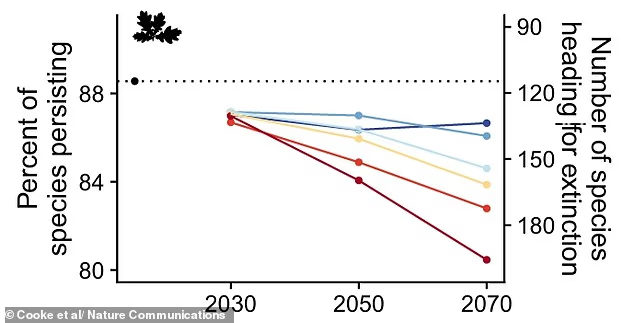
Researchers predict that under the worst–case scenarios, 196 plant, 31 bird and seven butterfly species could be lost forever by 2070.
This could include the merlin, the UK’s smallest bird of prey, and the mountain ringlet and large heath butterflies.
Plants such as burnt orchid, grass–of–parnassus and alpine gentian could also be lost forever, scientists warned.
For plants and birds, these startling figures are equivalent to more than three times the historic extinction rate in Great Britain, the team said.
But these numbers can be lowered if emissions are reduced and more sustainable land–use practices are implemented.
‘Our results show that the next 20 years are critical,’ lead author Dr Rob Cooke told the Daily Mail.
‘By around 2050, we reach a point where the choices we make on emissions and land use will largely determine whether Britain moves towards a much more degraded or a much more nature‑positive future. We should be concerned, because the projections show large and lasting changes to Britain’s wildlife.’
According to the study, nearly 200 British plant species could become extinct by 2070 under worst–case climate scenarios

The researchers also warned that up to 31 bird species could be lost forever without urgent action
While the modelling study did not directly analyse specific species, there are several ‘Red Lists’ which document Britain’s most at–risk flora and fauna.
This includes birds such as the greenfinch, swift, house martin, Bewick’s swan, Arctic tern and Leach’s storm petrel.
Half of the country’s 58 species of butterfly are also classed as at risk of extinction including the black hairstreak and grayling.
Meanwhile our most endangered plants include the ghost orchid, fen violet and the crested cow–wheat.
Even species that used to be common in our fields, including the corn buttercup, are now classed as critically endangered.
For their research, the team from the UK Centre for Ecology and Hydrology used large–scale biological and environmental data to model how more than 1,000 native species might be affected by changes to climate and land use.
Analysis, published in the journal Nature Communications, found that the risk of extinction increased under all scenarios.
But the worst was when the burning of fossil fuels remained high combined with widespread housing expansion, weakened environmental regulations and intensifying agriculture.

The merlin, which is the UK’s smallest bird of prey, is particularly vulnerable to become extinct, Dr Cooke told the Daily Mail

Plants that have been a part of our landscapes for centuries, such as the burnt orchid, are now at risk of being lost
‘Some species that have been part of our landscapes for centuries are now at risk of being lost, such as the merlin, the UK’s smallest bird of prey, mountain ringlet and large heath butterflies, as well as plants such as burnt orchid, grass–of–parnassus and alpine gentian,’ Dr Cooke said.
‘This will negatively affect local habitats and a range of ecological functions, from soil health and nutrient cycling to pollination and food production, with knock–on effects for wildlife and people.’
The scientists modelled six plausible future scenarios, involving different total greenhouse gas emissions and varying land management practices.
They found that even under mild warming scenarios, there will still be upheaval for biodiversity in Britain and it is likely already too late for some species due to the environmental changes that have already happened.
However, there is still hope for some species, with the study estimating that sustainable climate and land use policies would mean up to 69 fewer species – across plants, birds and butterflies – would eventually become extinct in Britain compared with the worst‑case scenario.
‘Our results show that the next 20 years will be decisive,’ Dr Cooke added.
‘The choices we make now will set Britain on a path either towards accelerating biodiversity loss or towards nature recovery.’
Last year, the International Union for Conservation of Nature (IUCN) warned more than 48,000 animals across the globe are at risk of being wiped out.
The IUCN has updated its ‘Red List’, revealing that three species of Arctic seal have moved closer to extinction.
The update also warns that the majority (61 per cent) of bird species globally are in decline – a huge increase on the 44 per cent at risk in 2016.
Sadly, the Red List update also saw six species moved to the Extinct category.
This includes the Christmas Island shrew, the slender–billed curlew, and the south–eastern striped bandicoot.